
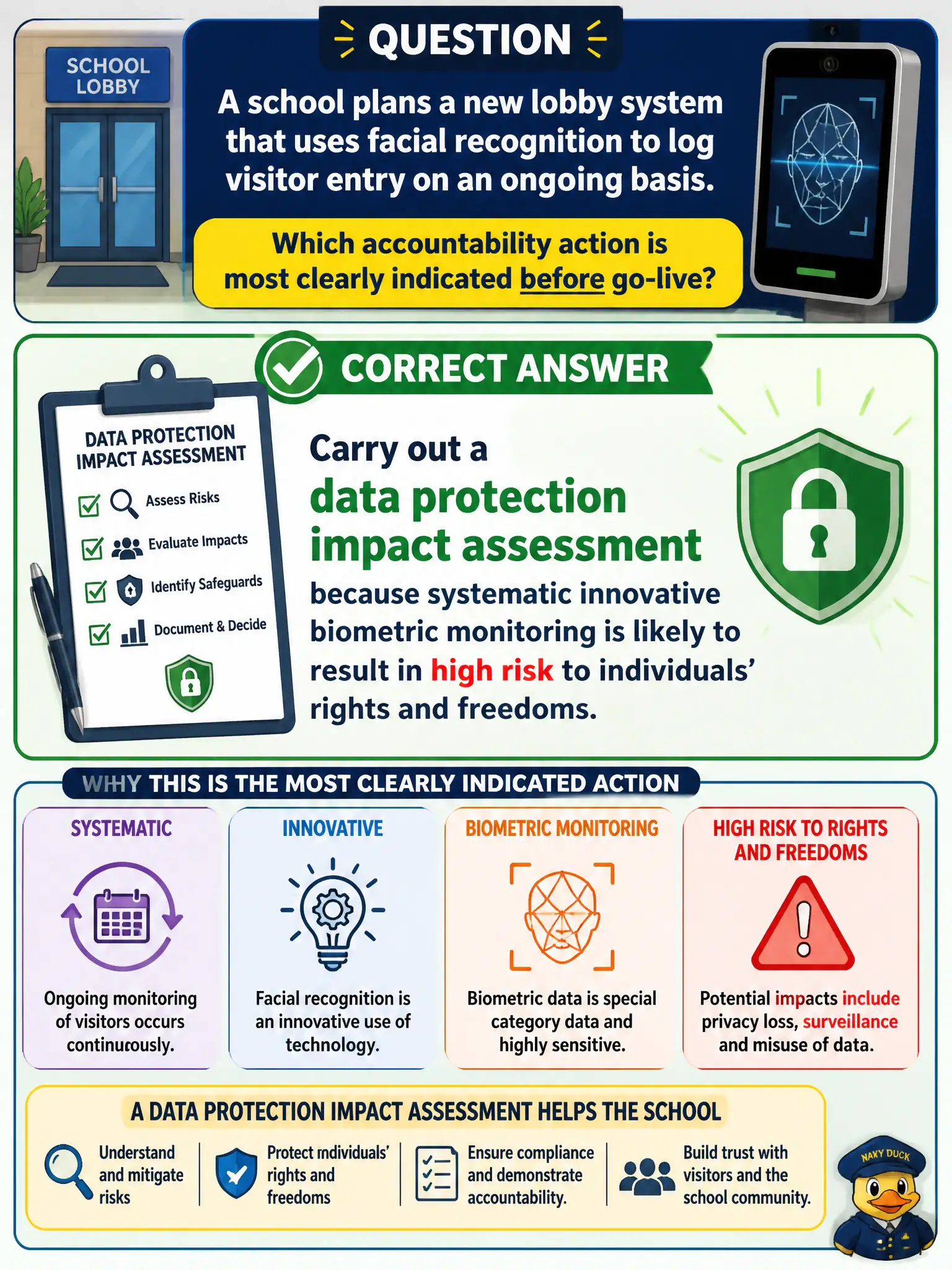
A school plans a new lobby system that uses facial recognition to log visitor entry on an ongoing basis. Which accountability action is most clearly indicated before go-live?
Select an answer to reveal the explanation.
Short Explanation
Wiring face-scanning into a school lobby is not a casual door-bell upgrade — it is high-stakes monitoring of kids and visitors. That is classic DPIA territory before flip-the-switch day. A glossy vendor PDF is not a substitute for that assessment.
Full Explanation
Article 35 requires a data protection impact assessment where processing is likely to result in high risk to rights and freedoms, especially for systematic biometric monitoring or innovative use of biometrics at scale. Facial recognition in a school lobby on an ongoing basis is a textbook high-risk pattern. Schools and other public-interest bodies are not exempt from DPIAs; children’s presence often heightens risk sensitivity. Accountability means analysing impacts before go-live, not after parents or regulators complain.
Public-interest status does not authorise skipping risk analysis. A vendor’s marketing brochure is not a DPIA. Biometrics used for unique identification are not ordinary contact data and frequently engage Article 9 as well as Article 35.
Exam caveat: DPIA timing is before processing begins. Residual high risk after mitigation may require prior consultation under Article 36. Necessity and proportionality of facial recognition in schools are frequently contested—document alternatives considered.
Operational check: complete a DPIA with stakeholder input, evaluate non-biometric alternatives, define retention and access controls, establish lawful-basis and Article 9 pathways, and halt deployment until mitigations and governance are approved.