
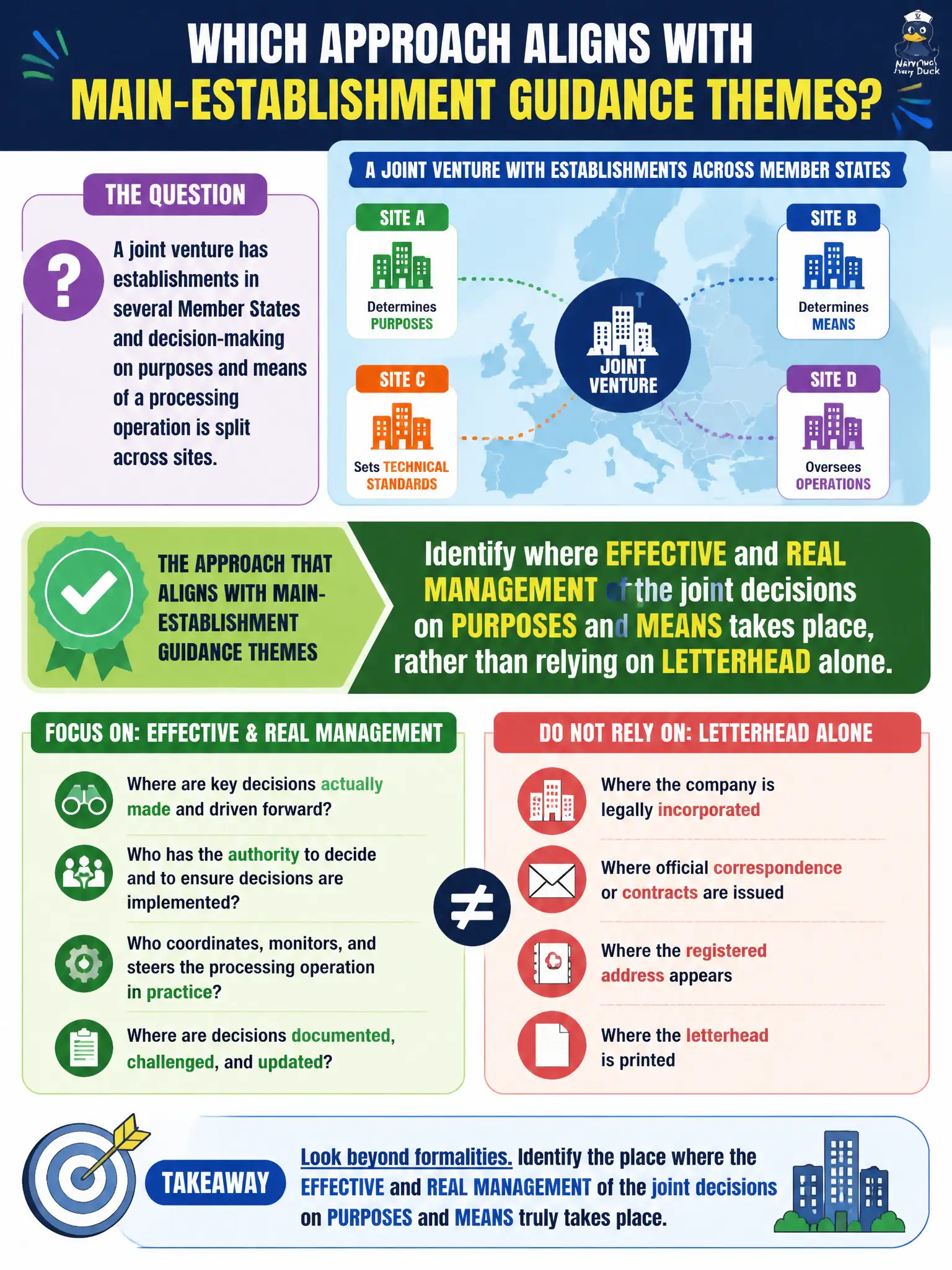
A joint venture has establishments in several Member States and decision-making on purposes and means of a processing operation is split across sites. Which approach aligns with main-establishment guidance themes?
Select an answer to reveal the explanation.
Short Explanation
When several kitchens claim to run the same recipe, find the stove where the real joint cooking decisions happen. Main establishment follows effective management of purposes and means, not the oldest letterhead or the biggest headcount. Two ‘mains’ for one processing is not how one-stop-shop is meant to work.
Full Explanation
Main-establishment analysis looks for where effective and real management decisions on purposes and means of the relevant processing are taken—not merely letterhead, oldest incorporation date, or headcount. When a joint venture splits decision-making across Member State sites, the organisation must identify the place of effective joint decision-making for that processing operation, consistent with Article 4(16) and EDPB one-stop-shop guidance themes. Accurate identification serves residents by clarifying which supervisory authority leads cross-border matters.
Oldest incorporation is not an automatic selection rule. Multiple establishments cannot each claim main-establishment status for the same processing simultaneously. Headcount alone does not override where decision authority actually sits.
Exam caveat: if no true main establishment can be identified for cross-border processing, one-stop-shop benefits may be limited and local supervisory authorities may act more autonomously—another reason to clarify governance rather than paper over it.
Operational check: map decision forums such as committees, approving roles, and budget owners for the processing, document the main-establishment conclusion with contemporaneous evidence, and align lead-authority communications with that map rather than branding preferences.