
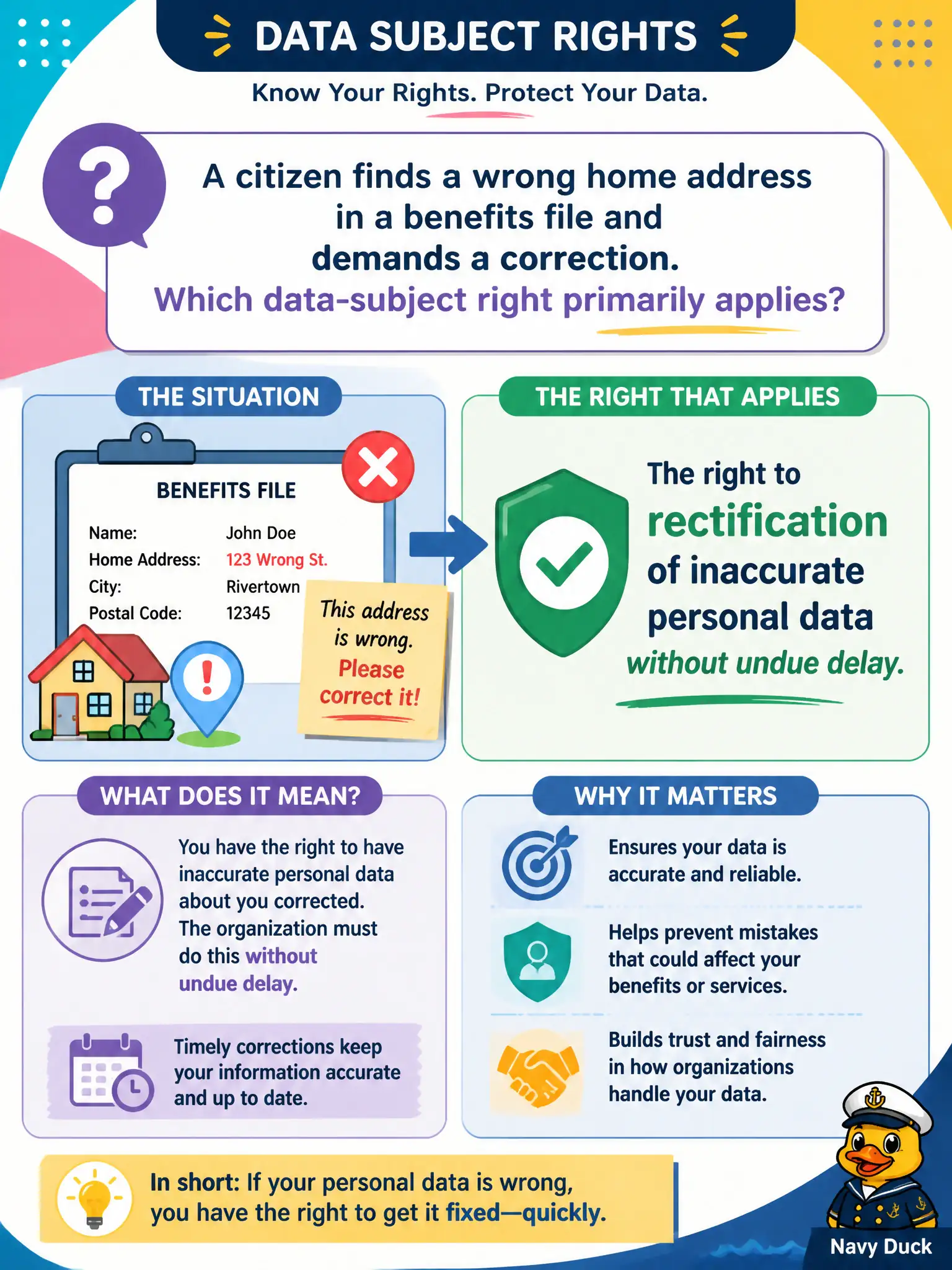
A citizen finds a wrong home address in a benefits file and demands a correction. Which data-subject right primarily applies?
Select an answer to reveal the explanation.
Short Explanation
Wrong address in the benefits file? That's a 'please fix my record' moment—the right to rectification. Controllers shouldn't leave known inaccuracies sitting there like a typo carved in stone. Update it without dragging feet.
Full Explanation
When a citizen finds a wrong home address in a benefits file and demands a correction, the primary data-subject right is rectification of inaccurate personal data without undue delay. Accurate contact and identity data are essential to fair administration; leaving known inaccuracies in place can cause missed notices, wrongful decisions, and downstream sharing of false information.
The right to data portability does not force immediate erasure of inaccurate addresses; portability and erasure are distinct tools with distinct conditions. The right to object to direct marketing does not correct postal fields in a benefits file. Restriction of processing may be useful while accuracy is contested, but it is not a permanent freeze of every benefits field and is not the primary remedy once inaccuracy is established.
Exam caveat: match the citizen’s ask to the correct right—fix versus pause versus delete versus move. Operational check: verify the correct address through proportionate checks, update authoritative systems, propagate corrections to processors and partner agencies, and confirm completion with the resident. Benefits administration depends on accurate civic records; supervisors should treat uncorrected known errors as both a compliance failure and a fairness failure toward the people the city serves.