
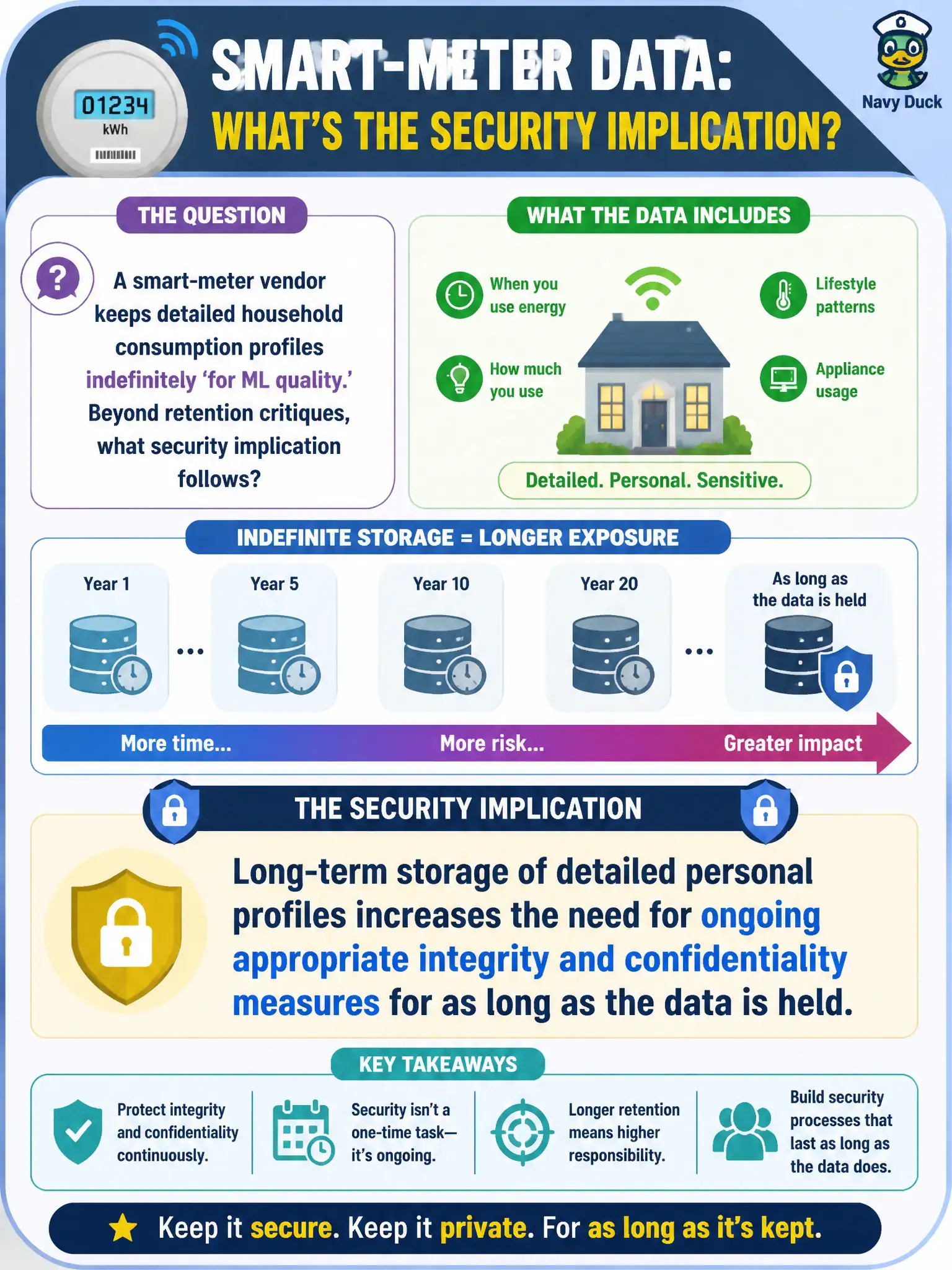
A smart-meter vendor keeps detailed household consumption profiles indefinitely 'for ML quality.' Beyond retention critiques, what security implication follows?
Select an answer to reveal the explanation.
Short Explanation
The longer you keep rich household profiles, the longer the vault has to stay locked. Indefinite 'ML quality' storage isn't a free security holiday—it raises the bar for ongoing confidentiality and integrity controls. Keep less, or protect harder for longer.
Full Explanation
Detailed household smart-meter consumption profiles retained indefinitely “for ML quality” expand the window during which confidentiality and integrity failures can harm residents. Beyond storage-limitation concerns, long-term retention of rich personal profiles increases the need for ongoing appropriate security measures—access control, encryption, monitoring, and vendor constraints—for as long as the data remain identifiable and linkable to households.
Indefinite storage does not automatically improve integrity on the theory that older data are less interesting to attackers; long retention often increases cumulative exposure. Machine-learning quality goals do not exempt profiles from access-control requirements. Personal data in ML feature stores also do not cease to be personal data after ninety days by default.
Exam caveat: retention length and security strength travel together on scenario questions. Operational check: justify and minimise retention, reduce feature granularity, encrypt and tightly access-control ML stores, segregate training environments, and purge when purposes end. Civic energy or utility programmes should not quietly build permanent behavioural dossiers on households without matching safeguards, limits, and a recorded rationale residents could respect.