
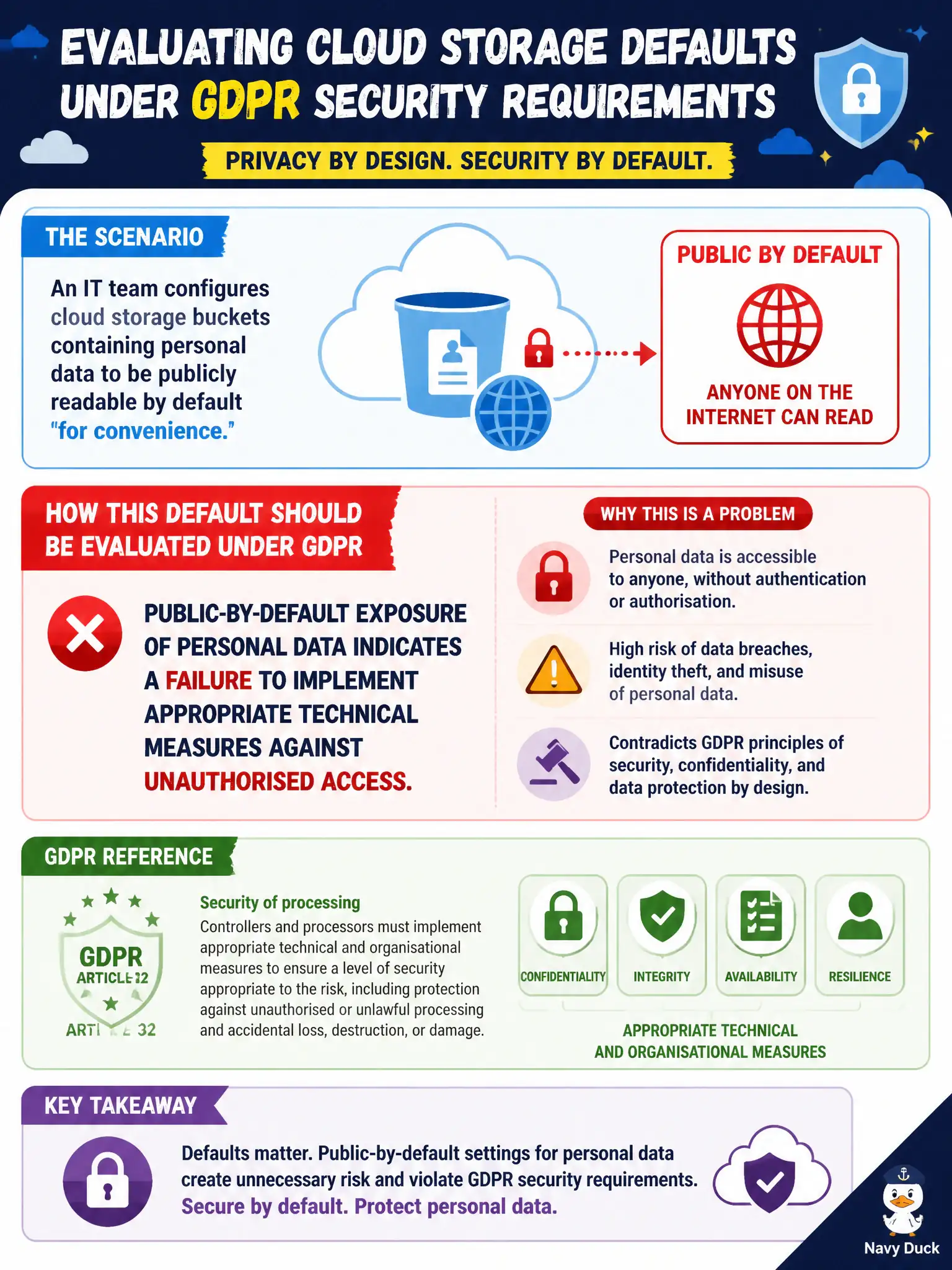
An IT team configures cloud storage buckets containing personal data to be publicly readable by default 'for convenience.' How should this default be evaluated under GDPR security requirements?
Select an answer to reveal the explanation.
Short Explanation
Leaving the bucket open to the world for convenience is the opposite of locking the filing cabinet. Appropriate technical measures mean defaults that protect, not defaults that publish. Famous cloud brands do not excuse that exposure.
Full Explanation
Public-by-default exposure of personal data in cloud storage buckets indicates a failure to implement appropriate technical measures against unauthorised access under Article 32. IT teams that choose public readability “for convenience” create foreseeable confidentiality breaches. Public defaults are not encouraged because transparency always outweighs confidentiality. Convenience settings labelled agile do not automatically satisfy Article 32. Well-known cloud providers do not place personal data outside GDPR security rules. Exam caveat: insecure defaults are a classic Article 32 failure mode. Operational check: enforce private-by-default bucket policies, block public ACLs on personal-data projects, and scan continuously for accidental public exposures in civic cloud accounts. For municipal teams, keep a one-page decision note that states the governing instrument, why competing labels fail, and what evidence would change the conclusion. Document the decision trail so auditors can see how the civic team matched facts to the correct legal category rather than to a slogan. Revisit the conclusion when facts, recipients, or processing purposes change, and record who approved the updated analysis.