
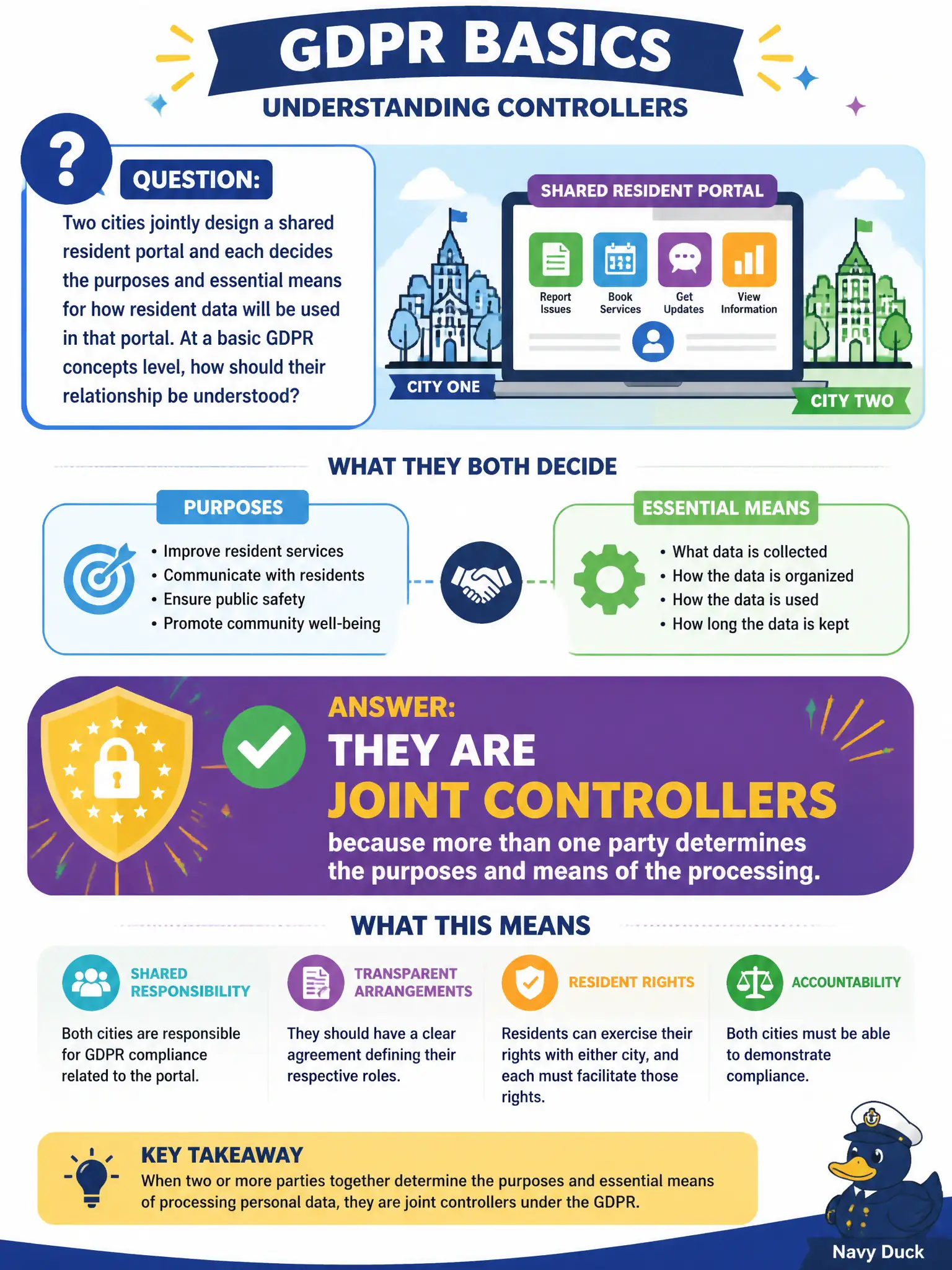
Two cities jointly design a shared resident portal and each decides the purposes and essential means for how resident data will be used in that portal. At a basic GDPR concepts level, how should their relationship be understood?
Select an answer to reveal the explanation.
Short Explanation
If both cities are steering what the portal is for and how it basically works, they are sharing the controller’s wheel—not one driving and one just washing the car. Joint controllers show up when more than one party decides purposes and means. Hosting alone does not settle that question.
Full Explanation
Where two cities jointly design a shared resident portal and each decides the purposes and essential means for how resident data will be used, they are joint controllers because more than one party determines the purposes and means of the processing. Article 26 expectations on transparent arrangements follow from that concept. Only the city that hosts the servers is not automatically the sole controller while the other is always a mere processor. Both cities do not become data subjects for every resident record. Joint public-body projects do not automatically fall outside the GDPR. Exam caveat: joint controllership turns on shared determination of purposes and means—not hosting location. Operational check: execute a joint-controller arrangement allocating GDPR duties (notices, rights handling, SA engagement) and publish the essence of the arrangement to residents using the portal. For municipal teams, keep a one-page decision note that states the governing instrument, why competing labels fail, and what evidence would change the conclusion. Document the decision trail so auditors can see how the civic team matched facts to the correct legal category rather than to a slogan. Revisit the conclusion when facts, recipients, or processing purposes change, and record who approved the updated analysis.