
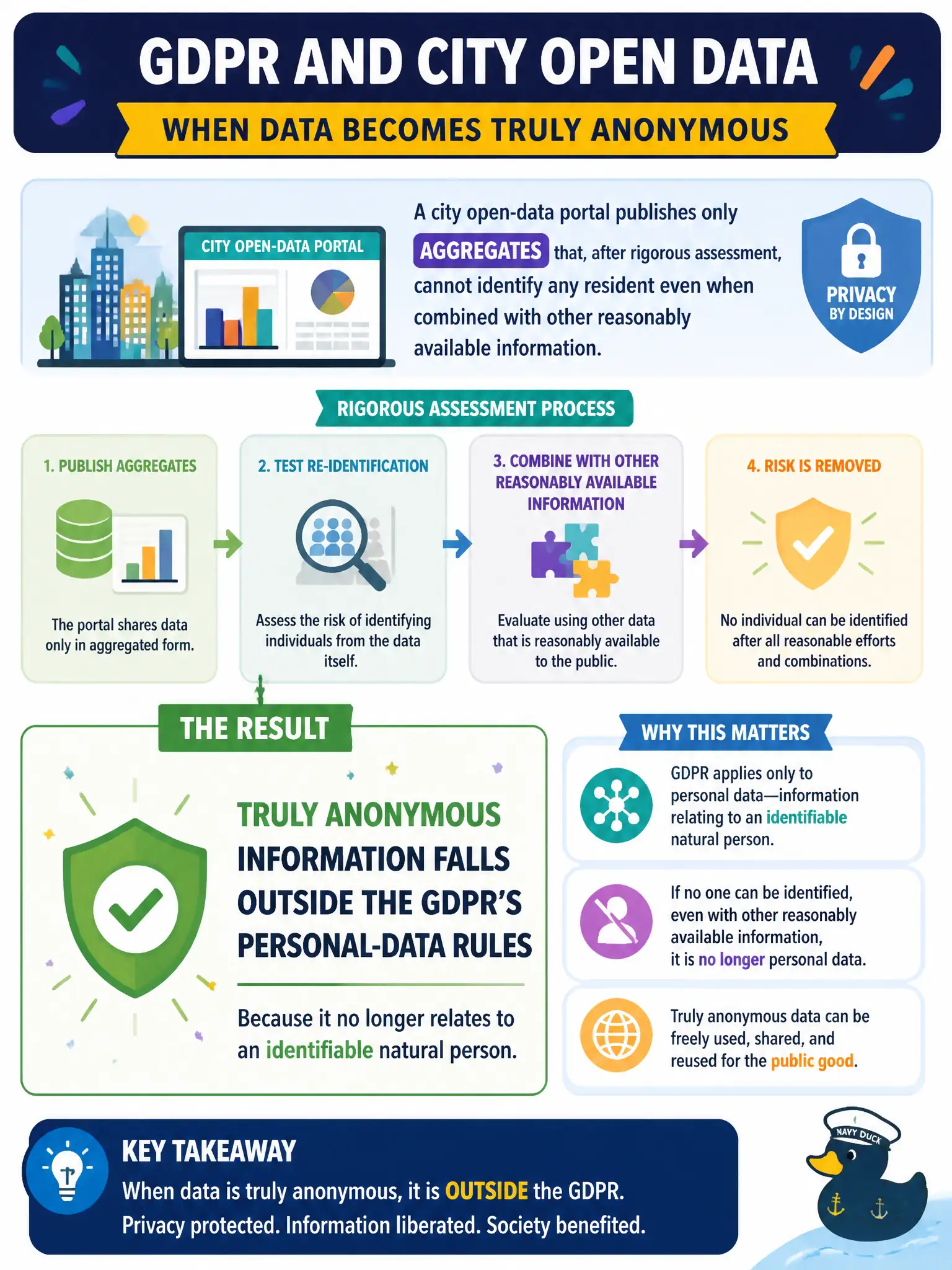
A city open-data portal publishes only aggregates that, after rigorous assessment, cannot identify any resident even when combined with other reasonably available information. How should the GDPR personal-data rules apply?
Select an answer to reveal the explanation.
Short Explanation
If the numbers truly cannot point back to anyone—even with other reasonable clues—you have left the personal-data zone. GDPR cares about identifiable people, not about every spreadsheet that ever touched a city hall. Real anonymisation is the off-ramp; weak masking is not.
Full Explanation
Truly anonymous information falls outside the GDPR’s personal-data rules because it no longer relates to an identifiable natural person. A city open-data portal that publishes only aggregates rigorously assessed as non-identifiable—even when combined with other reasonably available information—may treat those outputs as outside personal-data rules under Recital 26 logic. Aggregates do not always remain personal data forever merely because they once came from resident records. Anonymous open data does not still require Article 9 special-category consent for every download. Every published table need not be treated as a restricted Chapter III processing activity if true anonymity is achieved. Exam caveat: anonymity requires robust re-identification risk reduction, not a hopeful label. Operational check: before publishing civic aggregates, document the anonymisation method, residual risk assessment, and who signs off that reasonably available means cannot re-identify residents. For municipal teams, keep a one-page decision note that states the governing instrument, why competing labels fail, and what evidence would change the conclusion. Document the decision trail so auditors can see how the civic team matched facts to the correct legal category rather than to a slogan.