
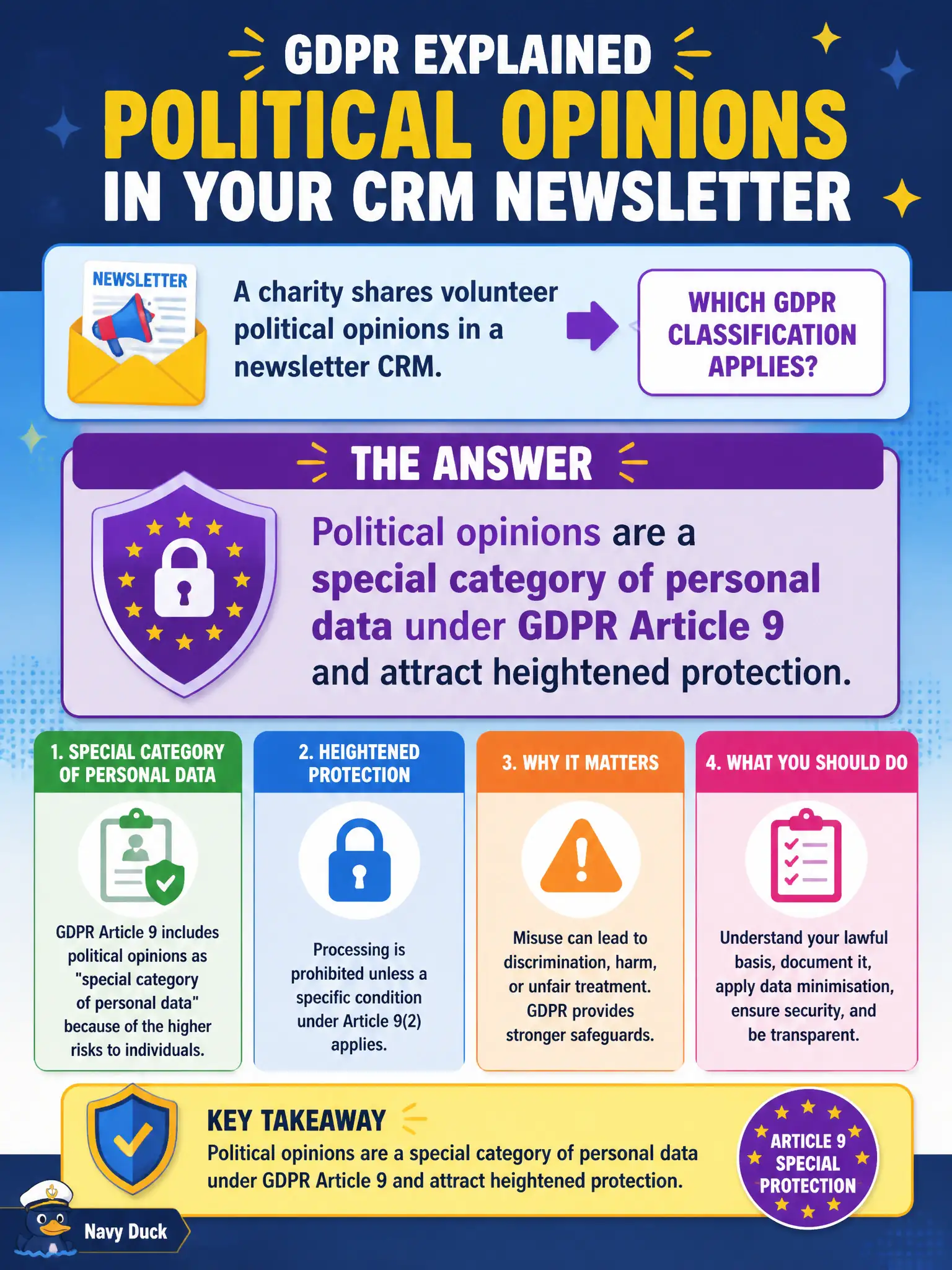
A charity shares volunteer political opinions in a newsletter CRM. Which GDPR classification applies to those political opinions?
Select an answer to reveal the explanation.
Short Explanation
Political opinions are not “just another CRM column.” GDPR Article 9 parks them in the special-category box with heightened rules—whether a charity or anyone else is doing the filing. Treat them with the stricter gate, not like an email address.
Full Explanation
Political opinions are a special category of personal data under GDPR Article 9 and attract heightened protection. A charity that stores volunteer political opinions in a newsletter CRM must treat those fields under the special-category regime—generally prohibited unless an Article 9(2) condition applies—rather than as ordinary contact data. Political opinions are not equivalent to email addresses for Article 9 purposes. Special-category status does not apply only when stored by political parties. Political opinions do not fall outside GDPR because campaign speech is absolutely unregulated. Exam caveat: Article 9 lists political opinions expressly—controller type does not erase that. Operational check: remove political-opinion fields from routine CRM exports, document any Article 9 condition if retention is necessary, and restrict access to staff with a demonstrated need. For municipal teams, keep a one-page decision note that states the governing instrument, why competing labels fail, and what evidence would change the conclusion. Document the decision trail so auditors can see how the civic team matched facts to the correct legal category rather than to a slogan. Revisit the conclusion when facts, recipients, or processing purposes change, and record who approved the updated analysis.