
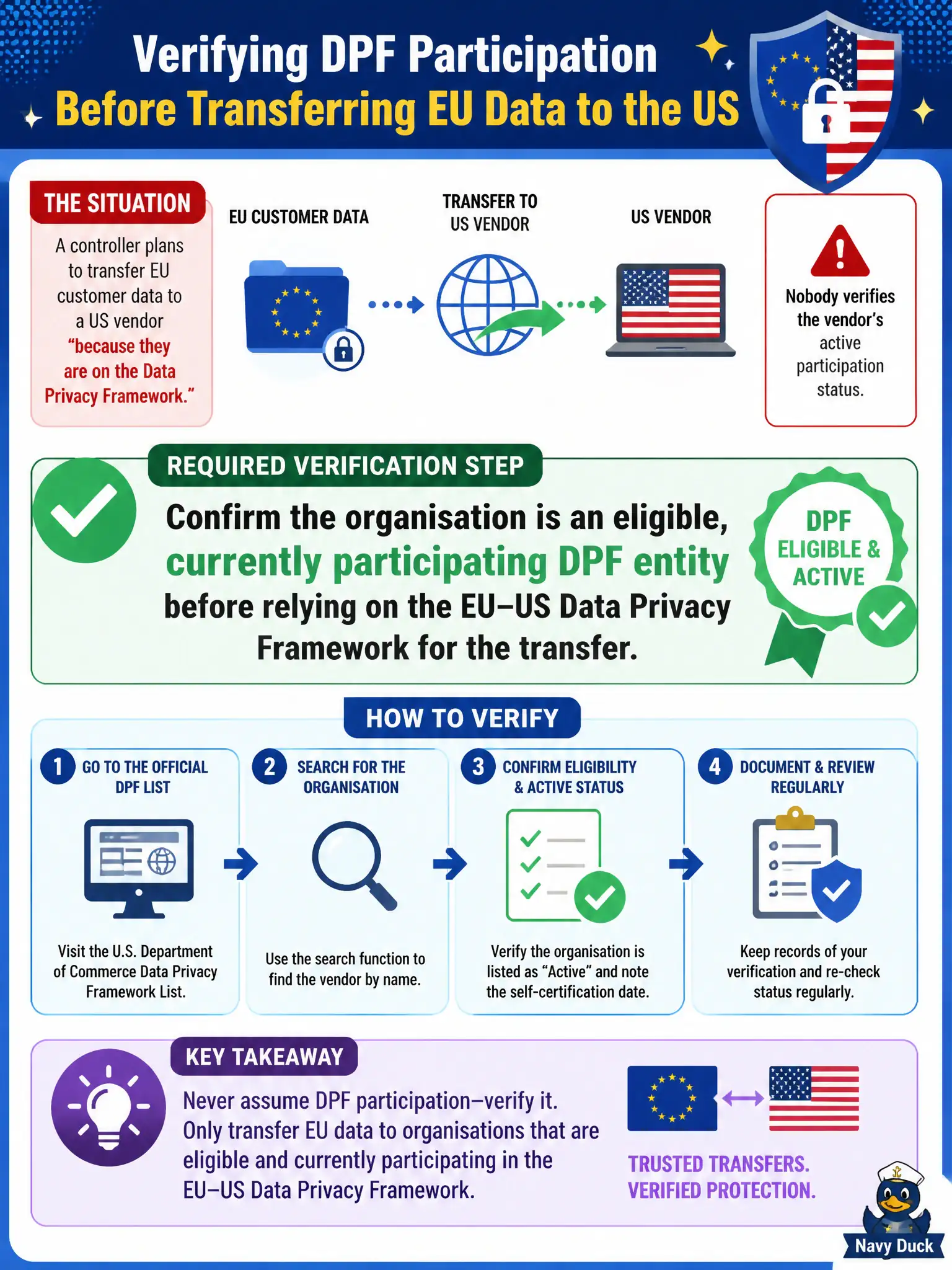
A controller plans to transfer EU customer data to a US vendor “because they are on the Data Privacy Framework,” but nobody verifies the vendor’s active participation status. What verification step is required?
Select an answer to reveal the explanation.
Short Explanation
The EU–US Data Privacy Framework is a guest list, not a vibe. You check that the vendor is actually on it and still in good standing before you lean on DPF for the transfer. Assuming participation from a glossy website or a Schrems II name-drop is how gaps appear.
Full Explanation
Relying on the EU–US Data Privacy Framework requires confirming that the recipient is an eligible organisation that currently participates in the Framework for the relevant data, not merely assuming a US vendor “must be on it.” Participation is verified through official listing resources and checked against the transfer’s scope before any export is treated as adequacy-covered. Civic procurement teams and private controllers share the same verification duty before telling the public or regulators that DPF covers the transfer.
DPF reliance is not automatic for every US company with a .com website. The primary vendor’s own participation matters; it is incorrect that only subcontractors need listing while the primary vendor never does. Sales proposals that mention Schrems II do not prove Framework status and cannot replace a listing check.
Exam caveat: Framework coverage can lapse, be limited by certification details, or fail to cover particular data categories. Onward transfers and subprocessors may need separate Chapter V analysis even when the primary vendor participates.
Operational check: record the vendor’s active DPF listing before contract signature, re-verify at each renewal or material scope change, align the privacy notice’s transfer language with verified status, and fall back to current SCCs plus a transfer impact assessment if participation cannot be confirmed on the official resource.