
A tourism app stores EU travellers’ photos only on servers in a country covered by a Commission adequacy decision. How does that destination choice affect the transfer analysis?
Select an answer to reveal the explanation.
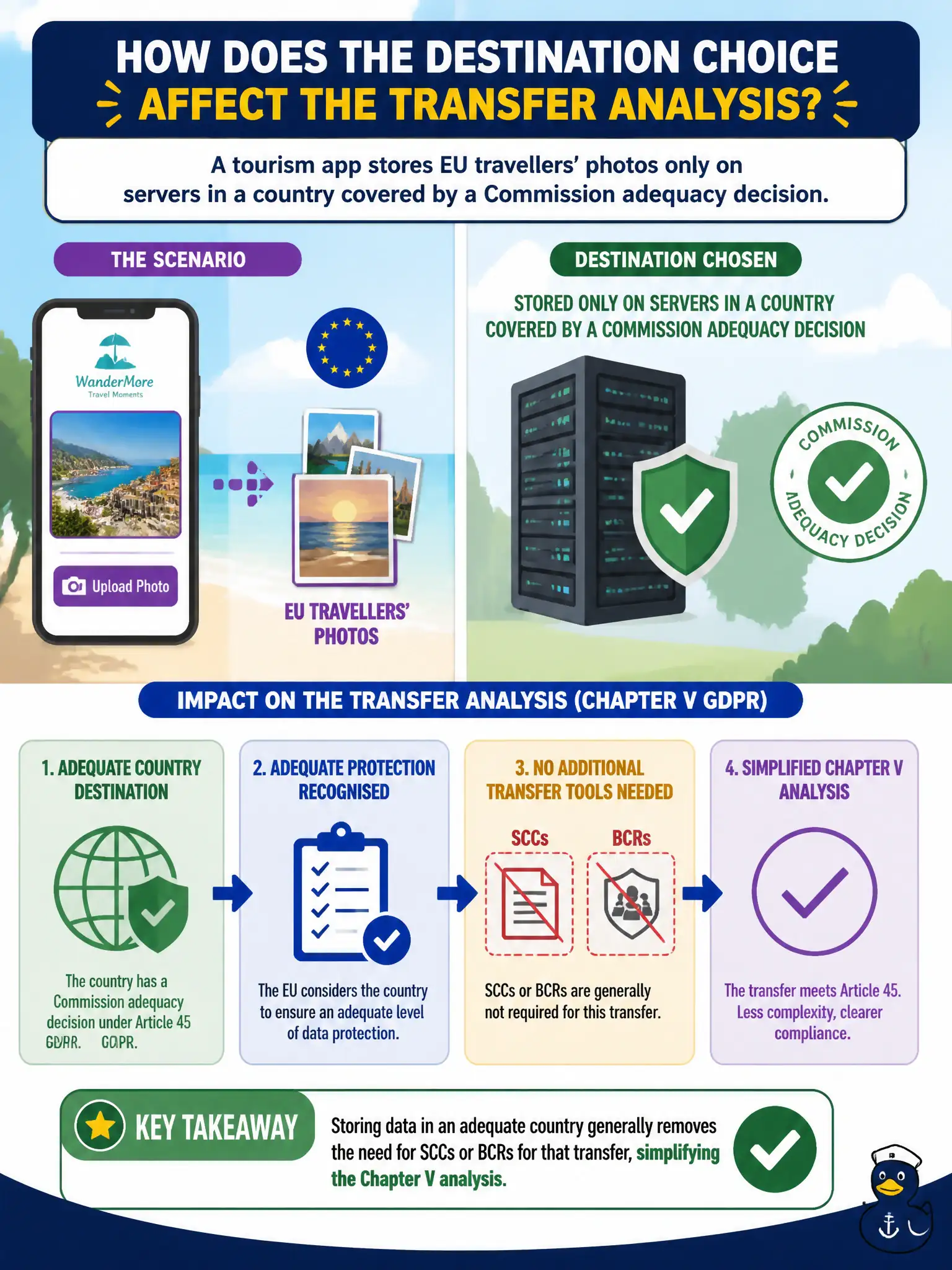
Short Explanation
Parking the photo vault in an adequate country is like shipping to a destination the EU already trusts. You typically skip bolting on SCCs or BCRs just for that hop. It simplifies Chapter V—it doesn’t mean the images stopped being personal data.
Full Explanation
When EU travellers’ photos are stored only on servers in a country covered by a Commission adequacy decision, Article 45 generally allows that transfer without Standard Contractual Clauses or Binding Corporate Rules for the destination. Adequacy simplifies the Chapter V analysis while leaving Articles 5 and 6, transparency, security, and retention duties intact. Tourism platforms and civic cultural apps alike still owe people a clear purpose and retention story; adequacy addresses the third-country protection bridge, not every GDPR principle that applies to image processing of identifiable visitors.
Adequate destinations do not still require BCRs for every consumer photo upload. Photos of identifiable people are typically personal data, so Chapter V can apply when those images leave the EEA. Article 49 consent forms are not a prerequisite before an organisation may rely on an adequacy decision.
Exam caveat: confirm the adequacy decision’s scope covers the relevant sector and that processing does not also involve non-adequate remote support access or onward transfers that reintroduce the need for Article 46 safeguards and transfer impact analysis.
Operational check: pin storage to the adequate region in vendor configuration, disclose the transfer and adequacy reliance in the privacy notice, block shadow replication to non-adequate regions, review subprocessors’ geography, and re-check controls whenever the vendor changes default regions or support routing.