
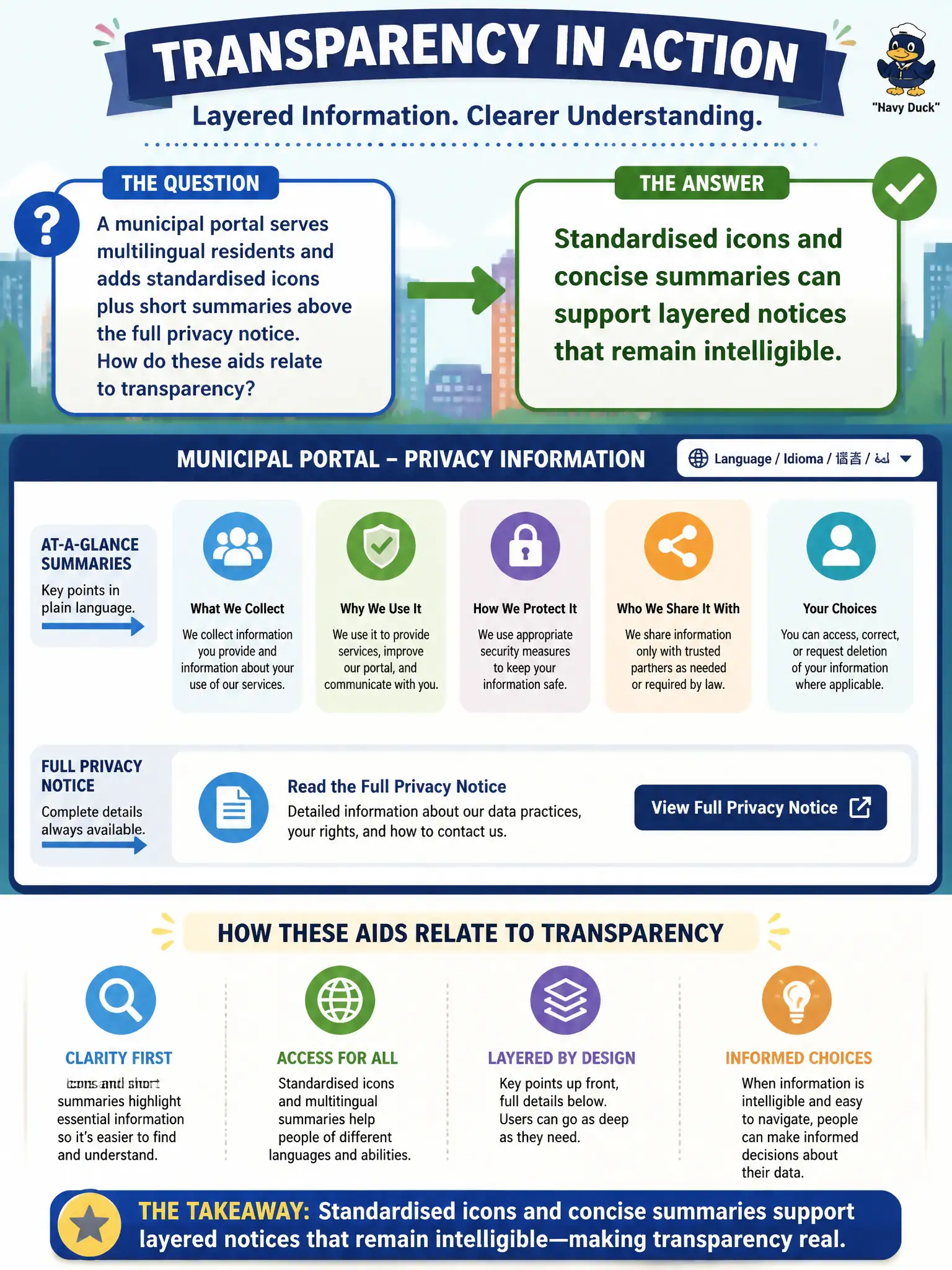
A municipal portal serves multilingual residents and adds standardised icons plus short summaries above the full privacy notice. How do these aids relate to transparency?
Select an answer to reveal the explanation.
Short Explanation
Think of icons and short blurbs as the big map at the front of a museum—then the detailed panels behind them. They help people who speak different languages grab the essentials fast without deleting the full notice. Layered transparency can still be clear and fair.
Full Explanation
Article 12 expressly envisages that information may be provided in combination with standardised icons, and European supervisory practice supports concise summaries within layered notices. A multilingual municipal portal that adds icons and short summaries above the full privacy notice uses those aids to keep privacy information intelligible for diverse residents. That is civic transparency done practically: visual cues and plain summaries help people find the full legal text without pretending icons erase legal substance.
Icons do not replace the legal notice entirely even if an EDPB pictogram catalogue exists; they support it. Article 12 does not forbid layered presentation—it encourages clarity and accessibility. Machine-readable representations can assist automation and intermediaries, but human-readable icons and summaries still count; JSON-only notices would fail many residents who need ordinary language.
Exam caveat: icons must be meaningful and not misleading, and summaries must not contradict the long-form notice. Providing notices in the languages actually used by the community remains an important intelligibility factor alongside iconography.
Operational check: validate each icon legend against real processing in the RoPA, user-test summaries with non-expert residents, keep the full notice one click away in every language offered by the portal, and version-control changes so icons do not drift from underlying purposes, bases, or retention rules.