
A SaaS privacy notice lists EU processors but is silent about recipients in third countries and related transfer safeguards. What notice deficiency is most relevant?
Select an answer to reveal the explanation.
Short Explanation
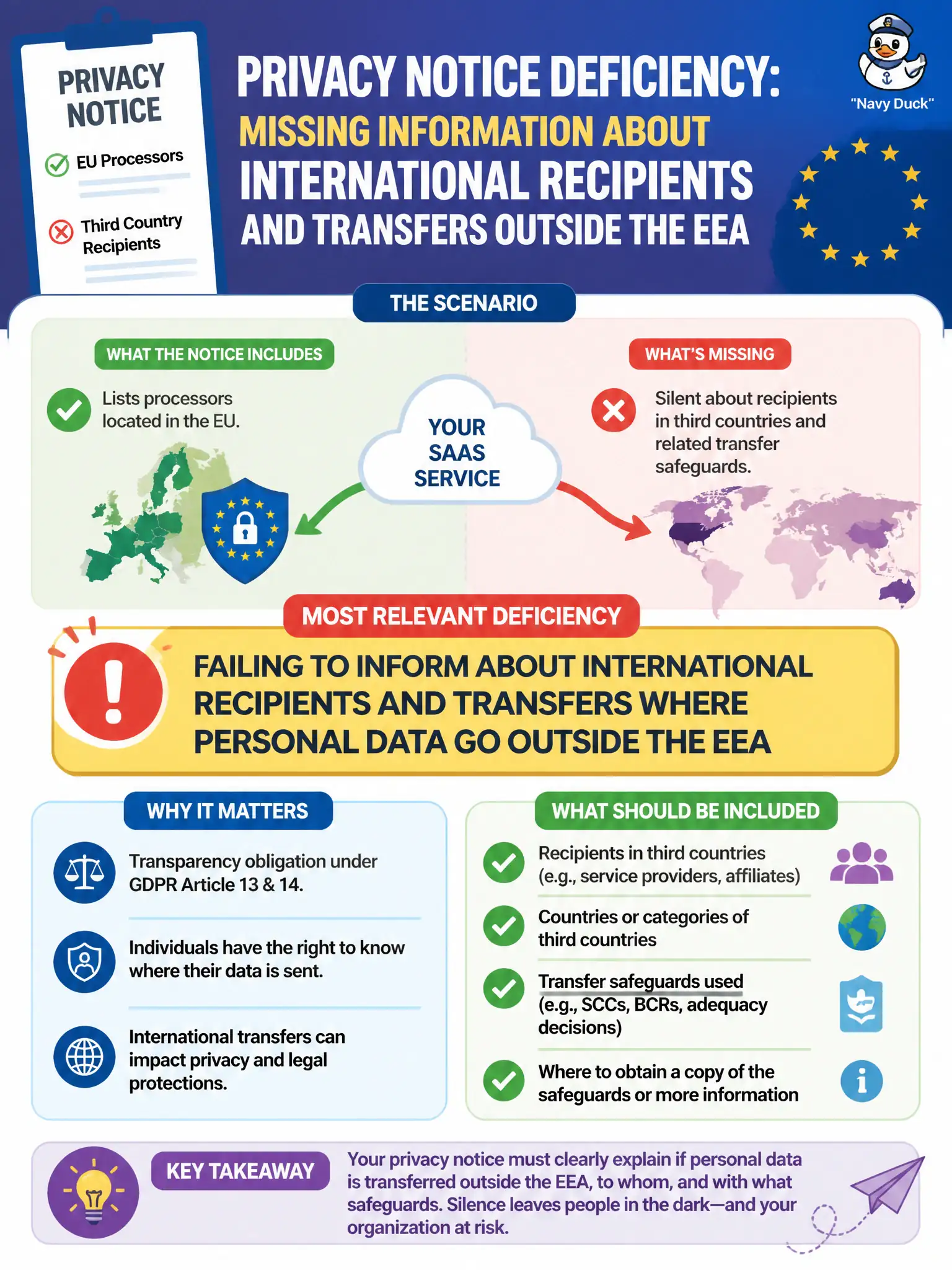
If data leave the EEA, say so—and say how you protect the trip. Hiding third-country recipients undercuts transparency. Naming EU processors is good, but transfer disclosure still matters when data go further.
Full Explanation
Articles 13 and 14 require information about recipients or categories of recipients and, for international transfers, the fact that the controller intends to transfer personal data to a third country or international organisation, the existence or absence of an adequacy decision, and reference to appropriate safeguards. A SaaS notice that lists EU processors but stays silent on third-country recipients and transfer safeguards therefore fails a core transparency duty for people whose data may leave the EEA. Civic digital services and commercial SaaS alike owe users a plain account of where data go and how Chapter V protection travels with them.
Publishing a CEO’s personal mobile in every language, listing every employee’s home address as a “recipient,” or annexing the full text of Convention 108+ are not the Article 13/14 fix. Those distractors confuse optional or irrelevant detail with the mandatory transfer narrative.
Exam caveat: “categories of recipients” can be used thoughtfully, but international transfers still need the adequacy/safeguard story. Naming only “cloud providers” without clarifying third-country locations often fails in practice when the processing actually involves non-EEA support or storage.
Operational check: inventory real storage and access locations, update the notice with third-country disclosures and safeguard references (SCCs, DPF participation, BCRs, etc.), align the RoPA, and verify a prospect can find that transfer section without reading the DPA.