
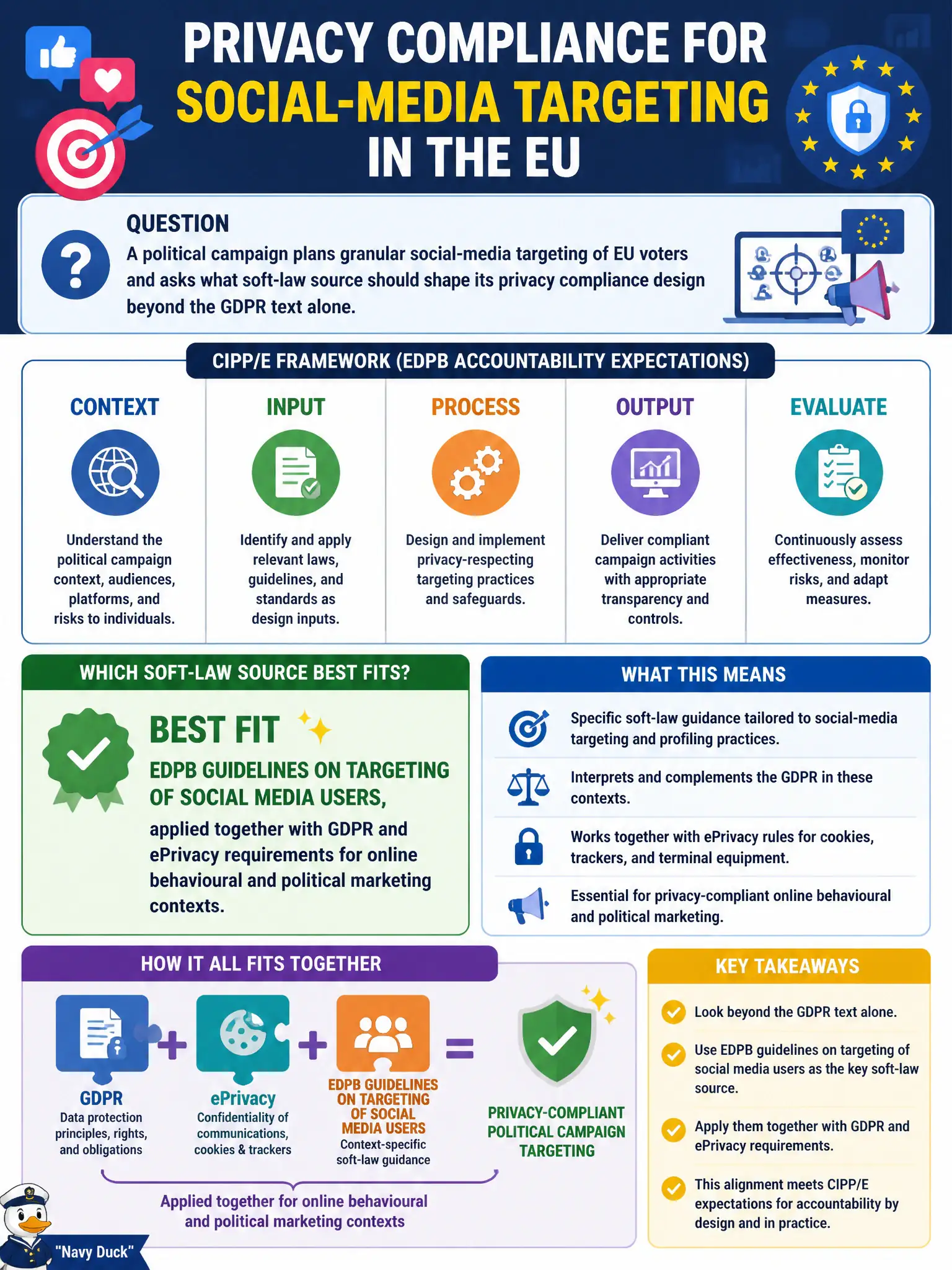
A political campaign plans granular social-media targeting of EU voters and asks what soft-law source should shape its privacy compliance design beyond the GDPR text alone. Which choice best fits CIPP/E expectations?
Select an answer to reveal the explanation.
Short Explanation
When politics meets micro-targeting, the EDPB's social-media targeting guidance is the map you actually want on the wall. It sits beside the GDPR and ePrivacy rules—not instead of them. Soft law still steers how supervisors expect you to behave.
Full Explanation
A political campaign planning granular social-media targeting of EU voters should shape privacy compliance design using EDPB guidelines on targeting of social media users, applied together with GDPR and ePrivacy requirements for online behavioural and political marketing contexts. Micro-targeting voters is a high-stakes civic integrity issue, not merely a growth hack. Relying only on US FTC endorsement guides because political speech is outside European DP law fails—EU data-protection and ePrivacy rules still apply to targeting EU users. Using internal sales playbooks that redefine profiling as ‘content customisation’ with no regulatory reference fails accountability. Substituting ISO food-safety standards for targeting transparency fails by invoking the wrong corpus. Exam caveat: EDPB targeting guidance informs roles, risks, and transparency expectations but does not replace concrete lawful-basis, special-category (e.g., political opinions), and tracker-consent analysis. Operational check: read the EDPB social-media targeting guidance, map actors and targeting methods, assess Art. 6/9 and ePrivacy consent, minimise special-category inferences, and document campaign privacy controls before launch.