
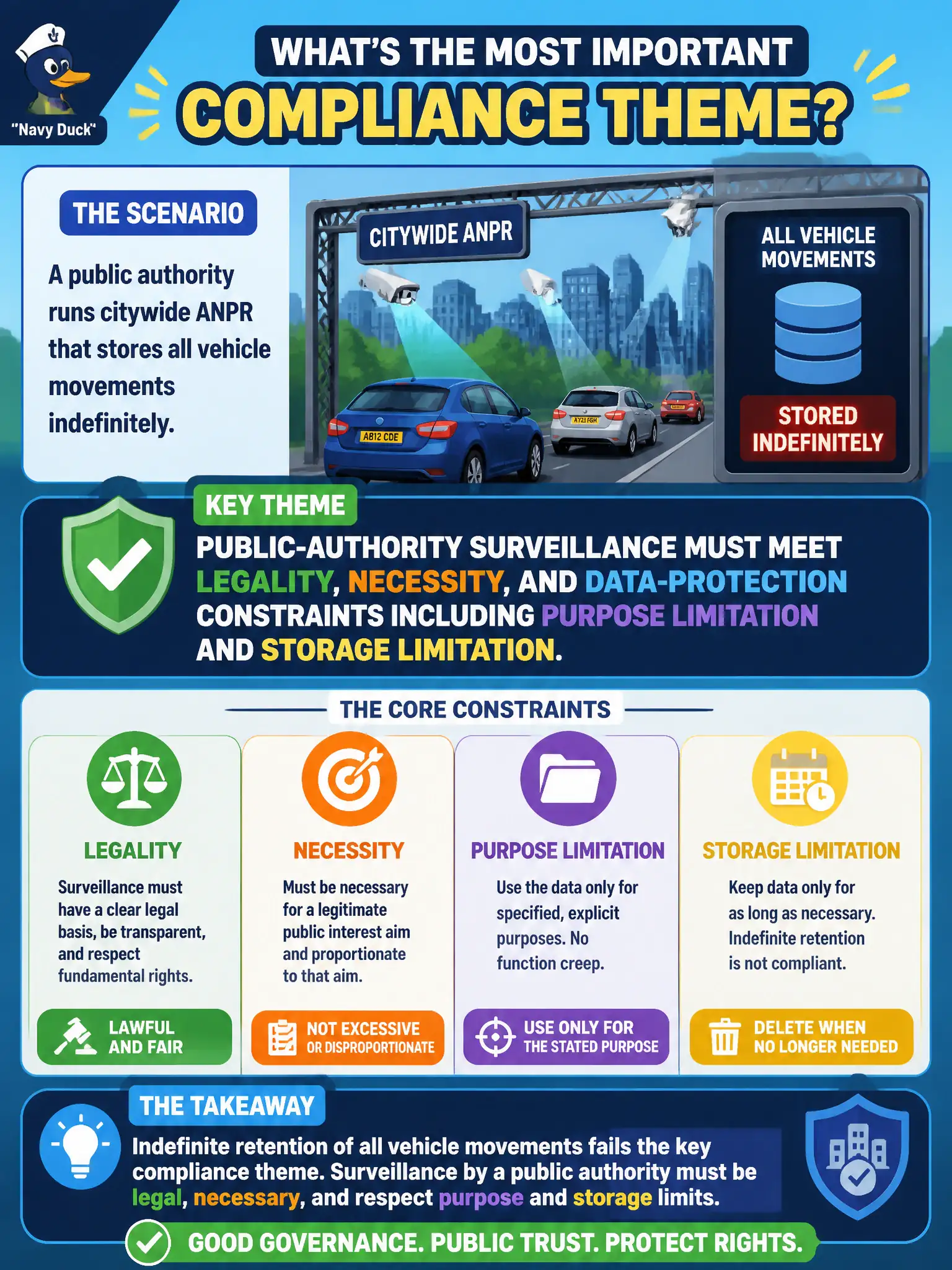
A public authority runs citywide ANPR that stores all vehicle movements indefinitely. What compliance theme is most important?
Select an answer to reveal the explanation.
Short Explanation
Tracking every car forever is a panopticon with license plates. Even public bodies need a clear legal basis, a real need, and retention limits. “Smart city” is not a blank cheque.
Full Explanation
A public authority running citywide ANPR that stores all vehicle movements indefinitely most importantly raises that public-authority surveillance must meet legality, necessity, and data-protection constraints including purpose limitation and storage limitation. Tracking every car forever is a civic panopticon problem—even governments need clear law, defined aims, and retention limits. Claiming indefinite ANPR retention is automatically lawful for any smart-city project fails storage limitation and necessity. Saying vehicle plates are never personal data when collected by government cameras fails when plates can identify natural persons. Asserting public authorities are exempt from GDPR-style principles whenever ANPR is used fails—public bodies remain bound by applicable data-protection regimes and fundamental-rights constraints. Exam caveat: law-enforcement contexts may engage LED/national rules alongside or instead of GDPR depending on purposes; the conceptual constant is legality, necessity, proportionality, and limited retention—not indefinite bulk warehouses. Operational check: define statutory purposes, set retention by purpose, segregate ANPR uses, complete DPIA/fundamental-rights assessments, publish transparency information, and purge indefinite citywide movement archives.