
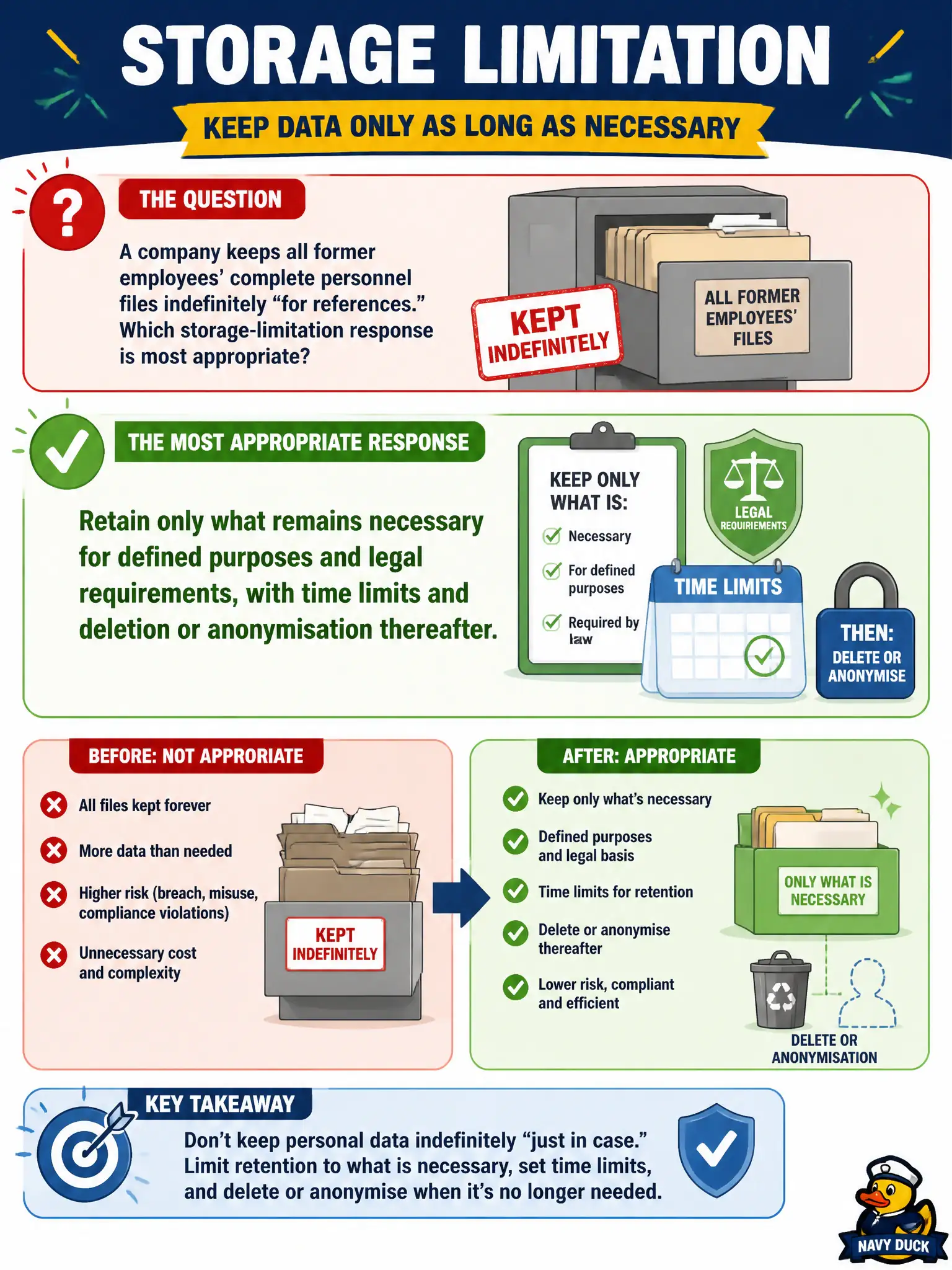
A company keeps all former employees’ complete personnel files indefinitely “for references.” Which storage-limitation response is most appropriate?
Select an answer to reveal the explanation.
Short Explanation
“Keep forever for references” is a junk drawer with a fancy label. Keep what you still need for real purposes and legal clocks, then delete or anonymise. Forever is not a retention schedule.
Full Explanation
A company that keeps all former employees’ complete personnel files indefinitely ‘for references’ should instead retain only what remains necessary for defined purposes and legal requirements, with time limits and deletion or anonymisation thereafter. Indefinite archives of leavers’ full lives are junk drawers that amplify breach impact and chill workers’ dignity after employment ends. Claiming indefinite retention is always lawful if labelled as a reference archive fails storage limitation. Deleting every record on the last working day, including records still needed for legal claims periods, fails by ignoring lawful retention needs. Transferring all leavers’ files to a public website so references are self-service fails confidentiality catastrophically. Exam caveat: reference-related retention should be field-minimised and time-bounded; legal holds and statutory retention can justify longer keeping of specific records without preserving entire historical files forever. Operational check: define purpose-specific retention schedules, retain minimal reference fields only as long as needed, automate deletion/anonymisation, and segregate litigation holds from routine HR archives. In public-interest terms, documenting the lawful analysis, assigning owners, and retaining evidence of how individuals were protected is how organisations demonstrate accountability when supervisory questions arrive.