
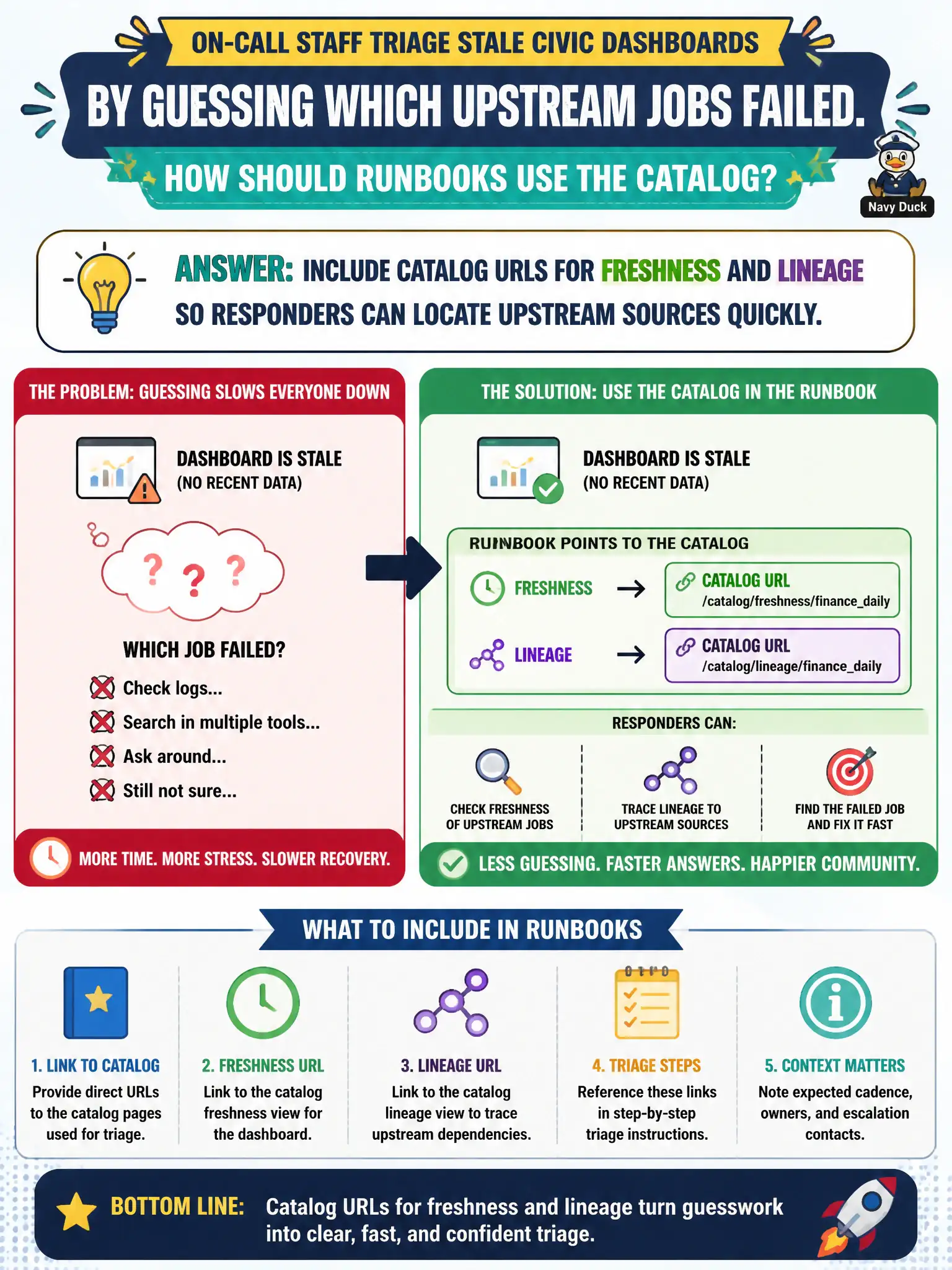
On-call staff triage stale civic dashboards by guessing which upstream jobs failed. How should runbooks use the catalog?
Select an answer to reveal the explanation.
Short Explanation
A good runbook is a treasure map, not a shrug. Point on-call staff at catalog freshness and lineage pages so they can chase the broken upstream job instead of guessing. Random reboots waste the night.
Full Explanation
On-call triage for stale civic dashboards should use catalog freshness and lineage, not guesswork. Runbooks should include catalog URLs for freshness and lineage so responders can locate upstream sources and failed jobs quickly when public-facing or operational charts go stale. Instructing responders to reboot random servers until charts look newer is superstition. Removing freshness timestamps to avoid alarming executives hides the signal responders need. Banning on-call coverage for analytics leaves stale dashboards permanently unowned. Exam pairing: operational metadata plus runbooks. Caveat: catalog links in runbooks must stay current; dead URLs recreate guessing under incident pressure. Operationally, embed deep links to the dashboard’s catalog entry and upstream lineage in the pager playbook, rehearse a stale-load scenario, and confirm responders can identify the failing job and steward contact within the target mean-time-to-diagnose. During incident drills, time how long responders need to move from a stale chart to the failing upstream job using only catalog links in the runbook. Freshness fields in the catalog must update from job telemetry automatically; static timestamps that staff forget to maintain recreate the guessing problem under incident pressure.