
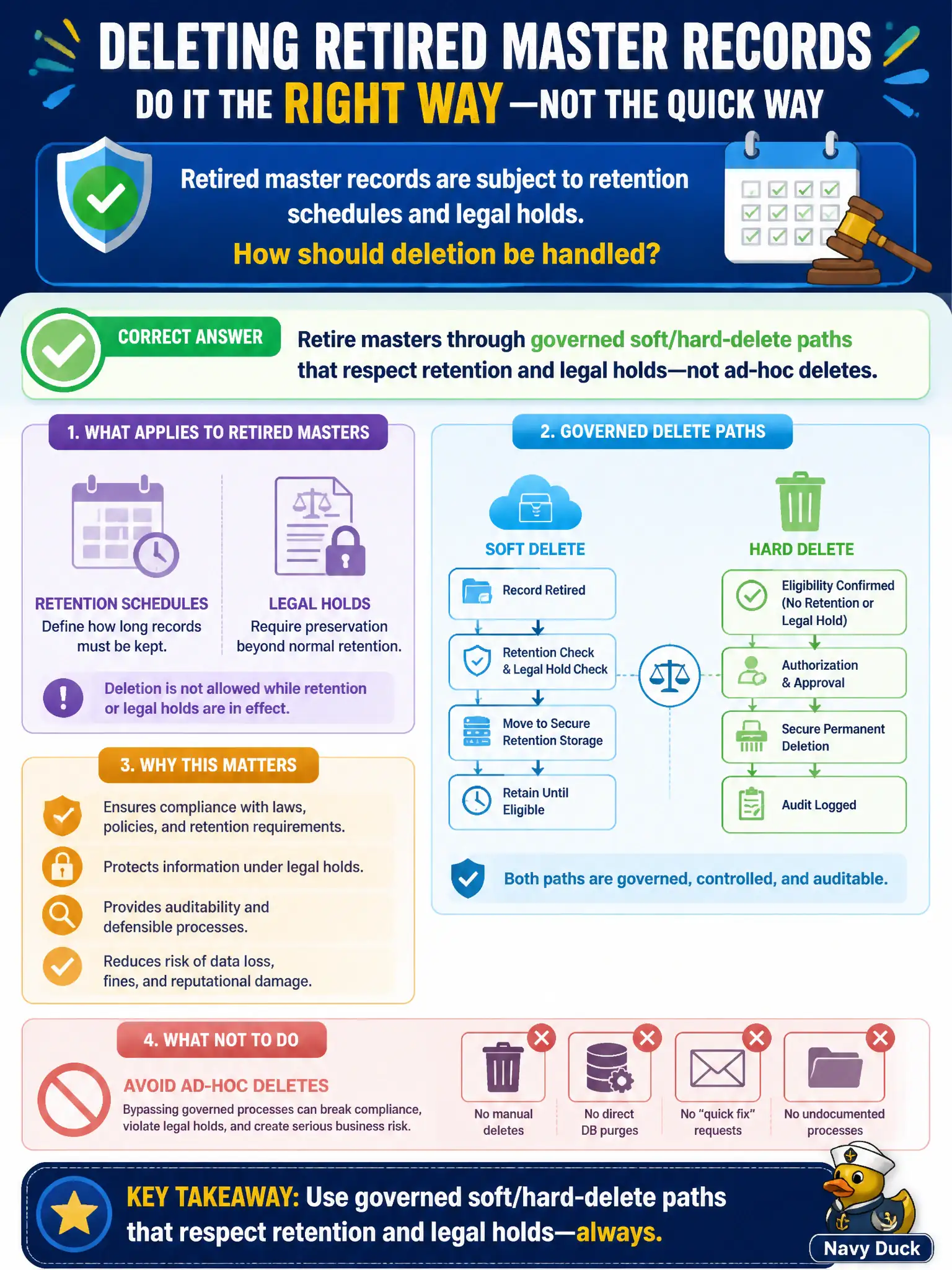
Retired master records are subject to retention schedules and legal holds. How should deletion be handled?
Select an answer to reveal the explanation.
Short Explanation
Retirement isn’t a delete button for convenience. Soft vs hard delete has to follow retention and legal holds—same as any other governed record.
Full Explanation
Retired master records remain subject to retention schedules and legal holds, so deletion must follow governed soft/hard-delete paths that respect retention and legal holds—not ad-hoc deletes. Civic records law does not exempt golden records. Hard-deleting any retired record the day a steward feels the table is large fails controlled disposition. Ignoring legal holds because golden records are supposedly exempt fails legal duty. Purging backups first so no recovery path remains under investigation destroys evidence. Exam caveat: master retirement follows retention and legal-hold governed delete paths. Operational check: implement soft-delete with hold checks, integrate with records schedules, require authorization for hard-delete, and audit disposition events. Coordinate with the municipal records officer before any bulk retirement purge. Keep verification evidence with the municipal runbook so audits can prove the chosen control was applied as designed and that rejected alternatives would have left city services exposed to the failure modes described above. Keep verification evidence with the municipal runbook so audits can prove the chosen control was applied as designed and that rejected alternatives would have left city services exposed to the failure modes described above.