
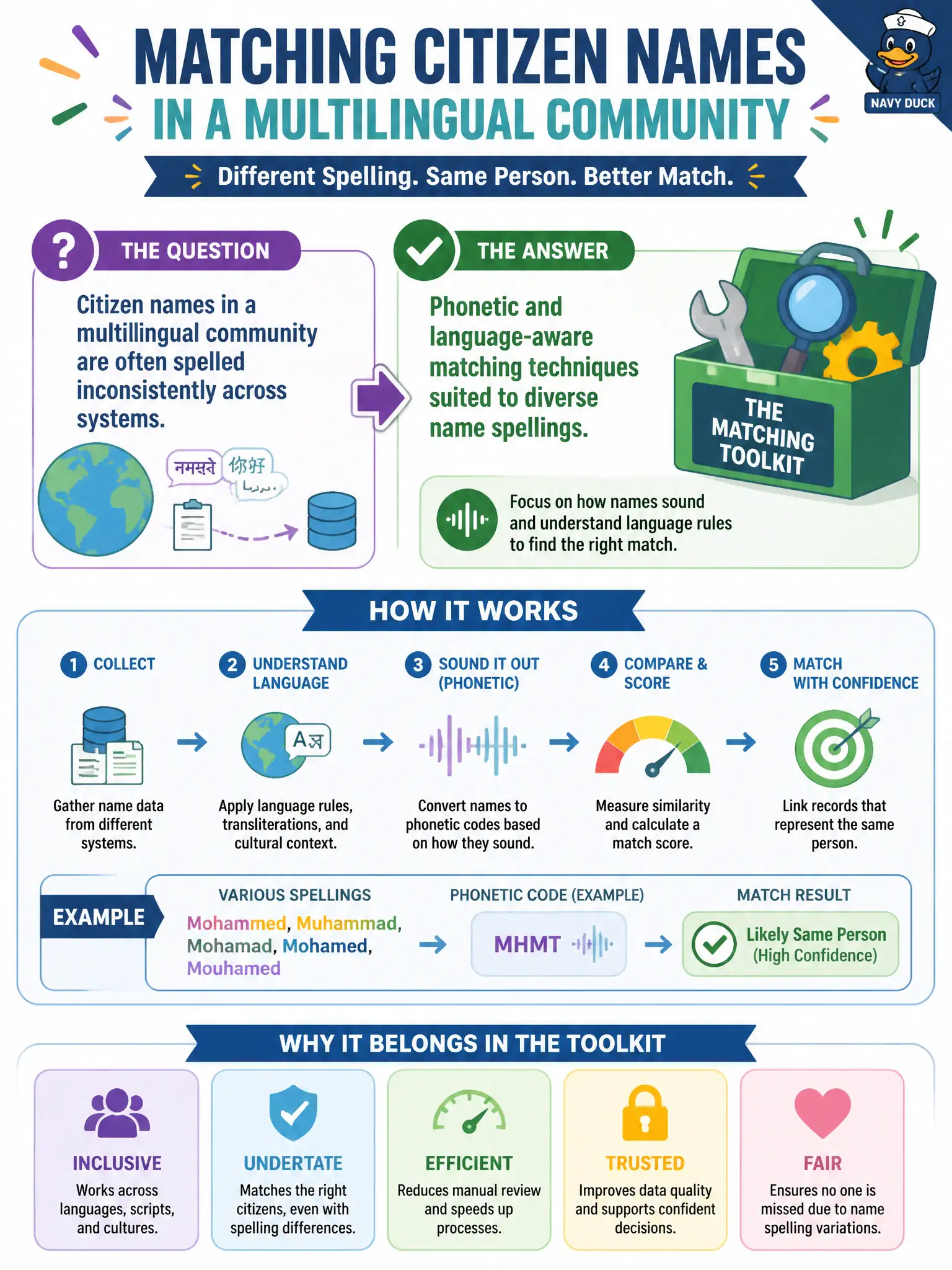
Citizen names in a multilingual community are often spelled inconsistently across systems. Which matching technique belongs in the toolkit?
Select an answer to reveal the explanation.
Short Explanation
Names get spelled a dozen ways in a multilingual city. Phonetic and language-aware matching help find the same person when letters differ.
Full Explanation
Citizen names in a multilingual community that are spelled inconsistently across systems call for phonetic and language-aware matching techniques suited to diverse name spellings. Civic inclusion and match quality both depend on more than exact ASCII equality. Exact byte-for-byte match only, rejecting any spelling variation, fails multilingual reality. Matching solely on favorite color fields that most records lack fails attribute usefulness. Ignoring names entirely and matching only on unrelated invoice totals fails identity logic. Exam caveat: phonetic/language-aware matching belongs in the toolkit for diverse civic name data. Operational check: enable phonetic and culturally aware name components, test on multilingual samples with community-knowledgeable stewards, and monitor false-positive risk. Document language-aware settings in the municipal match configuration guide. Keep verification evidence with the municipal runbook so audits can prove the chosen control was applied as designed and that rejected alternatives would have left city services exposed to the failure modes described above. Keep verification evidence with the municipal runbook so audits can prove the chosen control was applied as designed and that rejected alternatives would have left city services exposed to the failure modes described above.