
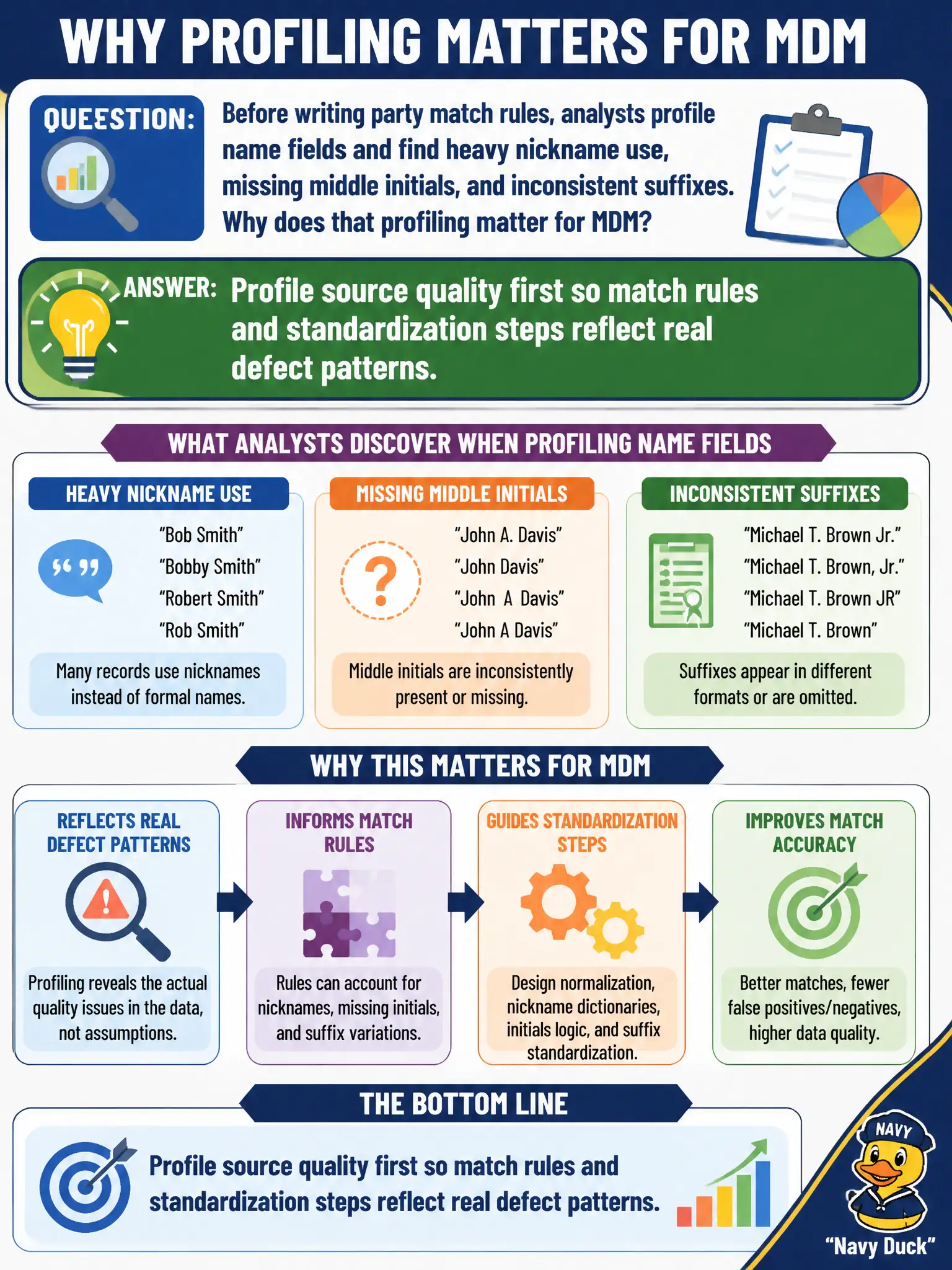
Before writing party match rules, analysts profile name fields and find heavy nickname use, missing middle initials, and inconsistent suffixes. Why does that profiling matter for MDM?
Select an answer to reveal the explanation.
Short Explanation
You do not design a net before you know what fish are in the river. Profiling names shows nicknames, blanks, and messy suffixes so match rules fit reality. Blind rules written in a conference room miss the mess on the ground.
Full Explanation
Profiling name fields before writing party match rules—and finding heavy nickname use, missing middle initials, and inconsistent suffixes—matters because teams should profile source quality first so match rules and standardization steps reflect real defect patterns. Civic name data is messy; rules written in the abstract miss local reality. Claiming profiling is only a DQ report artifact that must not influence MDM design fails; profiling should drive standardization and match strategy. Saying nickname prevalence makes party MDM impossible until all names are legally changed fails as an impractical barrier. Claiming profiling replaces steward review because statistics auto-approve merges fails; profiling informs design, it does not approve identity merges. Exam caveat: profile-then-design is standard MDM method guidance. Operational check: run name profiling, choose nickname dictionaries and suffix normalization, draft rules against observed patterns, and validate with steward samples. Attach profiling evidence to the municipal match-rule design packet for auditability. Keep verification evidence with the municipal runbook so audits can prove the chosen control was applied as designed and that rejected alternatives would have left city services exposed to the failure modes described above.