
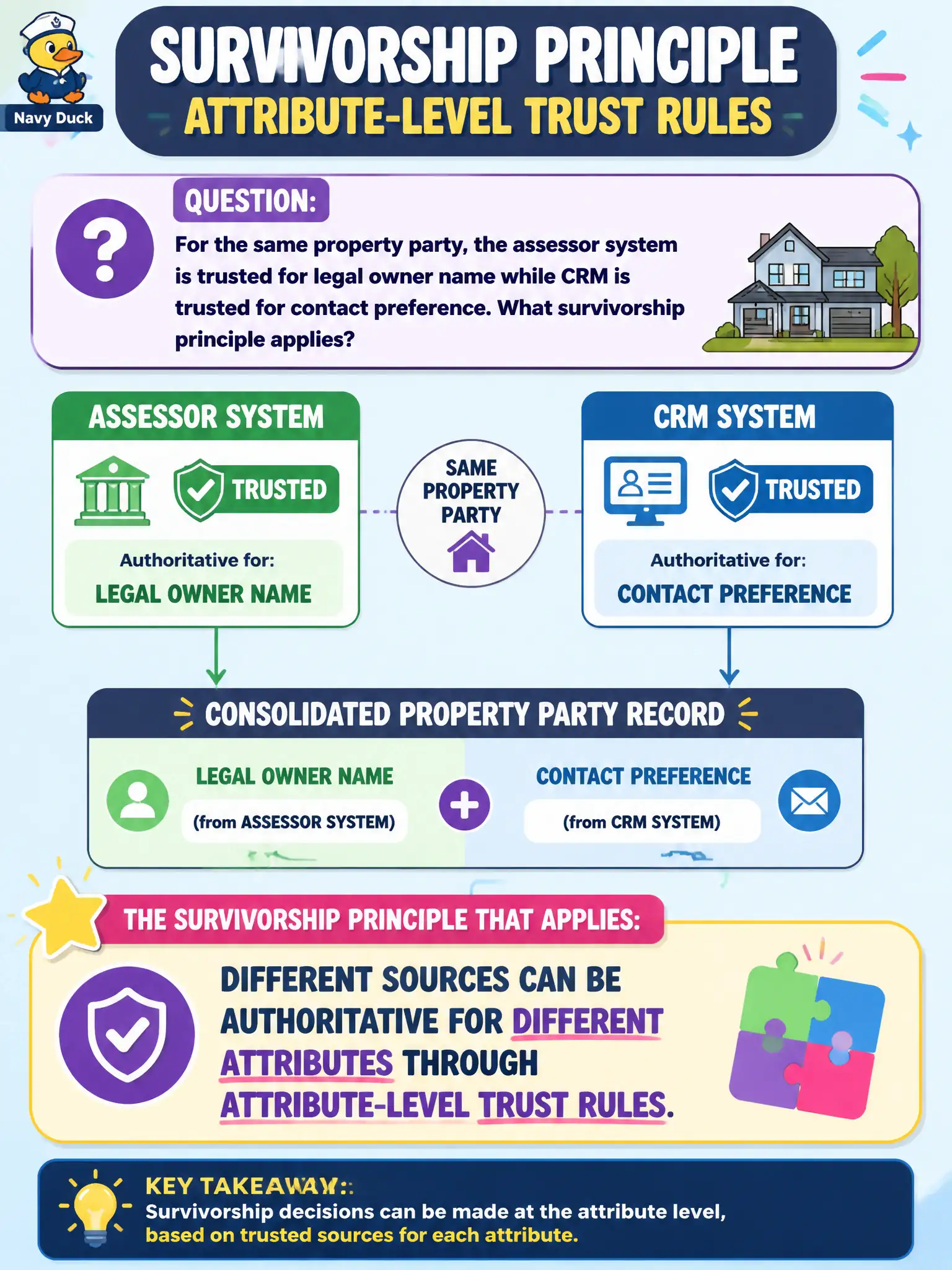
For the same property party, the assessor system is trusted for legal owner name while CRM is trusted for contact preference. What survivorship principle applies?
Select an answer to reveal the explanation.
Short Explanation
The assessor owns the deed name; CRM owns how the person likes to be reached—different jobs, different winners. Survivorship can be attribute-level, not a single system crown for everything. Mix-and-match trust is normal when designed on purpose.
Full Explanation
For the same property party, when the assessor system is trusted for legal owner name while CRM is trusted for contact preference, survivorship should allow different sources to be authoritative for different attributes through attribute-level trust rules. Civic truth is often multi-source by attribute. Requiring one source system to win every attribute or else the golden record is invalid fails unnecessary all-or-nothing thinking. Forcing contact preference to always inherit from the assessor because legal systems “outrank” CRM globally fails by misapplying legal authority to a preference attribute. Forcing legal owner to always inherit from CRM because it is newest fails by preferring freshness over the right authoritative source for legal identity. Exam caveat: attribute-level trust/survivorship is a core MDM design idea. Operational check: document per-attribute source authority for party, test conflicts, and expose lineage so stewards see why owner name and preference came from different systems. Review the trust matrix with assessor and CRM stewards in the municipal MDM design authority. Keep verification evidence with the municipal runbook so audits can prove the chosen control was applied as designed and that rejected alternatives would have left city services exposed to the failure modes described above.