
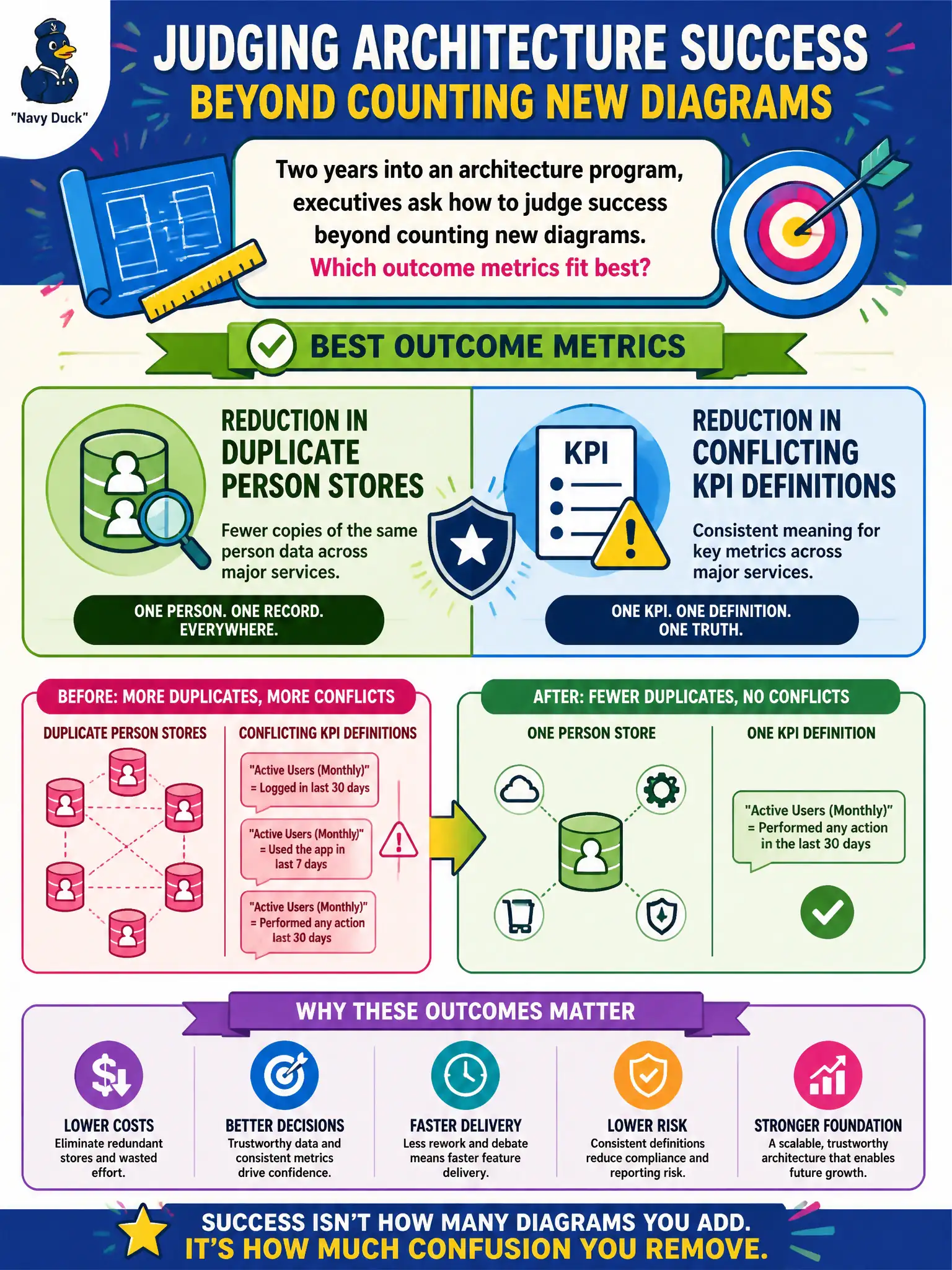
Two years into an architecture program, executives ask how to judge success beyond counting new diagrams. Which outcome metrics fit best?
Select an answer to reveal the explanation.
Short Explanation
Pretty diagrams are not the finish line. Success looks like fewer duplicate person stores and fewer dueling KPIs—real mess cleaned up, not slide volume.
Full Explanation
Two years into an architecture program, executives should judge success with outcome metrics such as reduction in duplicate person stores and conflicting KPI definitions across major municipal services. Those measures reflect information-management results: clearer system-of-record boundaries, consistent semantics, improved interoperability, and less citizen-facing confusion when agencies disagree about the same person or performance number. Counting colorful architecture slides produced per quarter fails by tracking presentation volume instead of estate improvement. Counting unused frameworks purchased regardless of adoption fails by rewarding procurement theater. Counting workshop hours with no service-quality change fails by measuring activity without outcomes. Exam caveat: outcome metrics must be attributable and baselined—claiming fewer duplicates without an inventory method is theater—and architecture value may also include change-failure rate and integration lead time when measured honestly. Operational check: baseline counts of duplicate person stores and conflicting official KPI definitions; remeasure on a fixed cadence with a documented method; tie roadmap funding to movement on those outcomes; and retire vanity activity metrics from executive scorecards used for civic program governance.