
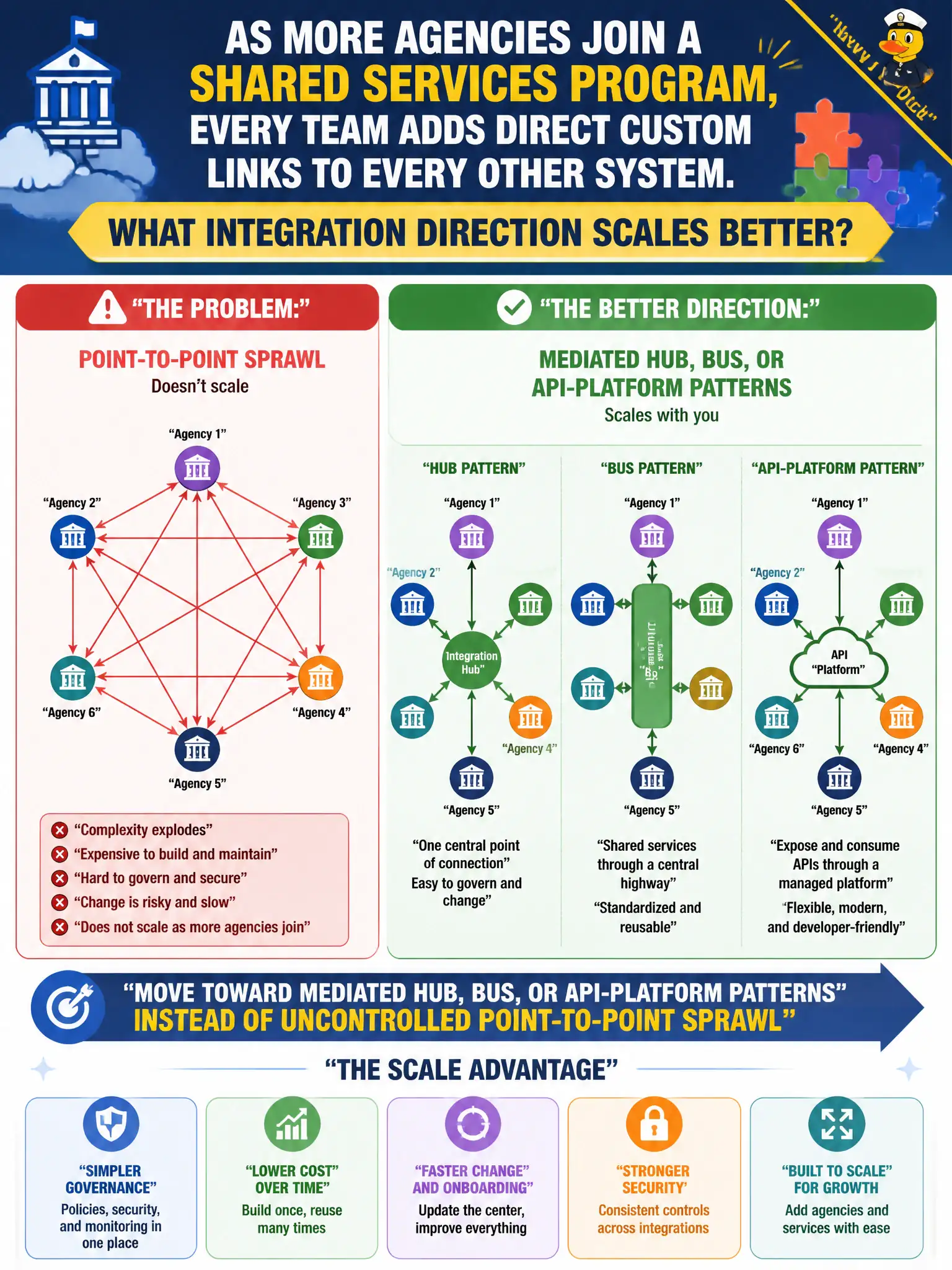
As more agencies join a shared services program, every team adds direct custom links to every other system. What integration direction scales better?
Select an answer to reveal the explanation.
Short Explanation
Every new handshake in a room of twenty people gets ugly fast. Mediated patterns—hubs, buses, API platforms—beat a spaghetti of one-off links when agencies keep joining.
Full Explanation
As agencies join a shared-services program, unrestricted custom links between every pair of systems create an N×N mesh that grows combinatorially and becomes fragile. Architecture should steer toward mediated hub, bus, or API-platform patterns that centralize cross-cutting concerns such as routing, security, transformation, versioning, and observability while still allowing justified exceptions under explicit controls. Continuing unrestricted point-to-point meshes as the permanent standard multiplies brittle couplings with each new agency. Requiring each pair to invent private protocols with no mediation fragments interoperability and multiplies maintenance cost. Banning interoperability so each agency remains isolated forever rejects the shared-services goal and forces citizens to navigate disconnected journeys. Exam caveat: mediation is not mandatory centralization of all business logic; local interfaces may remain, but uncontrolled sprawl without a platform strategy does not scale. Operational check: inventory current point-to-point links, prioritize high-churn pairs for mediation, publish platform interface standards, and require an exception ticket with compensating controls for any new permanent peer-to-peer production link.