
Three agencies must exchange permit status without growing a web of brittle point-to-point feeds. What interoperability architecture move best reduces that sprawl?
Select an answer to reveal the explanation.
Short Explanation
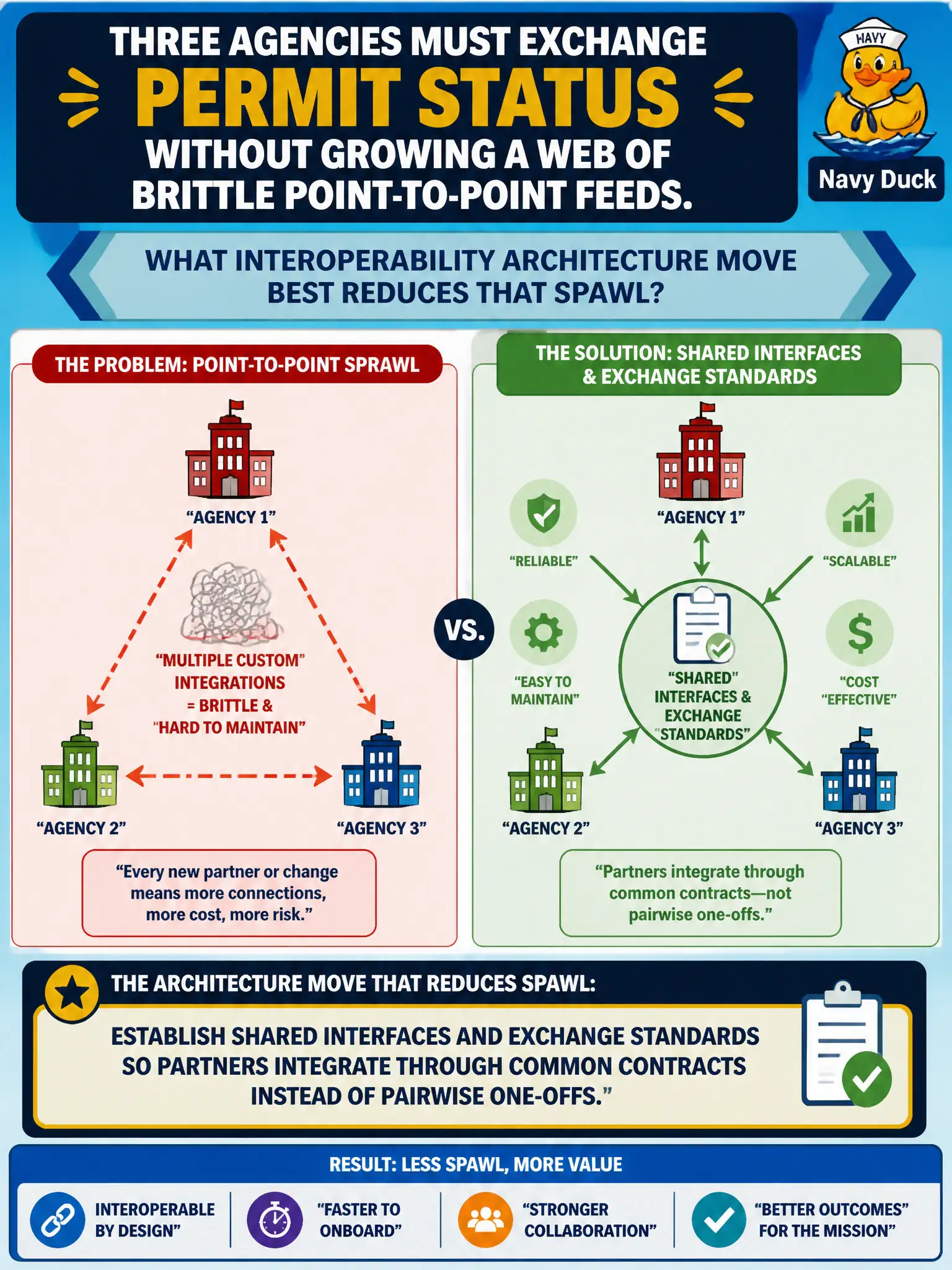
Point-to-point feeds are like every house digging its own private tunnel to every neighbor—soon you have a maze. Shared interfaces and standards are the public road: partners plug into common contracts instead of inventing a new tunnel each time.
Full Explanation
Three agencies exchanging permit status through growing pairwise feeds create brittle interoperability debt. Establishing shared interfaces and exchange standards so partners integrate through common contracts reduces sprawl and onboarding cost. Adding a unique custom file format for every bilateral pair multiplies mapping work. Embedding each agency’s private UI screens into the others’ applications couples presentation instead of data contracts. Duplicating permit tables into every agency’s OLTP without shared contracts creates conflicting copies. Exam focus: shared interface contracts over point-to-point exceptionalism. Caveat: shared standards still need versioning, code lists, and onboarding guides—publishing a vague “API” without schemas recreates ambiguity. Operationally, adopt a versioned permit-status exchange schema and code list, require new agency connections to use it, and inventory legacy pairwise feeds for strangler migration onto the shared contract. Retire at least one pairwise permit feed per quarter onto the shared contract until the brittle mesh is measurably smaller. Shared contracts need a stewarded change calendar; unannounced schema edits recreate the same brittle surprises that pairwise feeds already caused across agencies.