
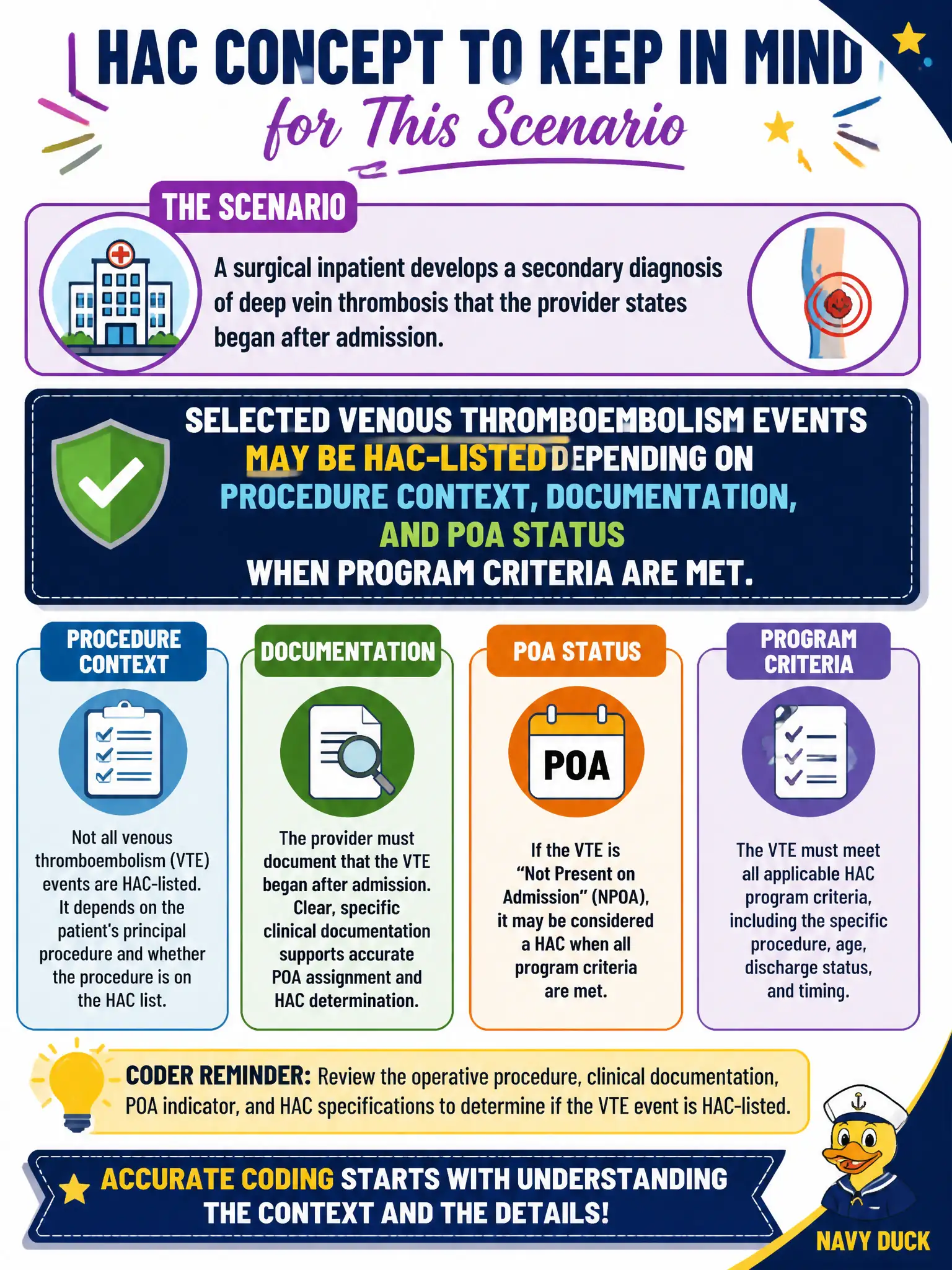
A surgical inpatient develops a secondary diagnosis of deep vein thrombosis that the provider states began after admission. Which HAC-related concept should the coder keep in mind?
Select an answer to reveal the explanation.
Short Explanation
A clot that forms after admission can land in the HAC conversation—especially around certain surgeries. Code the DVT when it is documented, set POA from the timing, and remember prophylaxis orders do not automatically rewrite POA to Y.
Full Explanation
A surgical inpatient at a county facility who develops deep vein thrombosis documented as beginning after admission may implicate HAC-listed venous thromboembolism concepts depending on procedure context, documentation, and POA when program criteria are met. Accurate secondary diagnosis coding with correct POA supports both payment integrity and civic patient-safety reporting. Making all venous thromboses principal diagnoses on surgical stays by default ignores UHDDS principal-diagnosis logic. Claiming DVT is never reportable as a secondary diagnosis deletes a clinically important condition. Forcing POA Y for postoperative DVT solely because prophylaxis was ordered confuses prevention orders with onset timing—prophylaxis does not prove the clot was present on admission. Exam caveat: HAC relevance is criteria-driven; prophylaxis status is not a POA override. Operational check: document onset relative to admission, code the DVT when supported, set POA from timing, review procedure context against HAC definitions with quality, and never omit a validated post-admission VTE solely to protect scores. Sustain civic accountability by pairing correct code assignment with transparent denial, quality, and privacy escalation paths so public reporting and payment integrity move together.