
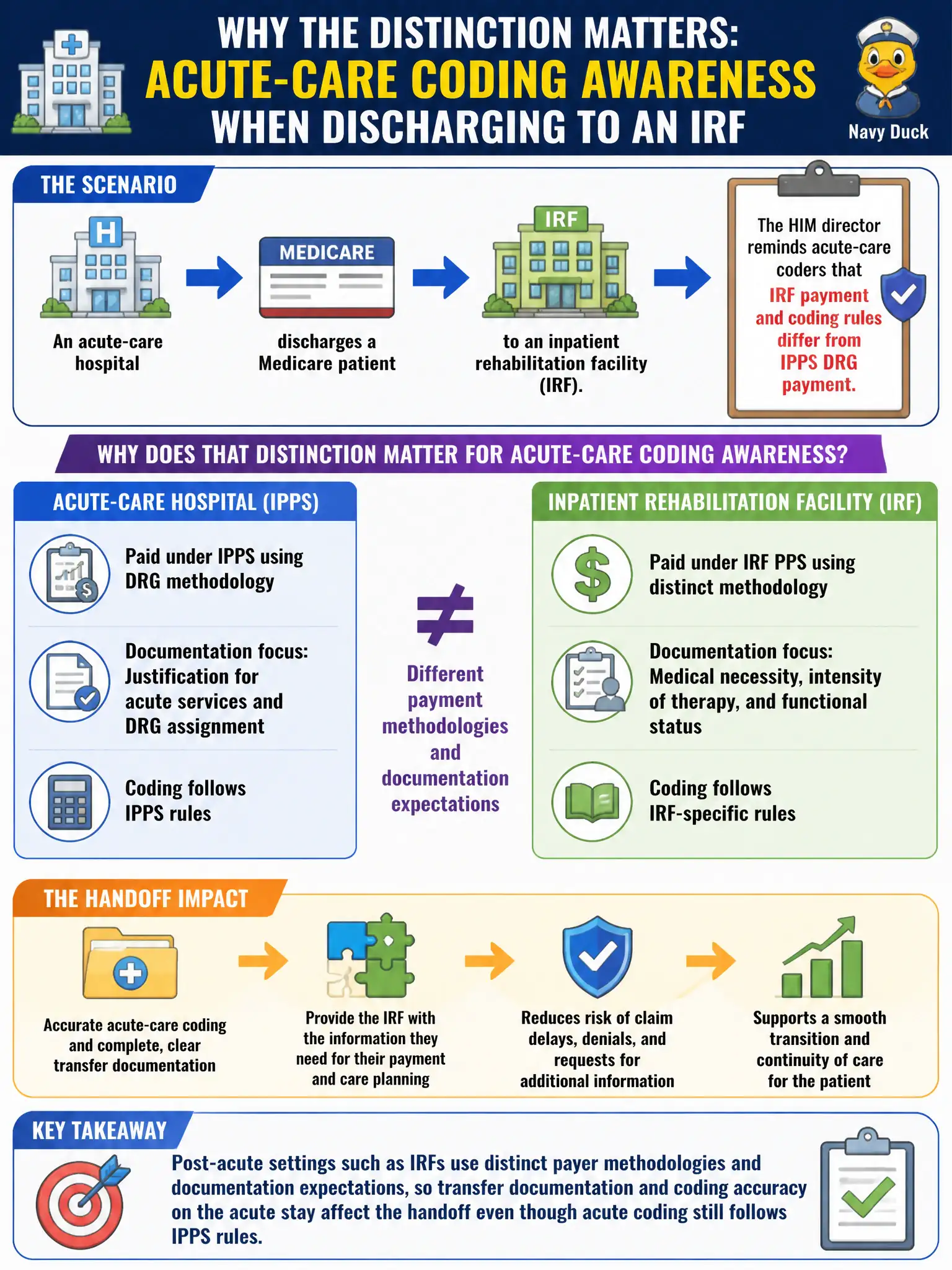
An acute-care hospital discharges a Medicare patient to an inpatient rehabilitation facility (IRF). The HIM director reminds acute-care coders that IRF payment and coding rules differ from IPPS DRG payment. Why does that distinction matter for acute-care coding awareness?
Select an answer to reveal the explanation.
Short Explanation
Leaving the hospital for rehab is like switching toll systems on the same trip. The acute claim still runs under IPPS rules, but IRF has its own payment and documentation world. Clean transfer coding and disposition on the acute side help the next setting—and keep quality and payment stories straight.
Full Explanation
When an acute-care civic hospital discharges a Medicare patient to an inpatient rehabilitation facility, acute-care coding still follows IPPS and Official Guidelines, but coders need awareness that IRF payment and documentation expectations differ from acute DRG payment. Accurate transfer coding, discharge disposition, and diagnoses on the acute stay support a clean handoff even though acute staff do not run the IRF-PAI. Public hospitals coordinate continuum care; muddling setting rules harms both payment integrity and continuity of rehabilitation data. Requiring acute coders to assign IRF-PAI assessment codes on the acute claim confuses post-acute assessment instruments with acute inpatient abstracting. Treating IRF admission as converting the acute stay to outpatient APC payment misstates payment systems—the acute episode remains inpatient under IPPS rules. Omitting discharge disposition because IRF staff will recode the acute episode deletes a required acute data element and invents a nonexistent rewrite of the prior stay. Exam caveat: setting-specific methodologies (IPPS versus IRF) coexist; knowing they differ is not the same as coding another setting's instrument on your claim. Operational check: verify discharge disposition to IRF, ensure acute diagnoses and procedures reflect the acute stay, and coordinate transfer documentation with case management without applying IRF-PAI codes to the acute UB. Sustain civic accountability by pairing correct code assignment with transparent denial, quality, and privacy escalation paths so public reporting and payment integrity move together.