
When is a yes/no provider query format most appropriately used?
Select an answer to reveal the explanation.
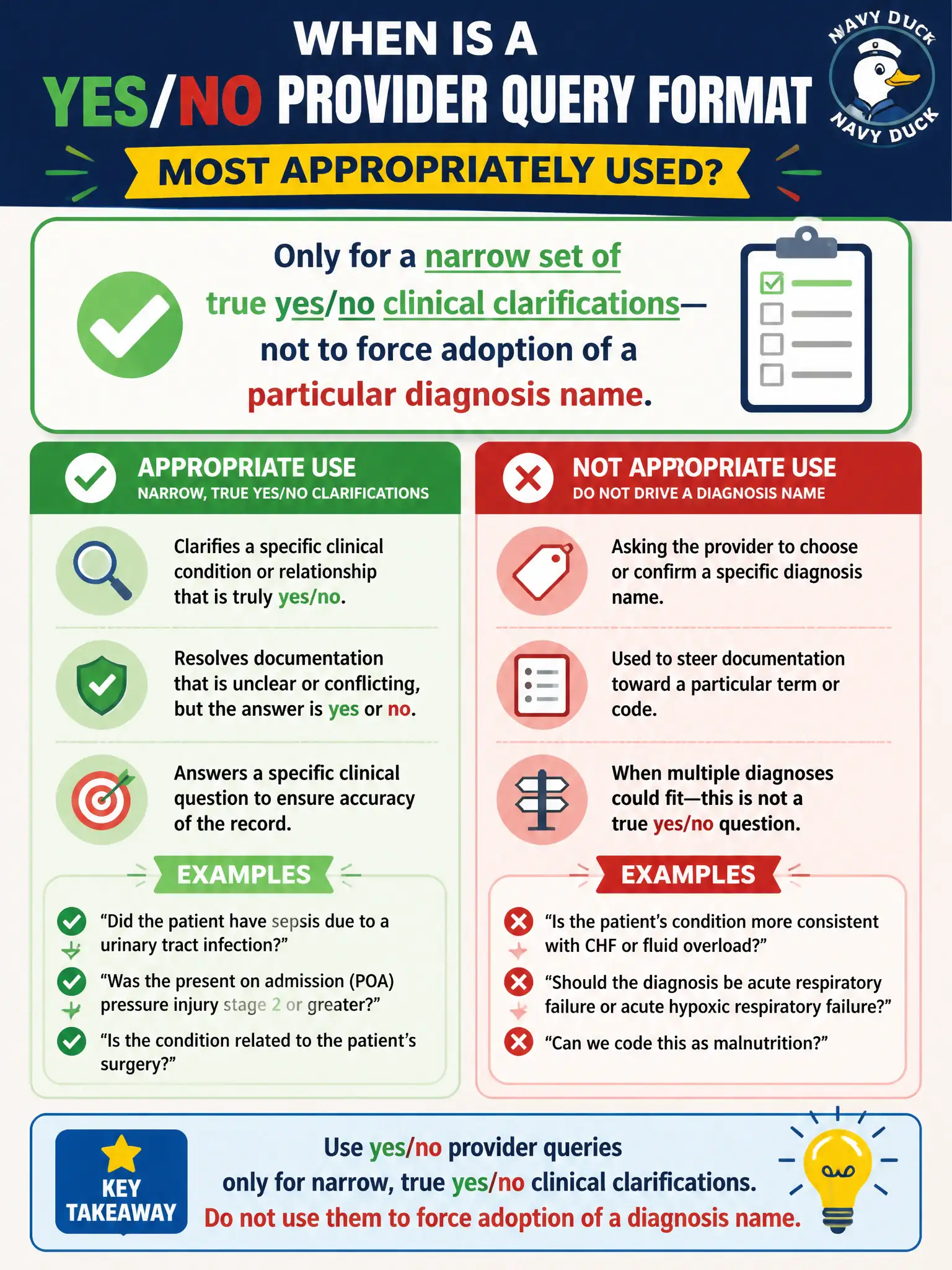
Short Explanation
Yes/no queries are specialty tools, not the everyday hammer. Use them for narrow clarifications that truly swing yes or no—not to shove a diagnosis name onto the chart. Wrong tool equals leading.
Full Explanation
Yes/no provider query formats are most appropriately used only for a narrow set of true yes/no clinical clarifications—not to force adoption of a particular diagnosis name. Used correctly, they can confirm a discrete fact already framed by indicators; used incorrectly, they become leading shortcuts that manufacture documentation. Deploying yes/no whenever the coder wants a specific new diagnosis name confirmed quickly is a classic misuse that pressures the provider. Making yes/no the default format for every specificity or etiology question oversimplifies complex differentials that need balanced multiple-choice or open designs. Using yes/no whenever adding an MCC would improve payment openly ties the format to reimbursement goals and is noncompliant. Exam caveat: if the contested issue is whether a condition exists at all, asserting it in a yes/no stem can still be leading—design carefully and prefer nonleading structures when existence is disputed. Operational check: reserve yes/no for genuinely binary clarifications in the civic chart; otherwise use multiple-choice with clinically reasonable alternatives and an uncertainty option. This discipline protects patients, supports accurate public reporting for municipal hospitals, and keeps the coded abstract defensible when auditors compare codes to the authenticated record.