
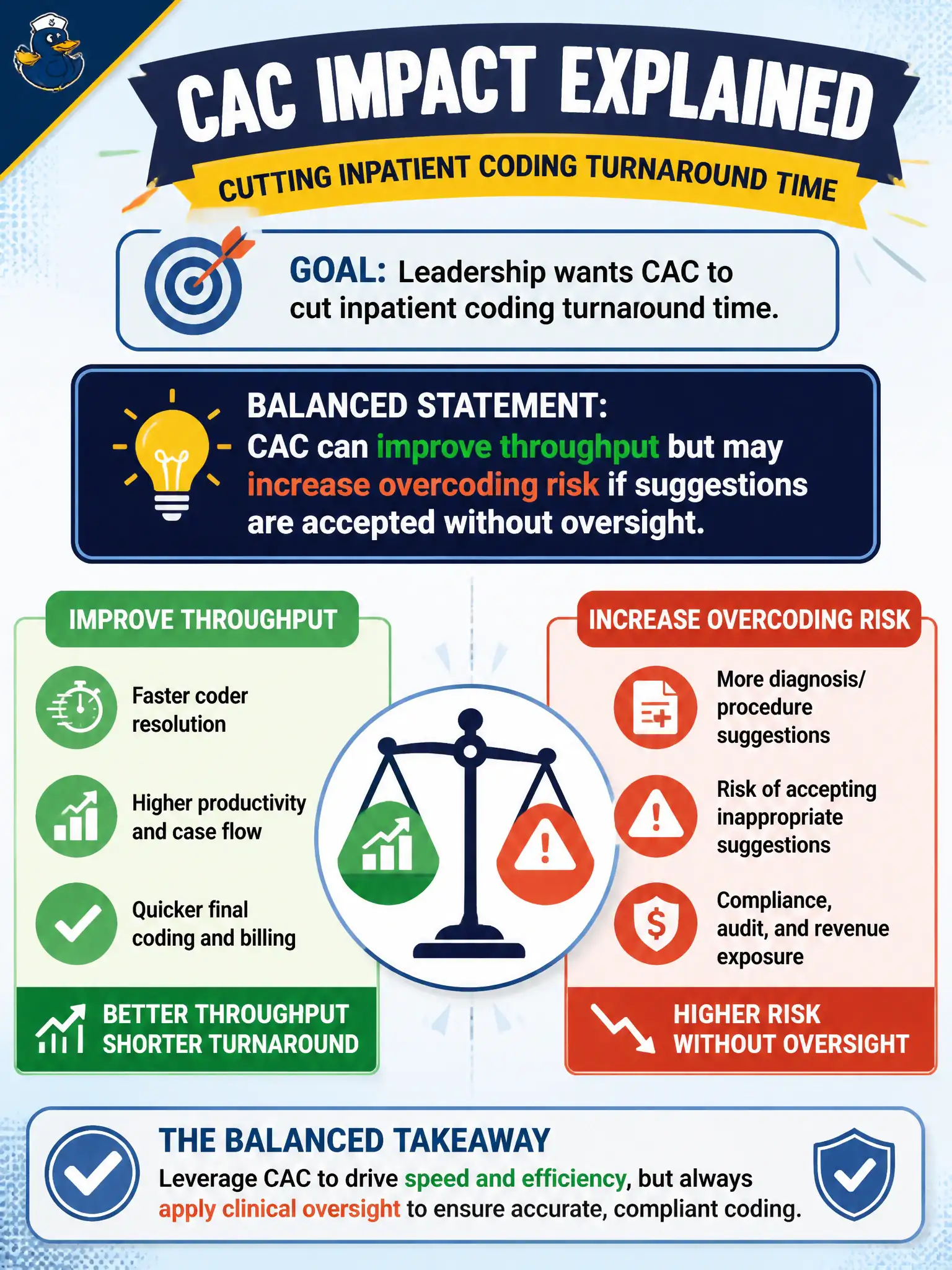
Leadership wants CAC to cut inpatient coding turnaround time. Which balanced statement reflects CAC’s typical impact?
Select an answer to reveal the explanation.
Short Explanation
CAC can help you move charts faster—like a power drill—but if nobody checks the work, you can also drill right through the compliance wall. Speed helps; unsupervised acceptance hurts.
Full Explanation
Leadership wanting CAC to cut inpatient coding turnaround at a county hospital should hear a balanced statement: CAC can improve throughput but may increase overcoding risk if suggestions are accepted without oversight. Civic efficiency goals must stay paired with integrity controls. Claiming CAC always reduces compliance risk to zero while doubling payment for every MS-DRG is marketing fantasy. Asserting CAC eliminates HIM staffing because NLP fully replaces certified coders ignores validation, queries, and ethical accountability. Saying CAC only slows coding and never improves productivity denies documented throughput benefits when governed well. Exam caveat: speed without review is a compliance hazard; review without dismissing productivity gains is the balanced CCS view. Operational check: measure turnaround and accuracy together, require coder validation of CAC output, audit overcoding patterns post-CAC, and staff to the review workload CAC creates rather than blindly cutting FTEs. Treat encoders, groupers, and CAC as assistants inside civic HIM: useful for speed, never a substitute for documentation review, Official Guidelines, or PHI safeguards. Re-read the authenticated record before finalizing whenever tools, payers, or dashboards push a result the documentation does not support.