
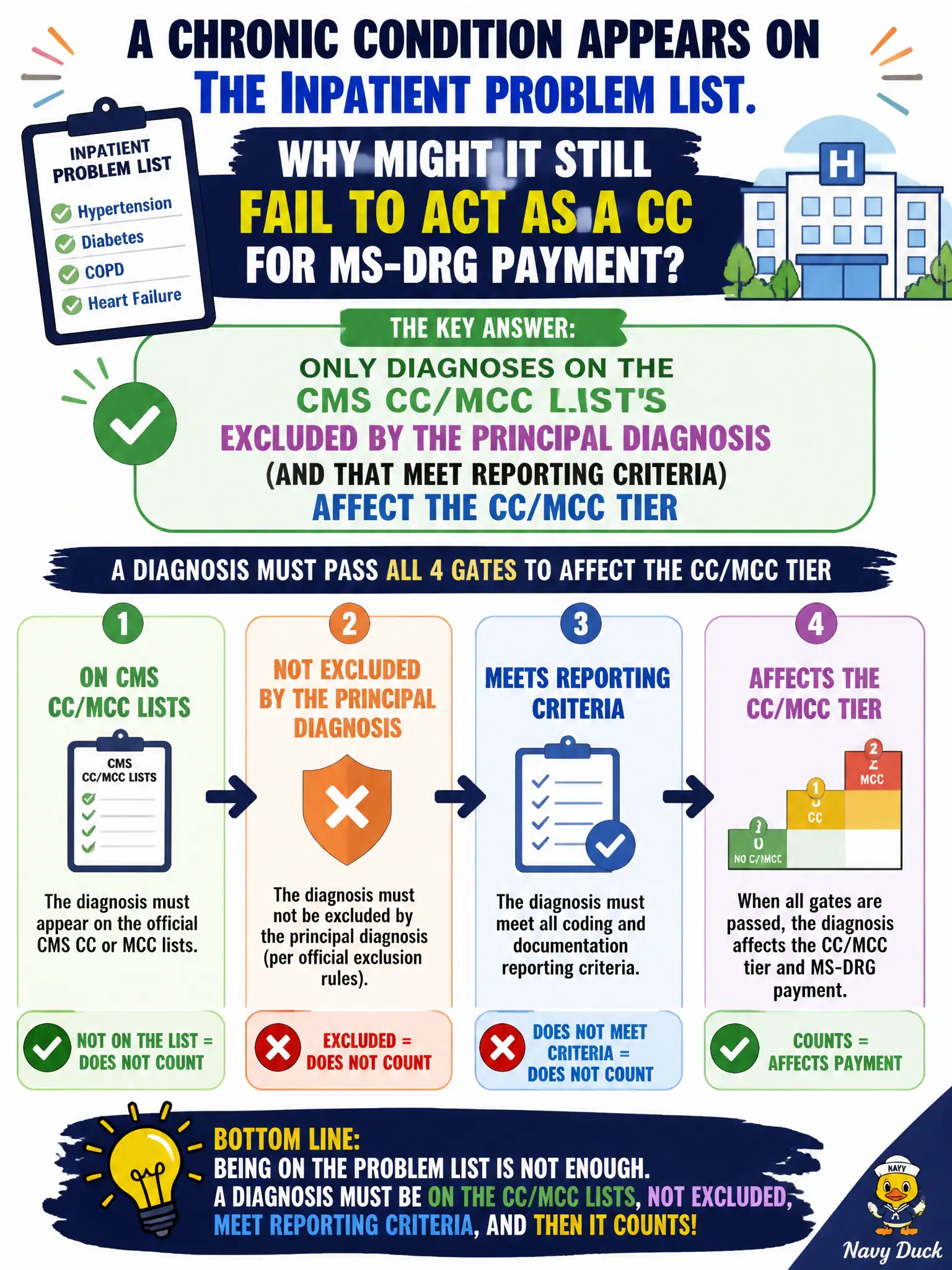
A chronic condition appears on the inpatient problem list. Why might it still fail to act as a CC for MS-DRG payment?
Select an answer to reveal the explanation.
Short Explanation
Not every problem-list entry is a paying CC. CMS has actual CC and MCC lists, plus exclusions tied to the principal diagnosis. If it is not on the list—or it is excluded—it will not move the DRG tier.
Full Explanation
A chronic condition on the inpatient problem list might still fail to act as a CC for MS-DRG payment because only diagnoses on the CMS CC/MCC lists that are not excluded by the principal diagnosis—and that meet secondary reporting criteria—affect the CC/MCC tier. Civic coding quality requires list literacy, not problem-list inflation. Problem-list conditions do not always group as MCCs by default. Any comorbidity does not automatically increase relative weight regardless of CMS lists. CC status is not assigned solely by length of stay. Exam caveat: CC/MCC impact = CMS list + exclusion logic + reporting criteria; problem-list presence is insufficient. Operational check: for each secondary on a public hospital abstract, verify reporting criteria for the stay, check CC/MCC list and exclusions relative to principal, and avoid counting historical problem-list entries that were not addressed. Use Grouper output education to show clinicians why some listed chronic conditions do not change payment tier. In municipal and county facility practice, record the rationale for the chosen coding path and the rejected alternatives in the abstract notes so auditors and future coders understand the clinical and compliance basis. Re-check the decision if new authenticated documentation arrives before final bill drop, and escalate persistent documentation gaps to CDI or compliance rather than normalizing unsupported shortcuts that would distort civic claims, quality metrics, or case-mix reporting.