
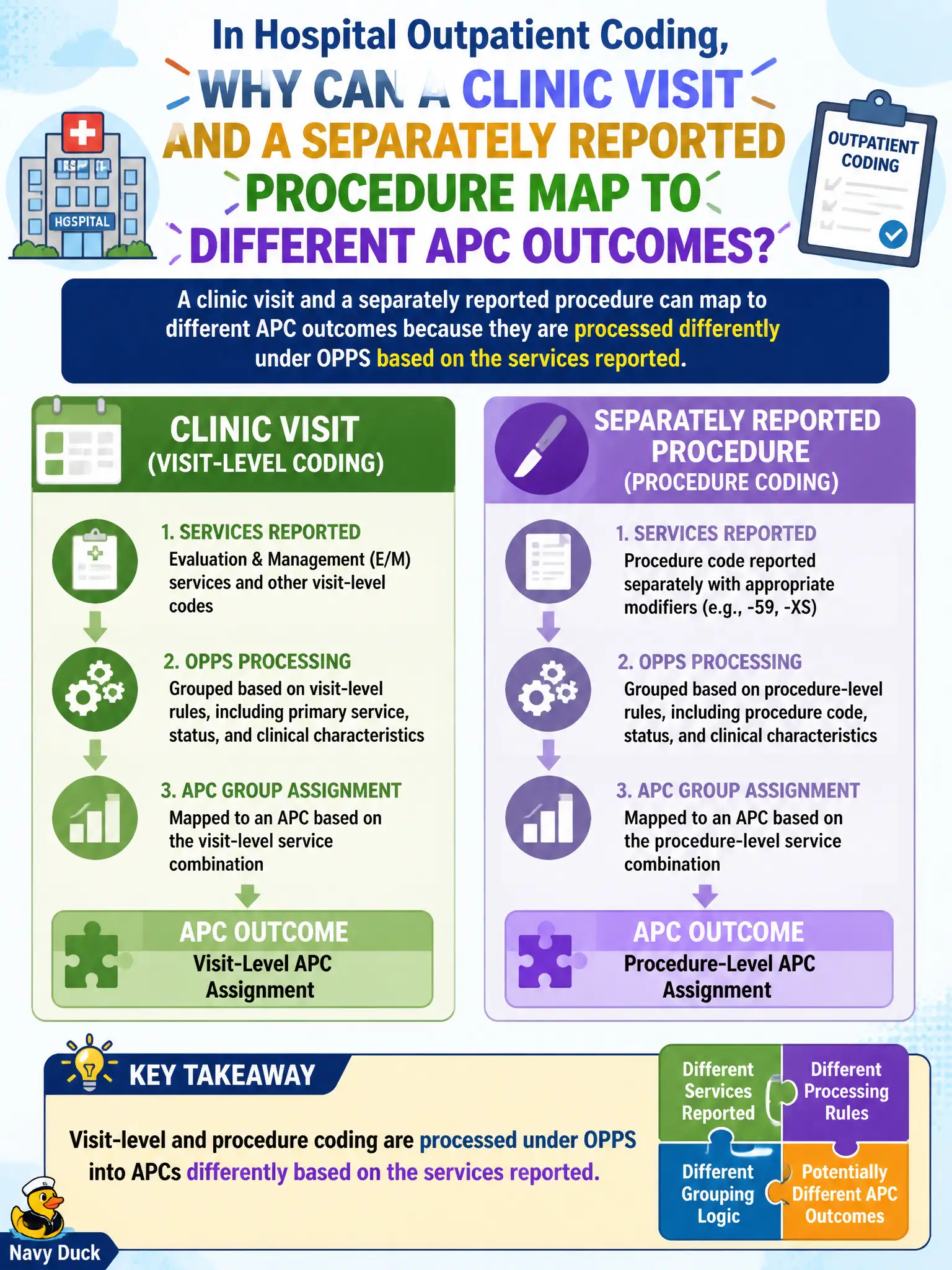
In hospital outpatient coding, why can a clinic visit and a separately reported procedure map to different APC outcomes?
Select an answer to reveal the explanation.
Short Explanation
A clinic visit and a procedure aren’t stamped with the same APC cookie cutter. What you code—visit complexity versus the procedure itself—steers different OPPS buckets. Same day doesn’t mean same payment logic.
Full Explanation
In hospital outpatient coding, a clinic visit and a separately reported procedure can map to different APC outcomes because visit-level and procedure coding are processed under OPPS into APCs differently based on the services reported, status indicators, and packaging relationships. Civic outpatient departments must report both accurately so public claims reflect what was furnished. Clinic visits do not use MS-DRG assignment; MS-DRGs are inpatient constructs. Procedures do receive APC assignment in the hospital outpatient setting when separately payable or otherwise treated under OPPS—they are central to outpatient facility payment. APC outcomes are not identical for every HCPCS code billed on the same day; packaging and status indicators create service-specific results. Exam caveat: distinguish OPPS APC behavior for visits versus procedures from inpatient DRG logic. Operational check: for a county hospital clinic day with a procedure, verify visit and procedure coding, review expected packaging or separate payment, and educate departments that same-day multi-service claims will not yield identical APC treatment for every line. Reconcile denials against status-indicator expectations before assuming every outpatient line pays separately.