
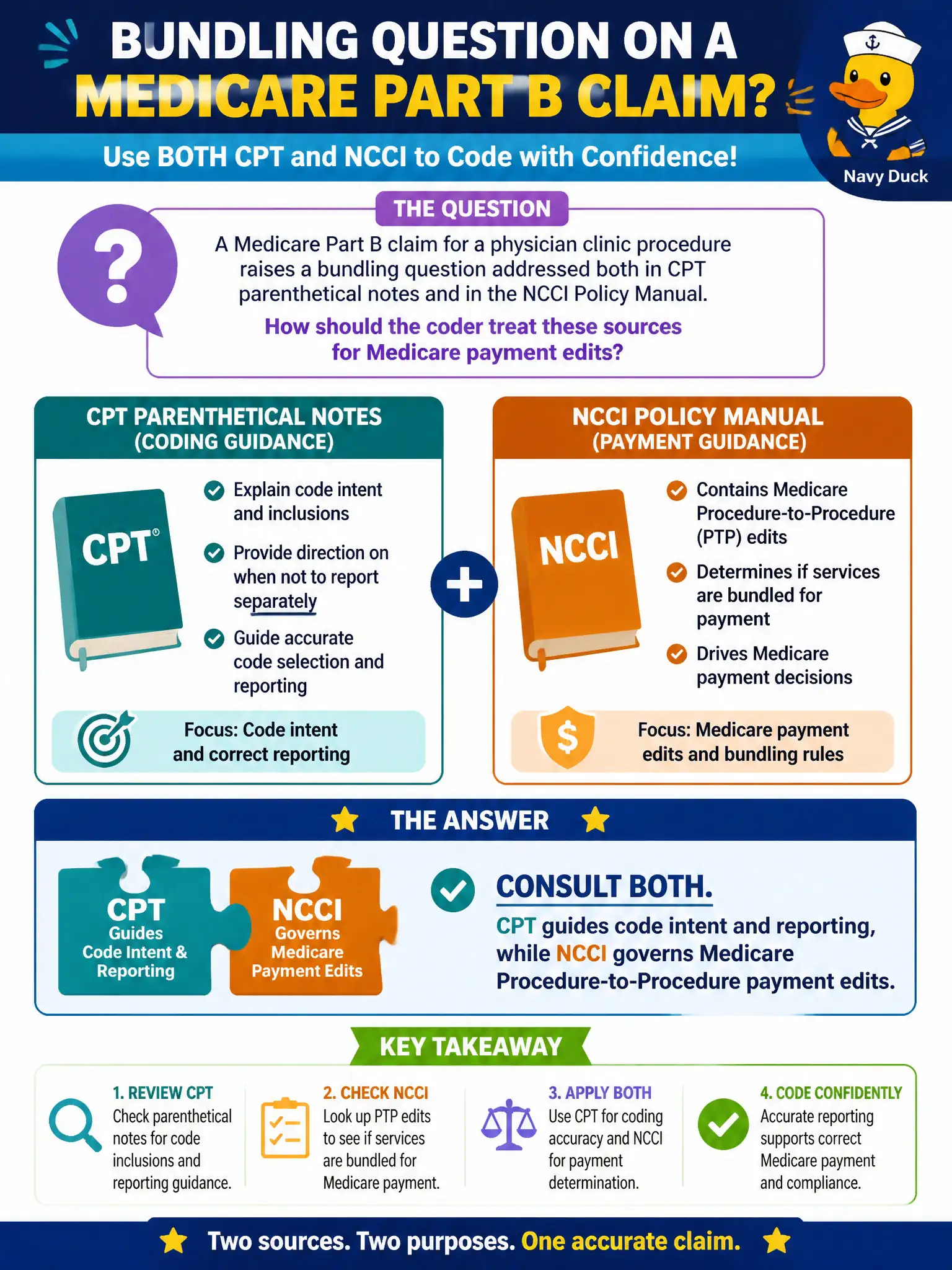
A Medicare Part B claim for a physician clinic procedure raises a bundling question addressed both in CPT parenthetical notes and in the NCCI Policy Manual. How should the coder treat these sources for Medicare payment edits?
Select an answer to reveal the explanation.
Short Explanation
Think of CPT as the dictionary and NCCI as Medicare’s traffic rules. You need the dictionary to pick the right code, and you need NCCI to know which code pairs Medicare will pay together. Using only one leaves you half-blind.
Full Explanation
CPT guidelines and parenthetical instructions establish proper code selection and reporting relationships. For Medicare Part B professional claims, the NCCI Policy Manual and PTP edits govern whether paired services are separately payable under Medicare payment edits. When a physician clinic procedure raises a bundling question addressed in both CPT parentheticals and the NCCI Policy Manual, the coder consults both: CPT for code intent/reporting integrity and NCCI for Medicare PTP payment-edit compliance. Using only CPT parentheticals and ignoring NCCI because AMA materials alone control Medicare payment fails—Medicare payment edits are an NCCI domain. Applying NCCI exclusively and never consulting CPT when an edit exists fails because code selection still requires CPT literacy. Deferring to Medicaid state fee schedules when the patient is traditional Medicare Part B fails by applying the wrong payer’s sources. Exam caveat: commercial plans may mirror NCCI or publish different edits—outside Medicare, still check plan-specific policy after CPT/NCCI literacy. Operational check: read CPT parentheticals for reporting intent, check NCCI Policy Manual/PTP for the DOS, apply allowed modifiers only with support, and record both citations on the civic Medicare Part B coding worksheet.