
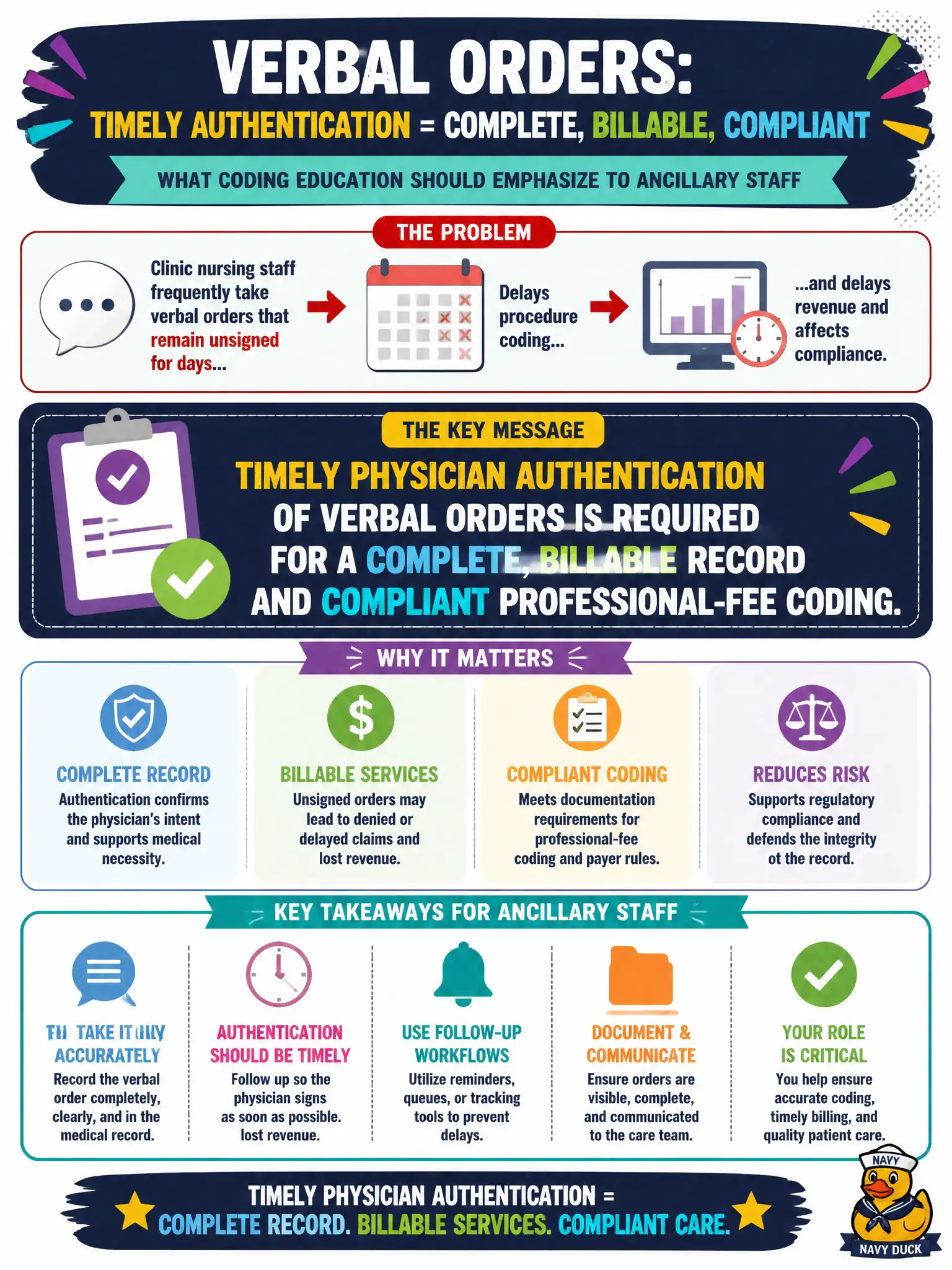
Clinic nursing staff frequently take verbal orders that remain unsigned for days, delaying procedure coding. What should coding education emphasize to ancillary staff?
Select an answer to reveal the explanation.
Short Explanation
A verbal order is like a voicemail—useful, but someone still has to own it in writing. If the physician never authenticates, coding and billing sit on shaky ground. Teach nursing why the signature clock matters for clean claims.
Full Explanation
Verbal orders are a common clinic reality, but they require timely physician authentication to produce a complete, billable record. Coding education for ancillary staff in a civic outpatient practice should emphasize that unsigned verbal orders leave professional-fee procedure coding on incomplete documentation and can delay compliant claim submission. Authentication closes the order loop so CPT/ICD assignment rests on an authenticated provider order rather than an orphaned nursing entry.
Asserting that verbal orders never need authentication if entered in the EHR fails by concept because electronic entry does not erase authentication requirements. Billing unsigned verbal orders under the nurse’s NPI until the physician signs fails because nursing entry does not substitute for the ordering/performing provider construct required for professional billing. Inventing order dates to avoid delays fails because falsifying documentation is a compliance violation, not a productivity technique.
Exam caveat: state law, payer rules, and organizational policy set authentication timeframes; CCS-P testing focuses on the principle that verbal orders must be authenticated for a complete record supporting coding. Operational check: teach nursing and front-line staff the authentication deadline, place unsigned verbal orders on a work queue visible to providers, and withhold final procedure coding/billing until authentication is present per policy.