
A school district runs EIGRP over DMVPN Phase 3 and must keep spoke routes usable without classic hub split-horizon or next-hop problems. Which design consideration is most accurate?
Select an answer to reveal the explanation.
Short Explanation
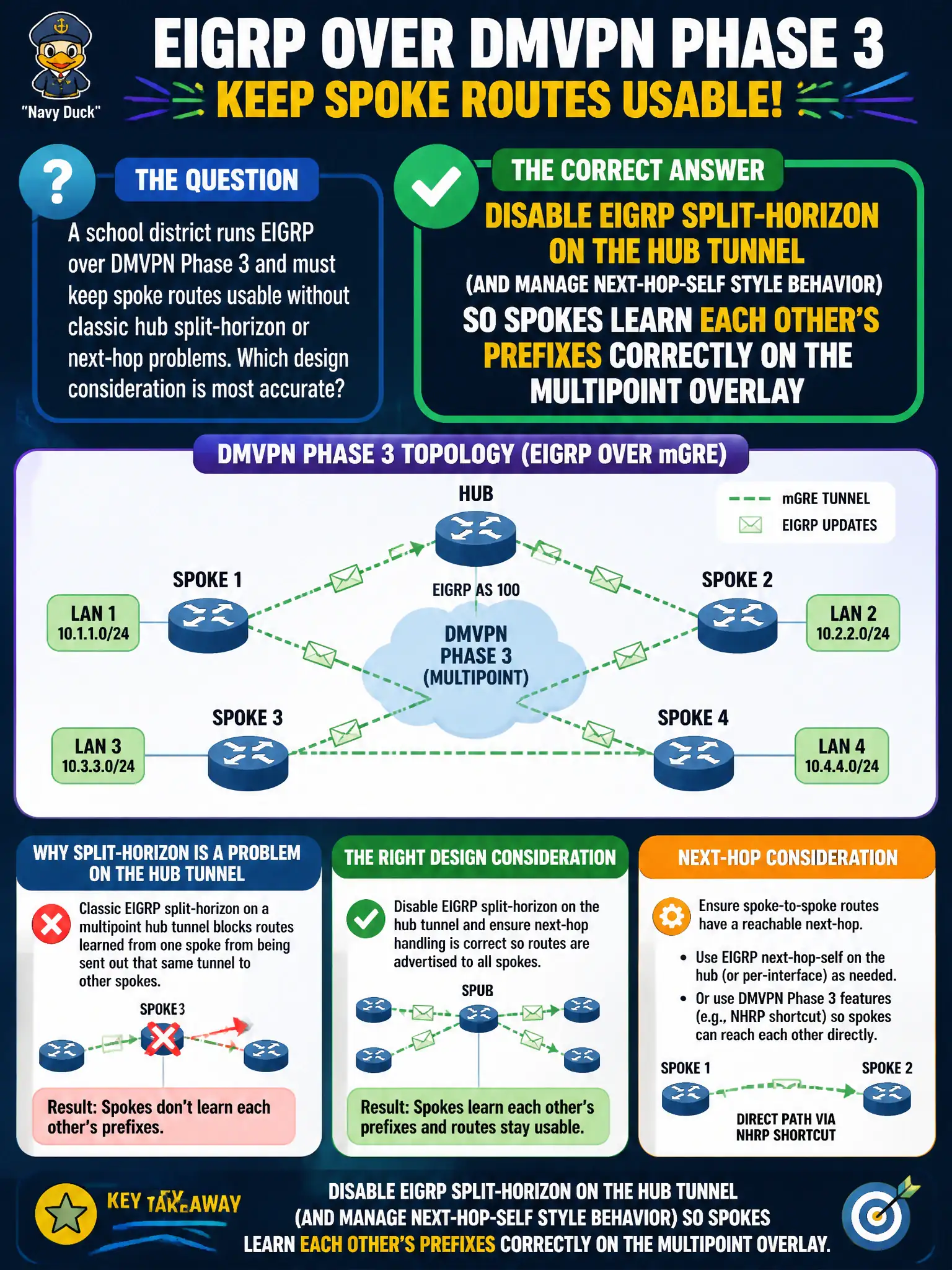
EIGRP on a multipoint hub is picky: split horizon will hide spoke routes from other spokes like a teacher who never repeats announcements. Disable split horizon on the hub tunnel (and get next-hop right) so Phase 3 routing matches the shortcuts. Static-only is not required.
Full Explanation
On DMVPN hub tunnels, EIGRP split horizon can prevent the hub from advertising one spoke’s prefixes to other spokes on the same multipoint interface. A school district running EIGRP over Phase 3 must disable split horizon on the hub tunnel—and manage next-hop behavior appropriately—so spokes learn remote spoke networks correctly on the multipoint overlay.
EIGRP can run on mGRE interfaces; static-only is not required. Leaving split horizon enabled and disabling NHRP fights both routing advertisement and the DMVPN shortcut model. Advertising default only from spokes toward the hub so the hub never needs next-hop fixups inverts typical hub summarization patterns and does not fix spoke-to-spoke learning.
Exam caveat: hub EIGRP on mGRE needs split-horizon attention—this is a classic DMVPN routing design point.
Operational check: disable split horizon on the hub tunnel, verify spokes learn each other’s summaries as intended, confirm next-hop reachability for Phase 3 shortcuts, and avoid disabling NHRP as a “fix.” For civic operations, record the chosen control and the rejected alternatives in the change record so future on-call engineers understand which failure modes were avoided for citizen-facing services.