
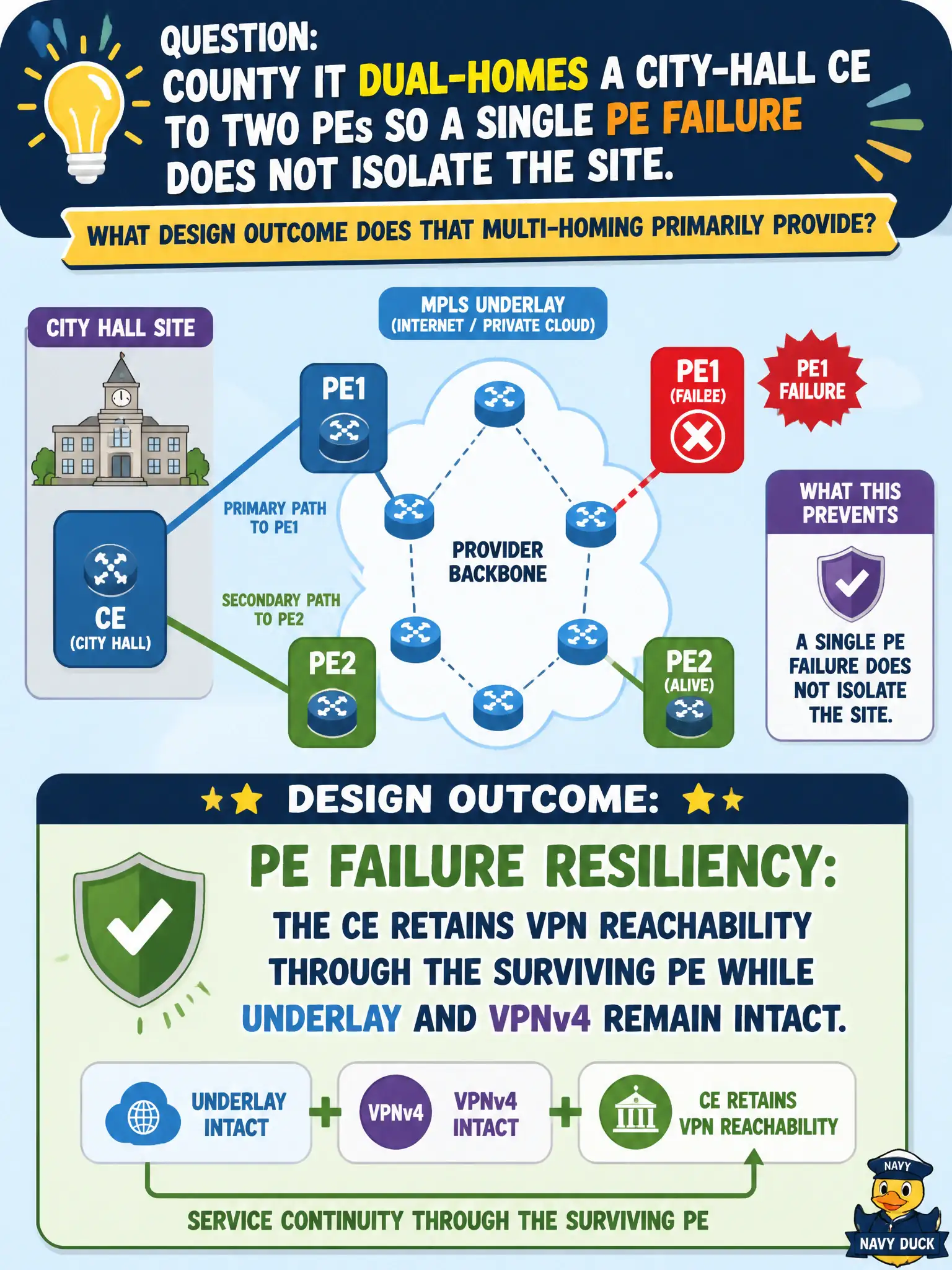
County IT dual-homes a city-hall CE to two PEs so a single PE failure does not isolate the site. What design outcome does that multi-homing primarily provide?
Select an answer to reveal the explanation.
Short Explanation
Two PE docks for one city-hall CE means if one loading bay burns down, the other still ships. That is PE resiliency — not a free pass to skip RTs or LDP. Keep both PE-CE routing sessions healthy and let the CE prefer or fail over cleanly.
Full Explanation
Multi-homing a city-hall CE to two PEs provides PE failure resiliency: if one PE or attachment fails, the CE retains VPN reachability through the surviving PE while underlay LSPs and VPNv4 on the alternate path remain intact. That edge redundancy is the primary design outcome county IT seeks for dual-homed civic sites.
Automatic extranet leaking between every VRF on both PEs without RT configuration is not what dual-homing provides. Elimination of LDP on both PEs because dual CE links “replace” transport labels is false. Converting the CE into a P router that label-switches core traffic during outages misunderstands CE versus P roles.
Exam caveat: dual-homing is edge resiliency; it still needs sound PE-CE routing, RT policy, and underlay LSPs on both PEs.
Operational check: dual-home city hall with routing that fails over cleanly, fail one PE in a window, confirm VPN continuity via the survivor, and watch for asymmetric black holes during convergence. For civic operations, record the chosen control and the rejected alternatives in the change record so future on-call engineers understand which failure modes were avoided for citizen-facing services. Re-validate after the next platform or policy change.