
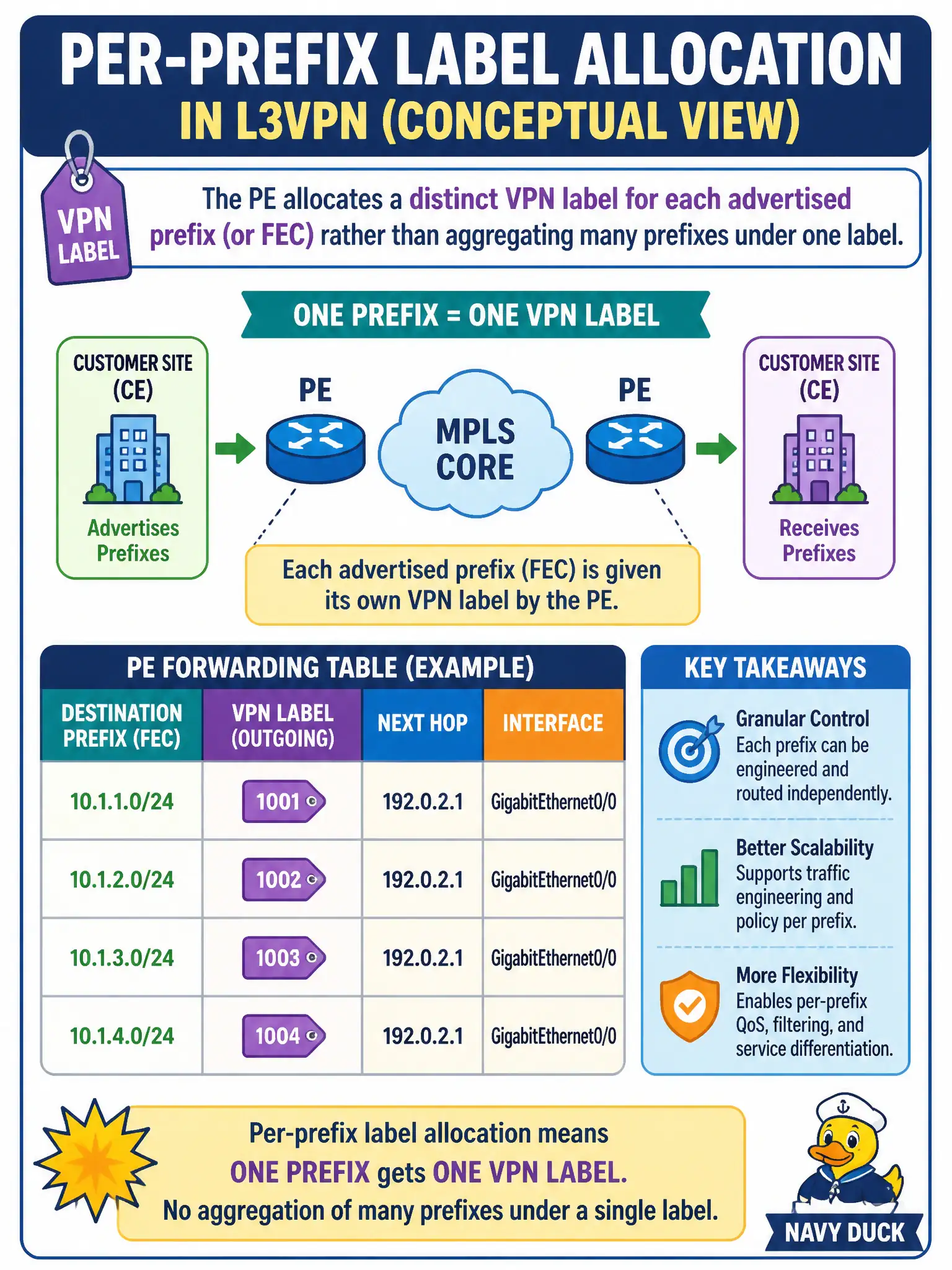
A building-permits desk is reading a PE forwarding table while troubleshooting an L3VPN and must interpret how VPN labels were assigned. At a conceptual level, what does per-prefix label allocation mean?
Select an answer to reveal the explanation.
Short Explanation
Per-prefix labeling is like giving every package its own sticker instead of one sticker for the whole truckload. More granularity in the forwarding table, more labels to track when you troubleshoot. Knowing the allocation mode tells you why CEF shows many VPN labels or just a few.
Full Explanation
Label allocation mode shapes how a building-permits desk interprets PE forwarding tables during L3VPN troubleshooting. Per-prefix (per-FEC) allocation assigns a distinct VPN label to each advertised prefix rather than aggregating many prefixes under one label, which increases granularity and changes what CEF displays when prefixes are added or withdrawn.
One transport label shared by the entire MPLS core regardless of destination PE confuses underlay transport reachability with per-prefix VPN allocation. Claiming each VRF receives exactly one unchanging label describes a different aggregate/per-VRF style, not per-prefix. Labels are not allocated only on P routers with PE CEF showing unlabeled VRF lookups only—PEs impose and dispose VPN labels.
Exam caveat: know whether the platform uses per-prefix versus per-VRF (or other) allocation before reading label counts as faults.
Operational check: identify allocation mode on the PE, correlate CEF VPN labels to prefixes, and explain permits-desk outputs using that mode rather than assuming a bug. For civic operations, record the chosen control and the rejected alternatives in the change record so future on-call engineers understand which failure modes were avoided for citizen-facing services.