
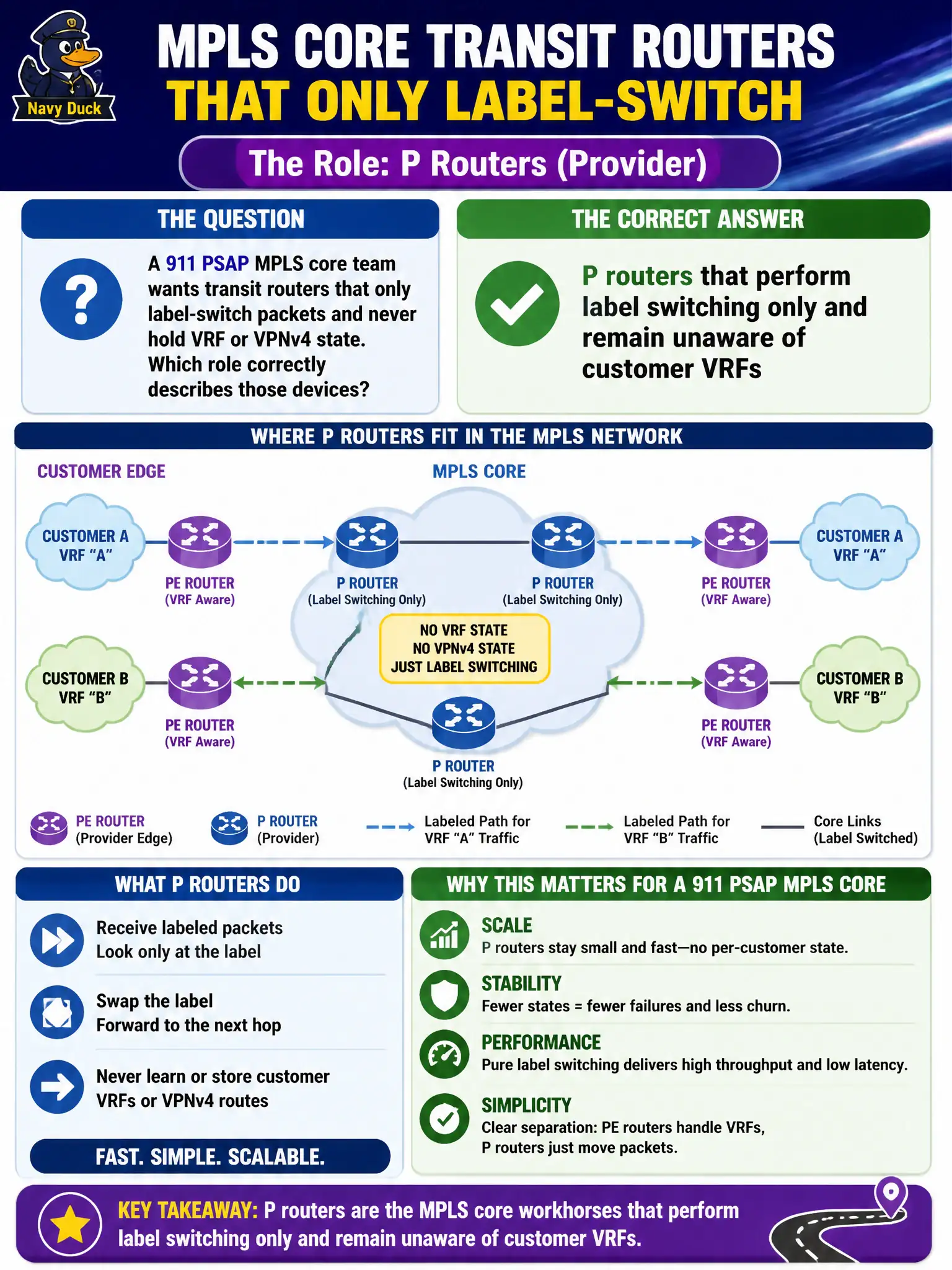
A 911 PSAP MPLS core team wants transit routers that only label-switch packets and never hold VRF or VPNv4 state. Which role correctly describes those devices?
Select an answer to reveal the explanation.
Short Explanation
P routers are the highway trucks that only care about the shipping label on the box — not what’s inside the VRF crate. PE routers are the loading docks that unpack customer VRFs. Keeping 911 core Ps VRF-free keeps the middle simple and fast.
Full Explanation
In MPLS L3VPN, P (provider) routers forward based on the outer transport label and do not store VRF or VPNv4 customer state. A 911 PSAP core team that wants transit routers which only label-switch is describing P routers: they remain unaware of customer VRFs, which keeps the middle of the network simple and scalable for emergency traffic.
PE routers terminate CE attachments and maintain per-VRF tables—that is the edge role, not the VRF-free core. Route reflectors that import extranet RTs are control-plane BGP functions, not the definition of label-only transit. CE routers run the customer IGP and sit outside the provider core; they are not P devices.
Exam caveat: P versus PE role separation is foundational—if a device holds VRFs, it is acting as a PE (or similar edge), not a pure P.
Operational check: confirm candidate core routers have LDP/IGP label switching without VRF definitions, verify VPNv4 and VRFs exist only on PEs, and ensure PSAP transit paths do not require P routers to store customer routes. For civic operations, record the chosen control and the rejected alternatives in the change record so future on-call engineers understand which failure modes were avoided for citizen-facing services.