
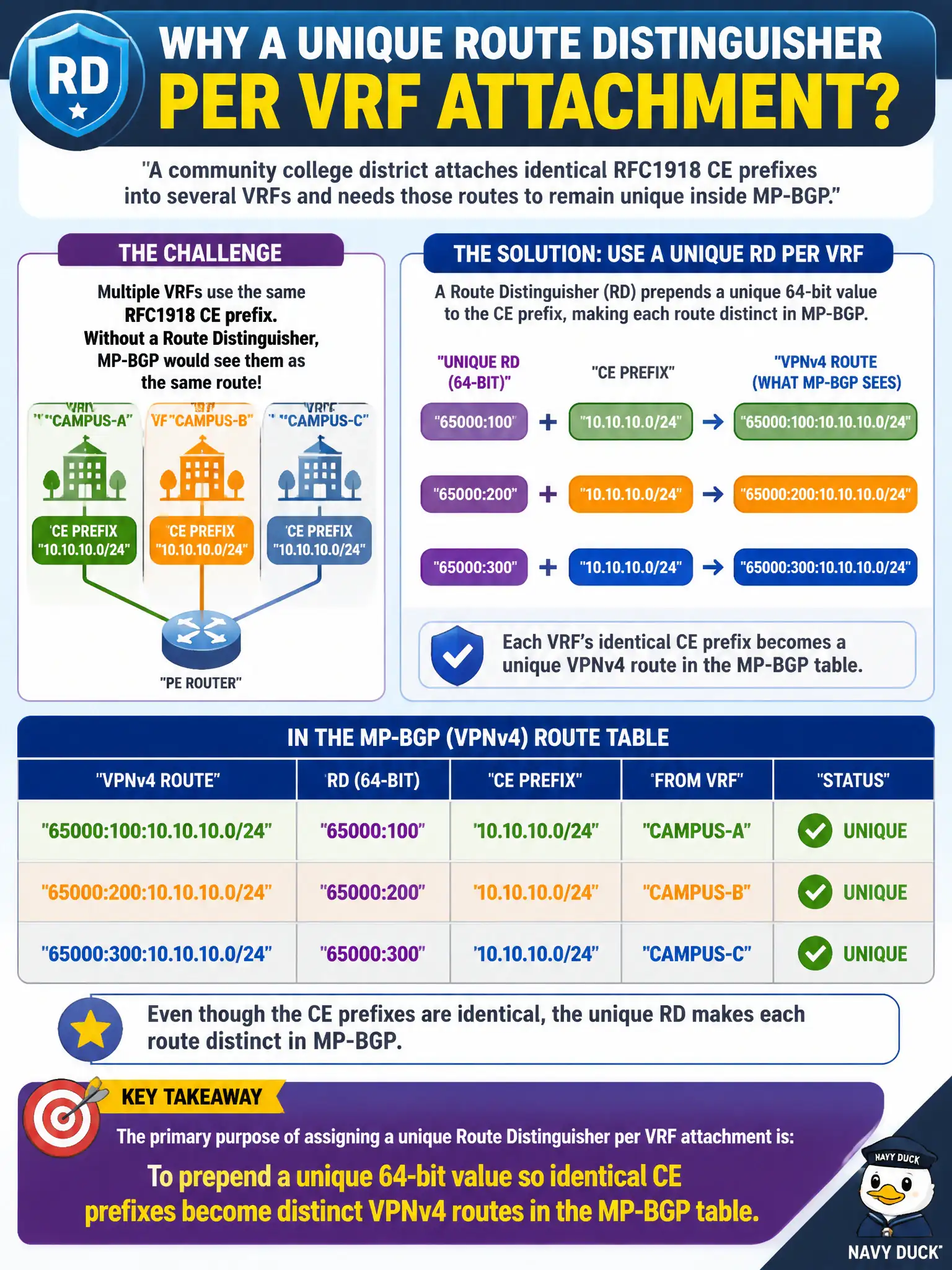
A community college district attaches identical RFC1918 CE prefixes into several VRFs and needs those routes to remain unique inside MP-BGP. What is the primary purpose of assigning a unique route distinguisher per VRF attachment?
Select an answer to reveal the explanation.
Short Explanation
Think of the RD as a unique barcode stuck on two boxes that both say "10.10.10.0/24" on the side. Same street address on the CE, different barcode in MP-BGP — so the control plane never confuses them. That uniqueness is the RD’s job, not encryption or mesh RT tricks.
Full Explanation
Route distinguishers prepend a unique 64-bit value so identical CE prefixes become distinct VPNv4 routes in the MP-BGP table. When a community college district attaches the same RFC1918 CE prefixes into several VRFs, unique RDs per VRF attachment prevent collisions in the provider BGP table while each site keeps familiar addressing.
RDs do not encrypt VPNv4 updates between route reflectors. They do not force every PE to import every RT to build automatic full-mesh clinics—that is RT policy. They do not replace LDP with BGP LU on the underlay or redefine PHP requirements. Design RDs for uniqueness; design RTs for who may import the route.
Exam caveat: overlapping CE addressing is normal in VPNs; RD uniqueness is what keeps MP-BGP coherent—do not treat RD as a topology or encryption control.
Operational check: assign unique RDs per college VRF attachment, advertise identical CE prefixes, confirm distinct VPNv4 NLRIs on the RR/PEs, and separately verify RT import policy matches intended VPN topology. For civic operations, record the chosen control and the rejected alternatives in the change record so future on-call engineers understand which failure modes were avoided for citizen-facing services.