
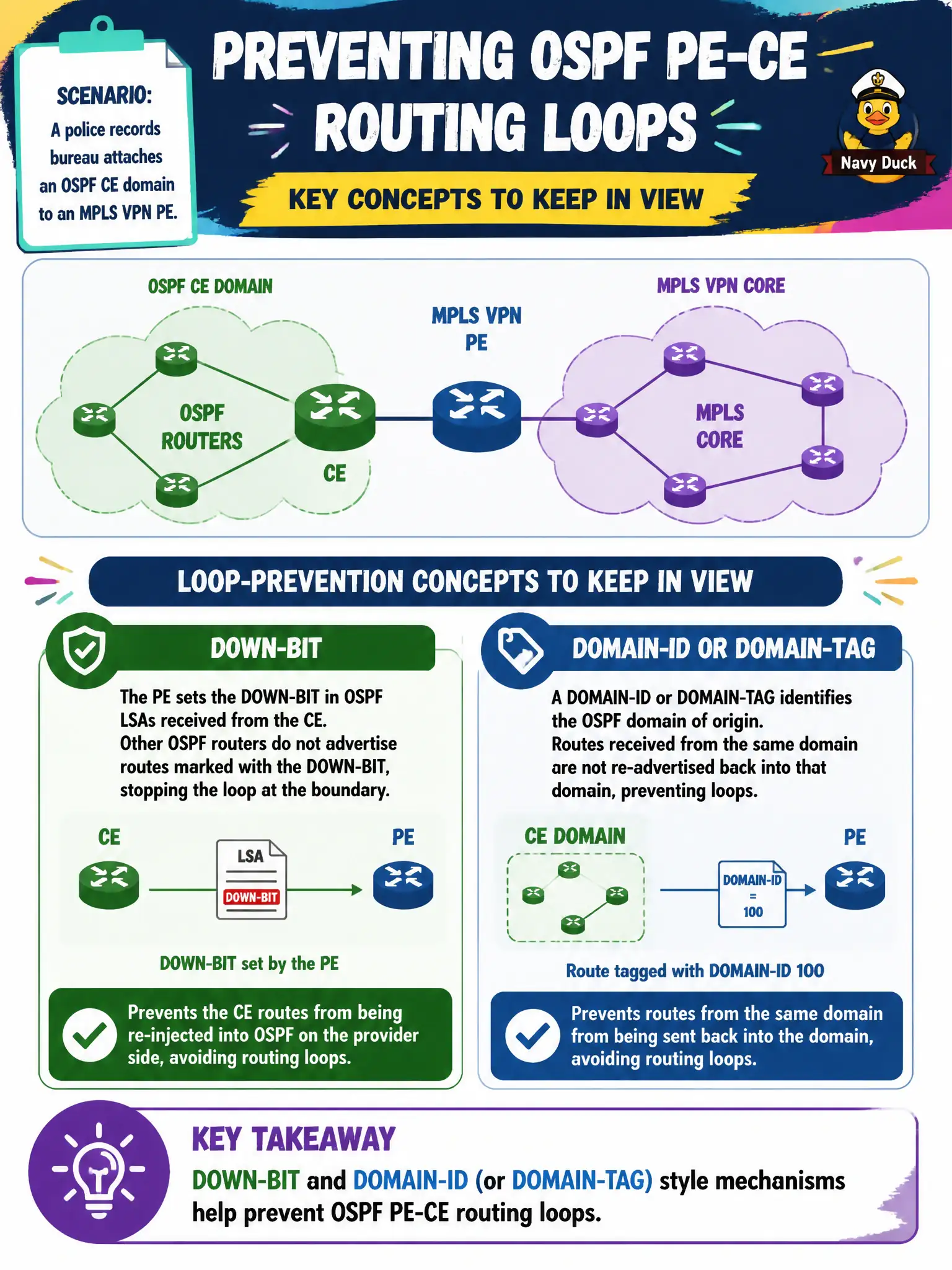
A police records bureau attaches an OSPF CE domain to an MPLS VPN PE. Which loop-prevention concepts should engineers keep in view?
Select an answer to reveal the explanation.
Short Explanation
OSPF across a VPN can accidentally learn its own routes back through another PE—classic loop fuel. Down-bit and domain-ID/domain-tag style tools exist so Type 3s and external-ish info don’t boomerang. Ignore them and the CE domain gets weird fast.
Full Explanation
When a police records bureau attaches an OSPF CE domain to an MPLS VPN PE, routes redistributed via MP-BGP and re-injected into OSPF at remote sites can create loops without safeguards. Down-bit behavior for summary/Type-3 style information and domain-ID or domain-tag mechanisms for external route handling are key conceptual controls that prevent OSPF PE-CE routing loops in VPN topologies.
Assuming OSPF PE-CE never risks loops so domain tags are unused ignores a classic failure mode. Relying only on BGP communities on the CE LAN switch does not implement OSPF’s PE-CE loop-prevention tools. Replacing OSPF with RIPv2 as a universal fix misses the OSPF-specific design issue the question targets.
Exam caveat: know down-bit and domain-tag/domain-ID concepts at a design level even if platform knobs vary—exams love OSPF-over-VPN loop scenarios.
Operational check: map OSPF domains across PEs, verify down-bit/domain-tag behavior on redistributed information, trace a Type-5/Type-3 path for feedback risk, and validate the records-bureau CE domain remains stable after PE failover. For civic operations, record the chosen control and the rejected alternatives in the change record so future on-call engineers understand which failure modes were avoided for citizen-facing services.