
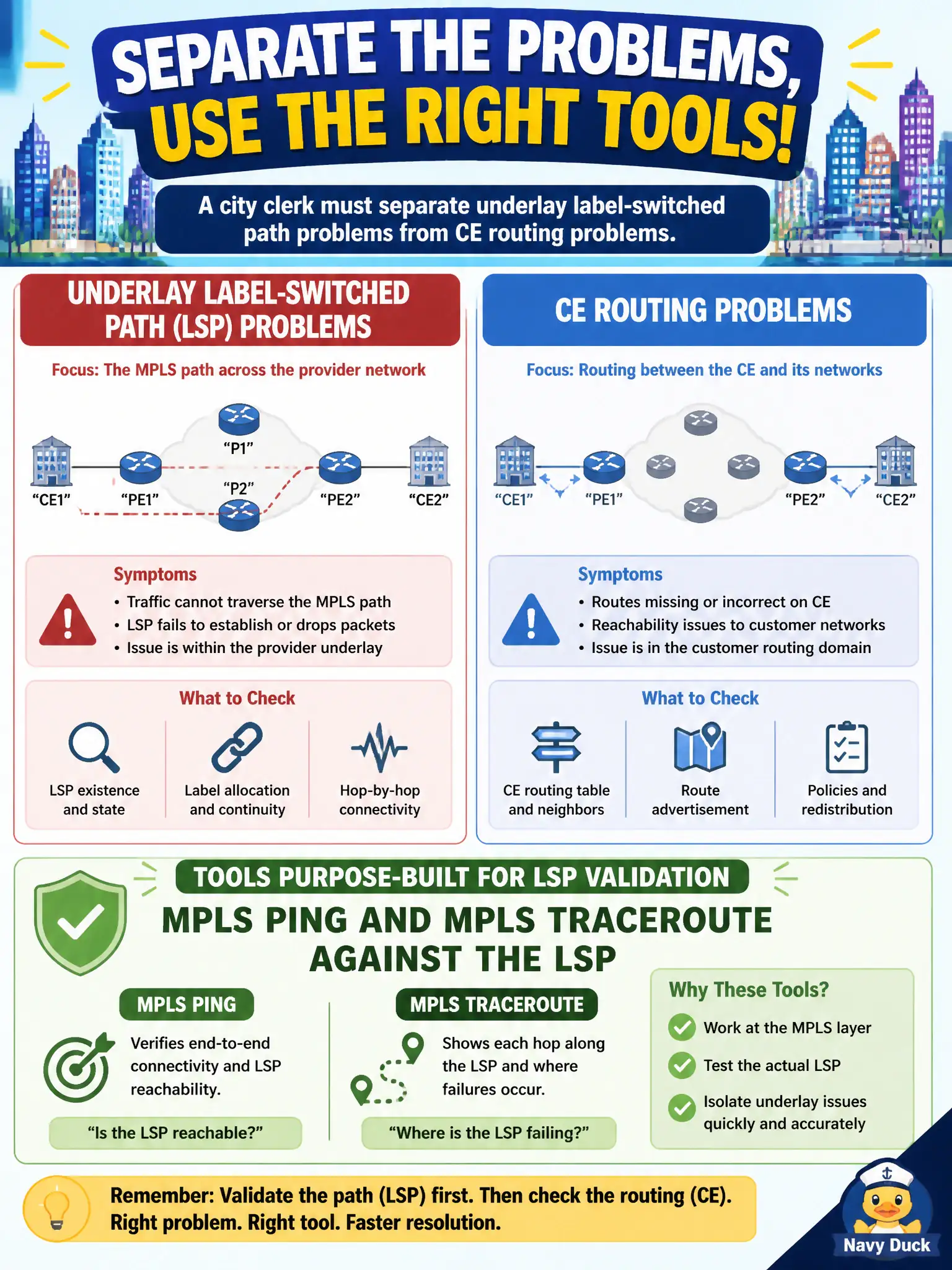
A city clerk must separate underlay label-switched path problems from CE routing problems. Which tools are purpose-built for LSP validation?
Select an answer to reveal the explanation.
Short Explanation
Regular ping to a CE LAN host won’t tell you if labels are healthy. MPLS ping and MPLS traceroute speak LSP language and show where the label path breaks. Use the right OAM wrench.
Full Explanation
MPLS ping and MPLS traceroute are purpose-built OAM tools that validate LSP forwarding and localize underlay label problems independently of whether a city clerk’s CE IP ping happens to succeed. They exercise the label-switched path so operators can separate core LSP faults from CE routing faults when departmental VPN symptoms appear.
A plain ICMP ping to a CE LAN interface lacks label awareness and can succeed or fail for reasons unrelated to the core LSP. Spanning Tree topology-change traps on access switches address L2 loop topics, not MPLS LSP validation. DHCP snooping bindings on the PE-CE Ethernet handoff speak to DHCP security, not transport-label OAM.
Exam caveat: successful CE ping does not clear the underlay; failed CE ping does not always mean the LSP is down—use MPLS OAM to speak the label plane’s language.
Operational check: from PE to PE, run MPLS ping and traceroute against the LSP, note the hop where labels break, remediate underlay/LDP, then retest CE reachability for the clerk’s VRF. For civic operations, record the chosen control and the rejected alternatives in the change record so future on-call engineers understand which failure modes were avoided for citizen-facing services.