
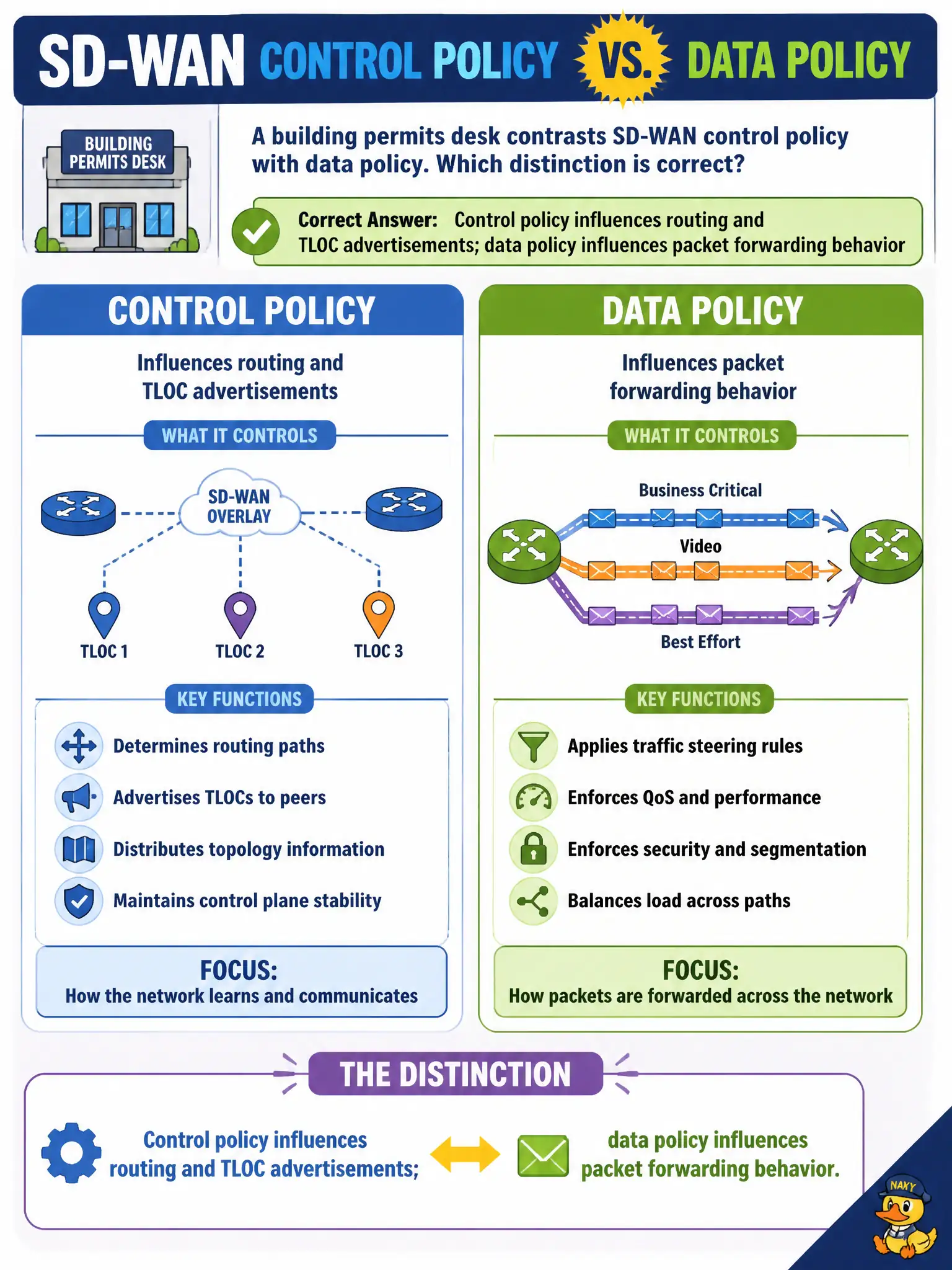
A building permits desk contrasts SD-WAN control policy with data policy. Which distinction is correct?
Select an answer to reveal the explanation.
Short Explanation
Control policy argues about maps and which exits get advertised; data policy grabs the actual packets and steers or filters them. One shapes what the overlay learns, the other shapes what flows. Keep those jobs straight and troubleshooting gets easier.
Full Explanation
In Cisco SD-WAN, control policy acts on the control plane—OMP routes, TLOC attributes, and advertisement behavior—so building-permits operators can influence what the overlay learns and prefers. Data policy acts on transit packets to filter, mark, or steer forwarding behavior for matching flows. Keeping that distinction clear prevents applying the wrong policy type to a symptom and chasing empty counters in the wrong plane.
Control policy does not rewrite TCP payloads while data policy changes OMP path attributes—that swaps the planes. Data policy is not limited to influencing routing tables only while control policy filters individual packets—that inverts responsibilities. Neither policy type operates exclusively in the underlay with no overlay VPN scope in normal SD-WAN designs.
Exam caveat: if the goal is route or TLOC advertisement, think control policy; if the goal is per-packet forwarding treatment, think data policy (centralized or localized as designed).
Operational check: classify the permits-desk requirement as control-plane versus data-plane, apply the matching policy construct, and verify with OMP and TLOC outputs for control changes or with packet counters and path traces for data-policy changes before releasing the change.