
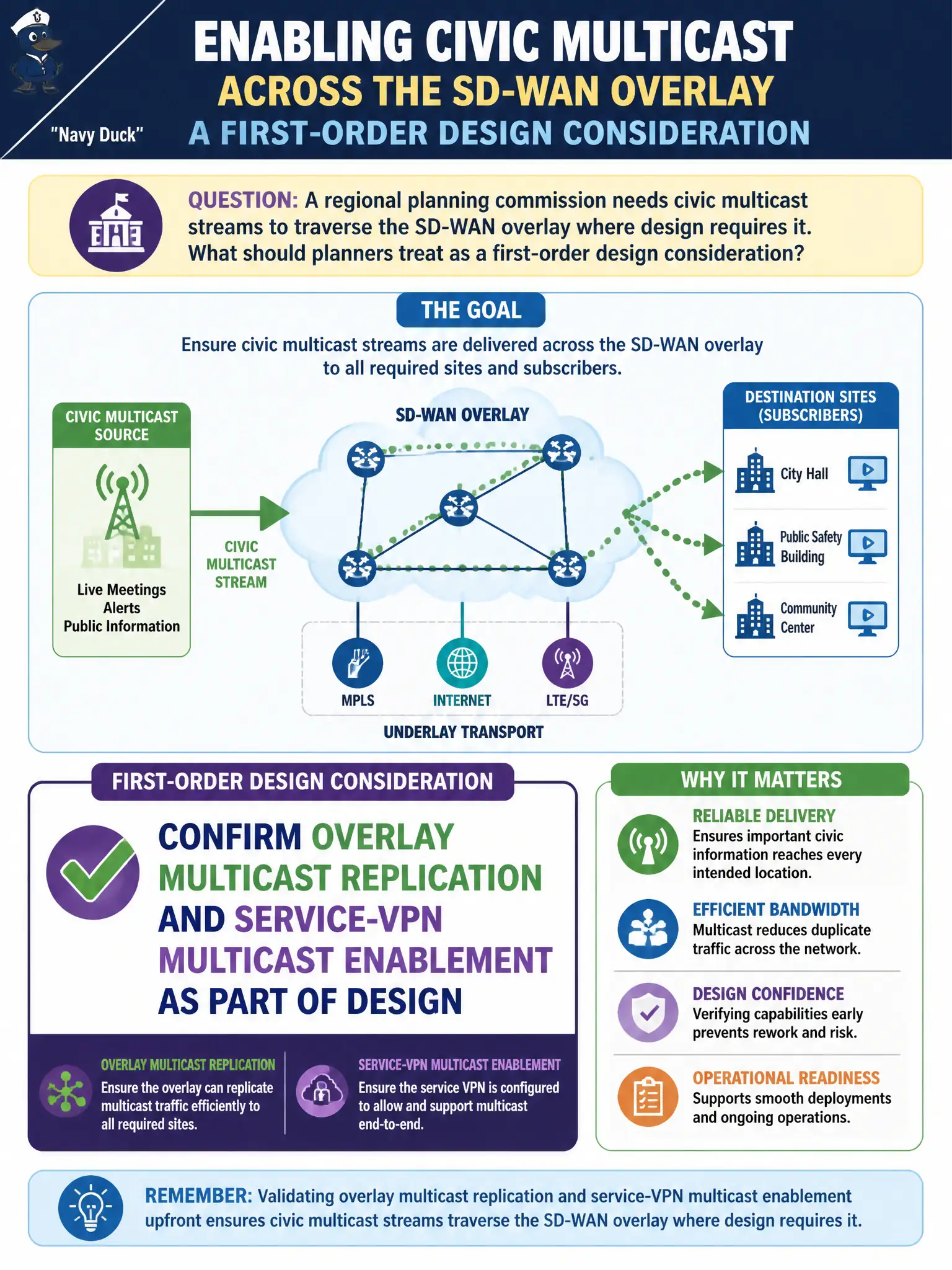
A regional planning commission needs civic multicast streams to traverse the SD-WAN overlay where design requires it. What should planners treat as a first-order design consideration?
Select an answer to reveal the explanation.
Short Explanation
Multicast isn’t a free bonus that just shows up on every color. If planning streams need the overlay, you design for replication and turn multicast on in the right service VPNs. Skip that homework and the stream dies at the Edge.
Full Explanation
Cisco SD-WAN can carry civic multicast across the overlay, but regional planning commission designers must treat replication behavior and service-VPN multicast enablement as first-order design items. Underlay versus overlay replication choices, VPN enablement, and path considerations determine whether planning streams and distribution applications actually traverse the fabric end to end. Multicast is not a free flood that appears on every TLOC color without configuration and validation.
Assuming multicast always floods automatically on every color skips required enablement and design work. Claiming multicast is unsupported on Cisco SD-WAN and must stay only on a parallel DMVPN tree is incorrect when overlay multicast is designed and enabled properly. Treating vManage as the exclusive replication engine misunderstands Edge and fabric replication roles in the data plane.
Exam caveat: distinguish “supported with deliberate design” from “automatic everywhere”; exam items often punish the automatic-flood assumption and the “unsupported forever” extreme.
Operational check: enable multicast in the correct service VPNs, validate replication mode and receiver join behavior across a test stream between sites, measure loss under load, and document which colors and hubs participate before production civic video depends on the path.