
A municipal hospital campus must choose where SD-WAN policy decisions are authored versus where they are applied on the Edge. Which statement is accurate?
Select an answer to reveal the explanation.
Short Explanation
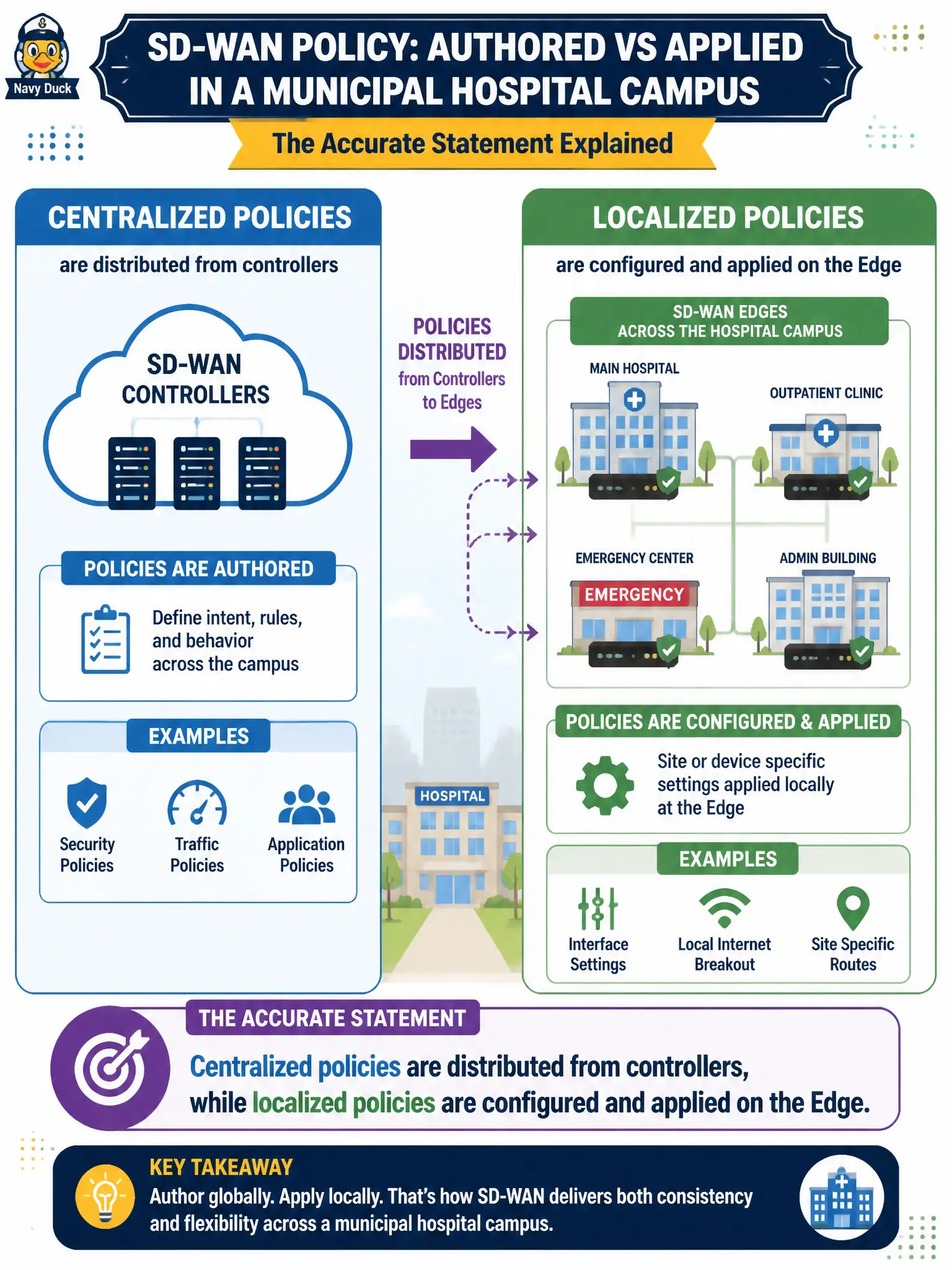
Centralized policy is the playbook the coaches hand out from the sideline; localized policy is the timeout call the Edge makes on its own sideline. Controllers push the big routing and traffic rules, while on-box localized policy covers site-specific exceptions.
Full Explanation
In Cisco SD-WAN, centralized control and data policies are authored in the controller fabric (commonly via vManage toward vSmart) and distributed so multi-site behavior stays consistent for a municipal hospital campus. Localized policies are configured to take effect on the individual Edge—site ACLs, local route policy, and similar on-box exceptions—without requiring every exception to become fabric-wide centralized policy.
Saying localized policies are authored only on vSmart and never stored on the Edge reverses the split. Claiming data policies can exist only as localized ACLs ignores centralized data-policy constructs. Asserting control policies always execute only on an underlay CE outside SD-WAN misplaces control-policy scope away from the overlay controllers and Edges.
Exam caveat: know which knob is centralized versus localized before troubleshooting—hunting a site-only ACL inside a vSmart centralized template wastes time, as does expecting a localized list to rewrite fabric-wide OMP behavior.
Operational check: for a hospital change, decide whether the rule must apply everywhere (centralized) or only on one Edge (localized), push or configure accordingly, and verify with policy counters or packet behavior at that site before closing the change.