
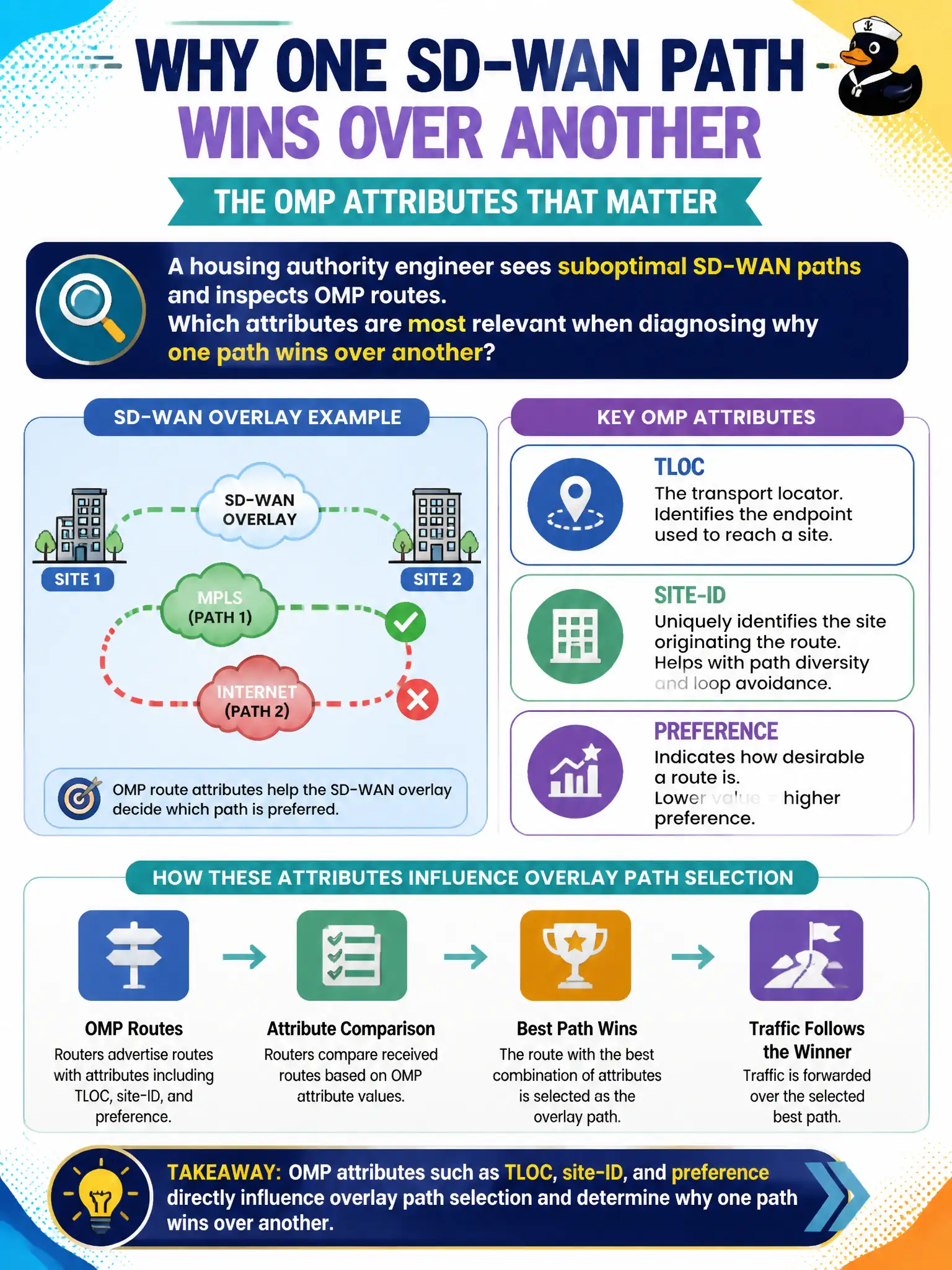
A housing authority engineer sees suboptimal SD-WAN paths and inspects OMP routes. Which attributes are most relevant when diagnosing why one path wins over another?
Select an answer to reveal the explanation.
Short Explanation
When the overlay picks a weird road to a housing site, read the OMP route like a shipping label—TLOC, site-ID, preference, and friends explain the choice. Cable paint in the MDF and hostname length are not best-path algorithms. And no, vSmart does not run STP on eth0 to pick OMP winners.
Full Explanation
A housing-authority engineer diagnosing suboptimal SD-WAN paths should inspect OMP attributes such as TLOC, site-ID, and preference that influence overlay path selection. Those fields explain why one path wins over another in the civic overlay.
Only the underlay cable color paint code in the MDF with no OMP fields is physical labeling folklore, not overlay best-path data.
Spanning-tree root priority on the vSmart eth0 interface is irrelevant to OMP path selection.
The ASCII hostname length of the WAN Edge as the primary best-path tiebreaker is not an OMP rule.
Exam caveat: also check originator, TLOC preference, and policy-applied attributes—preference alone may be overridden by control policy.
Operational check: compare OMP route entries for the suboptimal prefix across candidate TLOCs, adjust preference/policy, and re-evaluate. Capture before/after OMP attributes in the housing WAN incident ticket. In municipal operations, record the rationale in the change ticket so future on-call staff know which control was chosen and which failure modes the rejected options would create for city services. Re-validate after the next maintenance window that the same control still holds under the platform code and policy revisions used by the civic network team.