
City public-works needs SD-Access at a small town-hall footprint where collapsing fabric roles onto fewer platforms is acceptable. Which design pattern matches that constraint?
Select an answer to reveal the explanation.
Short Explanation
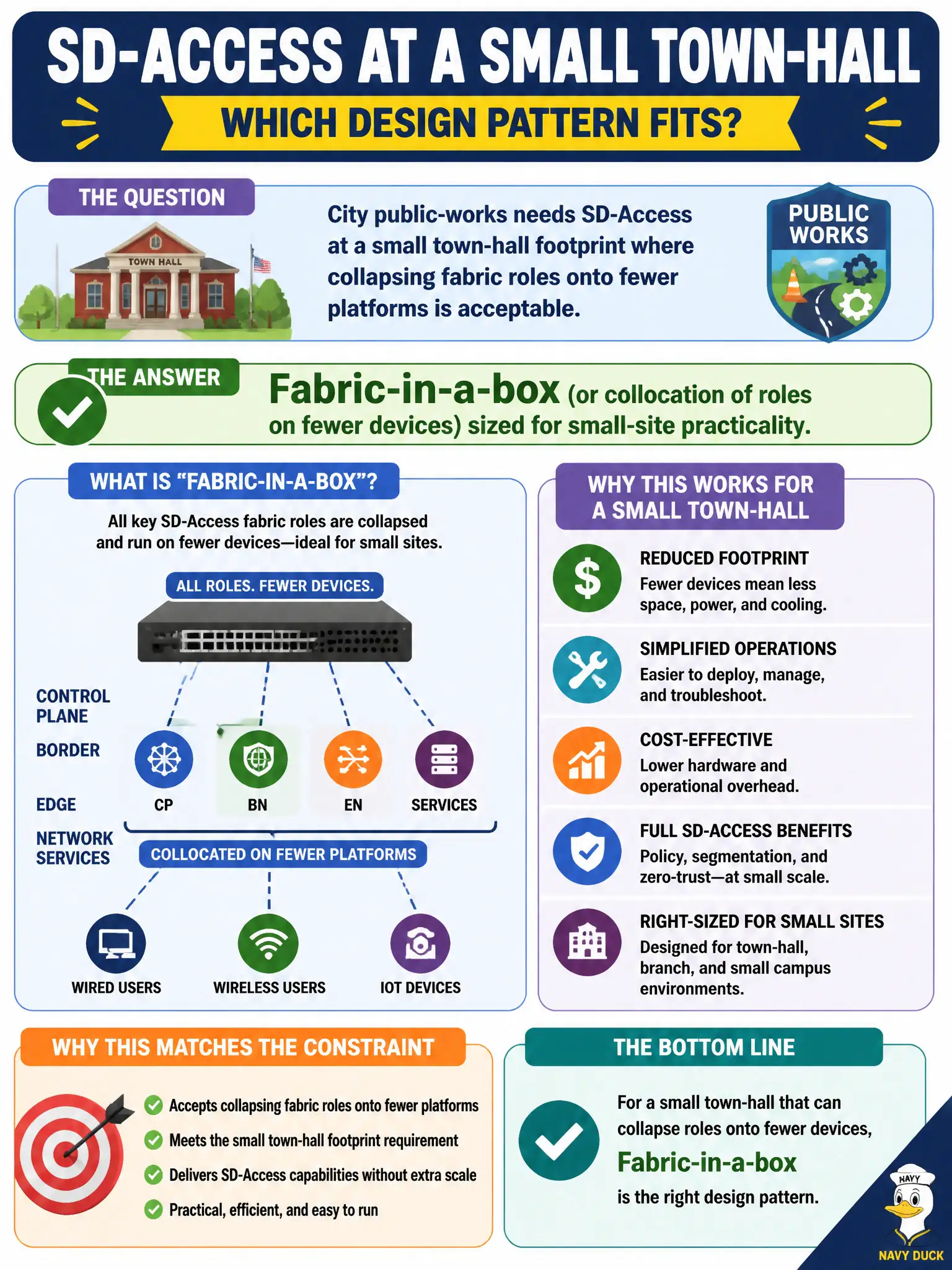
A tiny town hall should not inherit a mega-campus bill of materials. Fabric-in-a-box (or role collocation) parks multiple SD-Access jobs on fewer boxes so the site still gets fabric benefits. Save the sprawling dedicated-role designs for campuses that actually need them.
Full Explanation
City public-works needing SD-Access at a small town-hall footprint should use fabric-in-a-box (or collocation of roles on fewer platforms) sized for small-site practicality. Collapsing edge/border/CP functions onto fewer devices is an accepted pattern when scale and budget do not justify dedicated boxes per role.
Mandatory multi-site SD-WAN transit with four dedicated border chassis per closet overbuilds a small site and misses the collocation intent.
Separate hardware for every role including dedicated transit control planes in each wiring closet contradicts small-site consolidation.
A full multisite fabric domain with unique underlay ASNs per access switch stack invents unnecessary ASN sprawl unrelated to fabric-in-a-box.
Exam caveat: collocation simplifies hardware but concentrates failure domains—document which roles share a chassis and how backup CP/border coverage works.
Operational check: assign collocated roles in Catalyst Center for the town hall, verify underlay reachability and map-server function on the shared platforms, and test host onboarding. Record the small-site BOM and role map in the public-works fabric catalog. In municipal operations, record the rationale in the change ticket so future on-call staff know which control was chosen and which failure modes the rejected options would create for city services. Re-validate after the next maintenance window that the same control still holds under the platform code and policy revisions used by the civic network team.