
An election office is assigning SD-Access fabric roles on a county campus. Which mapping of roles to purposes is correct?
Select an answer to reveal the explanation.
Short Explanation
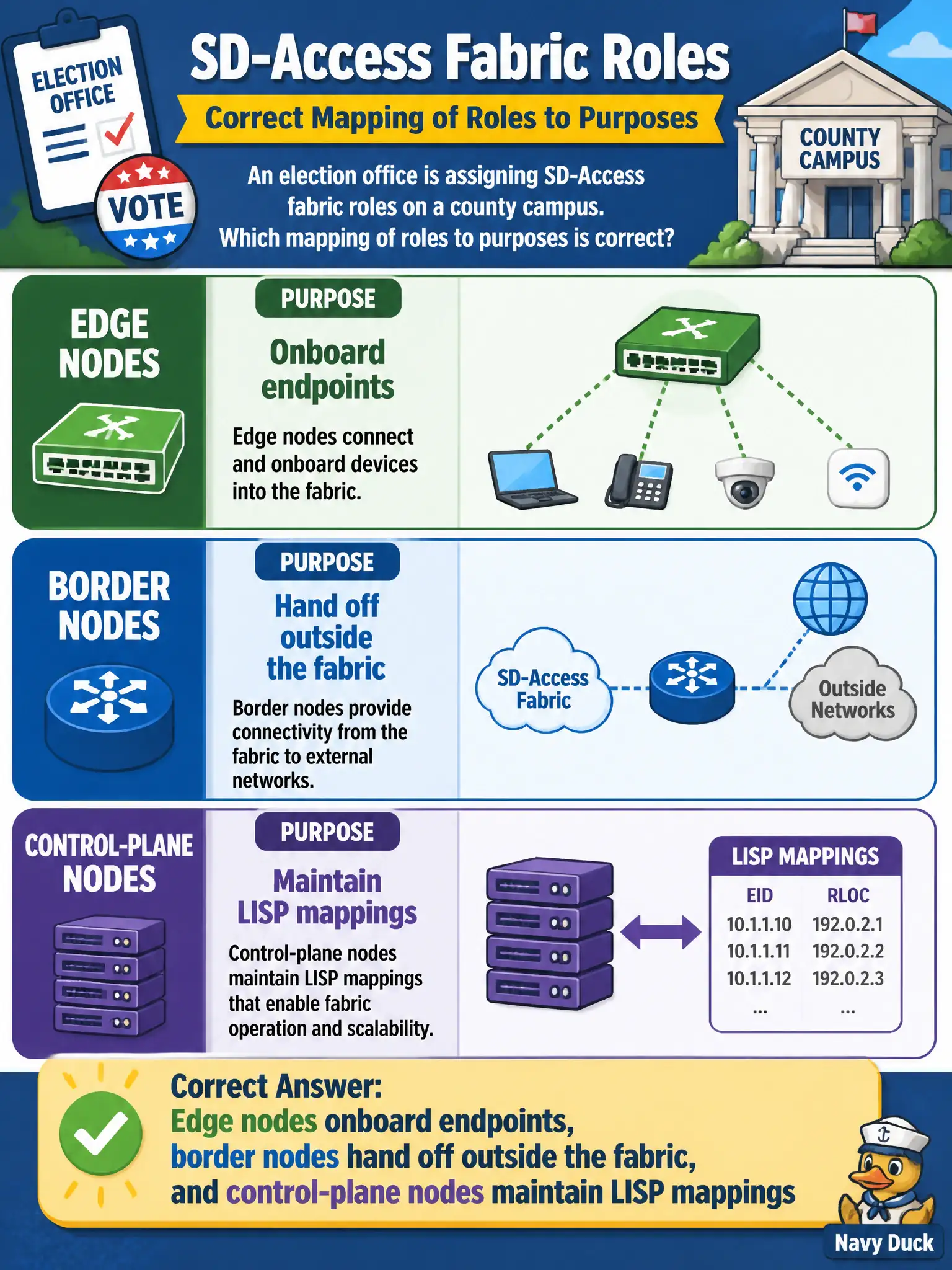
Edges are the front doors where endpoints walk in. Borders are the city gates to the outside world. Control-plane nodes keep the LISP map—the who’s-where directory. Mix those job titles up and the fabric story falls apart.
Full Explanation
On a county election-office campus, SD-Access roles map cleanly: edge nodes onboard endpoints and encapsulate into the fabric, border nodes hand traffic outside the fabric, and control-plane nodes maintain LISP mappings (map-server/resolver functions). That role separation is what operators assign in Catalyst Center when building civic fabrics.
Borders only running IGMP snooping, edges only peering MSDP, and control-plane nodes only terminating WAN crypto mixes multicast and crypto roles into the wrong SD-Access functions.
Control-plane nodes as the only VTEPs with edges never encapsulating VXLAN reverses the usual edge/border VTEP model.
Requiring every access switch to be a border while core switches must never be edges is an arbitrary and incorrect role mandate.
Exam caveat: a device can sometimes host combined roles in small designs, but the conceptual responsibilities remain distinct on the exam—know what each role does.
Operational check: list each county switch’s fabric role, verify edges learn endpoints, borders show external handoffs, and CP nodes show LISP map-server state. Publish a role diagram in the election-network runbook for poll-worker device onboarding season.