
A regional planning commission can build one campus fabric now or plan multi-site fabrics tied together later for sister cities. Which design distinction matters most for that choice?
Select an answer to reveal the explanation.
Short Explanation
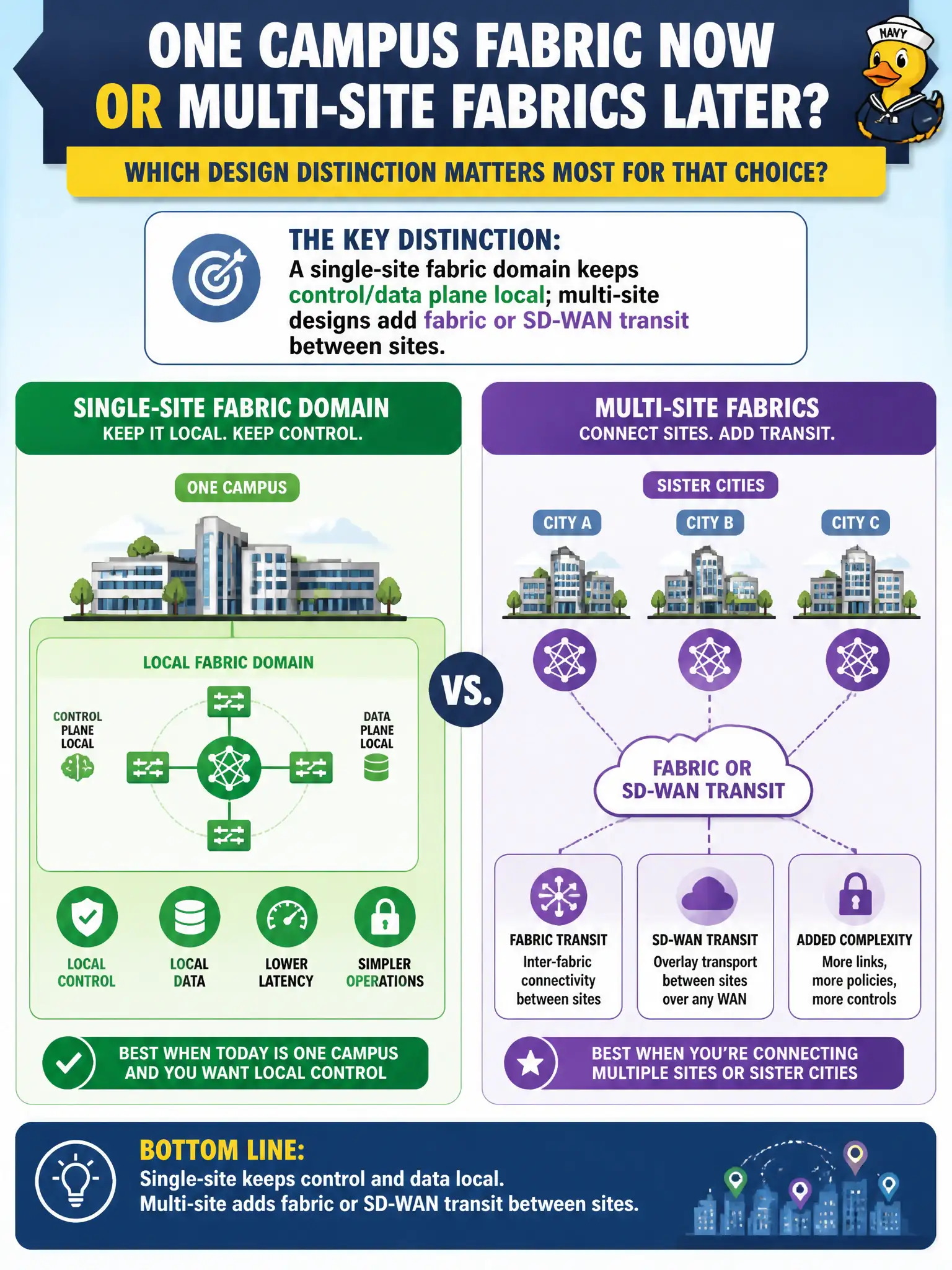
One campus fabric is a single stadium with its own scoreboard. Multi-site is several stadiums that need a transit league—often SD-Access transit or SD-WAN—so identities and VNs can stretch sanely. Decide early whether sister cities share one domain story or federate later.
Full Explanation
A regional planning commission choosing one campus fabric now versus multi-site fabrics should understand that a single-site fabric domain keeps control and data plane local to one location, while multi-site designs add fabric or SD-WAN transit patterns to interconnect sites. That is the primary architectural fork—not a claim that one mode forbids borders or LISP.
Multi-site always requiring disabling LISP and running only VLAN trunking between cities abandons fabric overlay principles and is not the standard multi-site approach.
Saying single-site fabrics cannot use borders, or multi-site fabrics forbid control-plane nodes, invents role prohibitions that do not match SD-Access role models.
Mandating classic EIGRP over DMVPN instead of any fabric transit as the only sister-city option ignores fabric site interconnect and SD-WAN handoff patterns used in civic multi-site designs.
Exam caveat: multi-site adds operational and control-plane scale considerations (map-servers, transit VN, border handoffs); do not treat it as “same as single-site plus a trunk.”
Operational check: document whether sister campuses share one fabric domain or interconnect via SD-Access transit/SD-WAN, then validate endpoint reachability across the chosen model. Capture the decision in the commission’s WAN/campus strategy so funding matches the control-plane scope.