
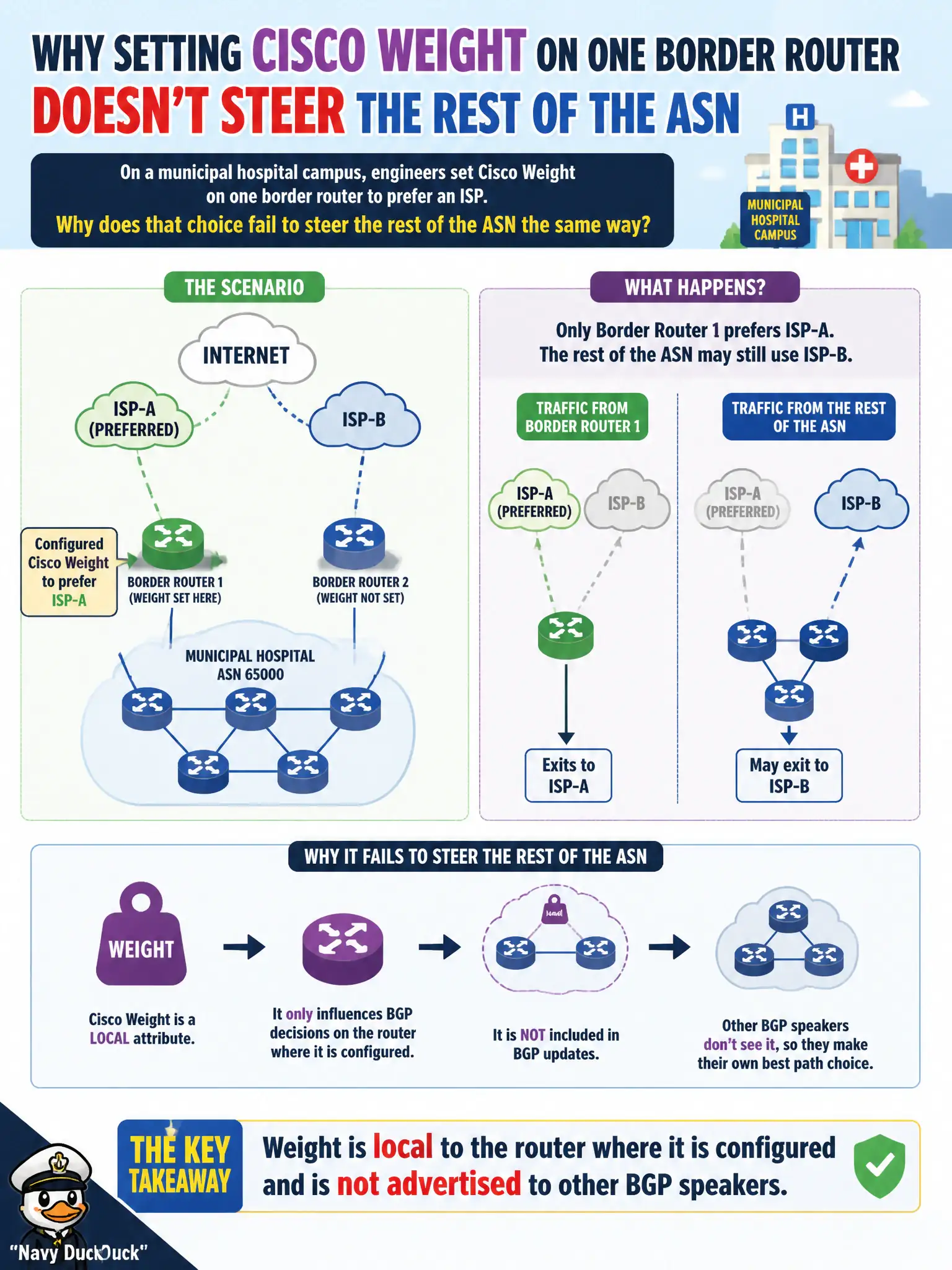
On a municipal hospital campus, engineers set Cisco Weight on one border router to prefer an ISP. Why does that choice fail to steer the rest of the ASN the same way?
Select an answer to reveal the explanation.
Short Explanation
Weight is a sticky note glued to one router’s monitor—nobody else in the hospital ASN can see it. If you need the whole campus to prefer an ISP, use LOCAL_PREF, which actually travels over iBGP.
Full Explanation
Cisco Weight is the first criterion in BGP best-path selection, but it exists only in local router configuration and is never advertised to peers. On a municipal hospital campus, setting Weight on one border router to prefer an ISP therefore fails to steer the rest of the ASN the same way: other routers never see that Weight value. LOCAL_PREF is the AS-wide attribute for consistent outbound preference and should be used when the whole campus must agree on an exit. Weight remains useful for per-router exceptions, not campus-wide policy.
Weight is not transitive and does not automatically override LOCAL_PREF on every iBGP neighbor. Weight is not exchanged in eBGP UPDATEs such that only ISP routers see it—peers do not receive Weight at all. Weight is not limited to OSPF routes; when configured, it applies to BGP best-path selection on the local router only.
Exam caveat: a high Weight on one border can make that box disagree with the rest of the ASN that uses LOCAL_PREF—avoid mixing unless the exception is intentional and documented in change control. Operational check: reserve Weight for host-specific exceptions, use LOCAL_PREF for ASN-wide ISP preference, and compare show bgp outputs on multiple hospital routers to confirm consistent exits.