
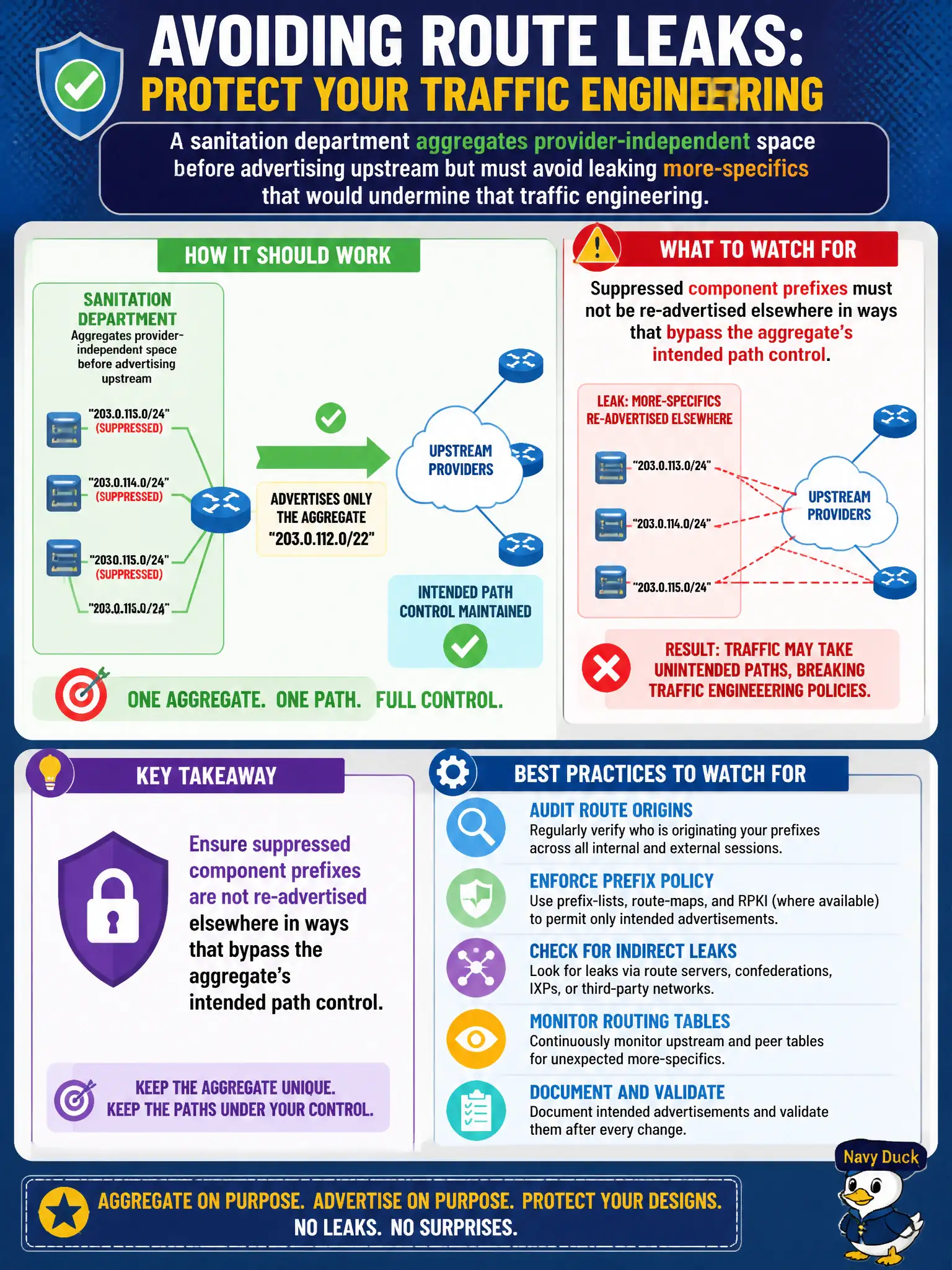
A sanitation department aggregates provider-independent space before advertising upstream but must avoid leaking more-specifics that would undermine that traffic engineering. What should operators watch for?
Select an answer to reveal the explanation.
Short Explanation
An aggregate is the big dumpster route; the little /24s are bags inside it. If you advertise the aggregate for TE but then leak the bags out another door, traffic ignores your neat plan. Keep the components suppressed where the aggregate is supposed to steer.
Full Explanation
BGP aggregation summarizes components into a covering prefix for cleaner advertisements and traffic engineering. If more-specifics leak through another path, longest-match forwarding bypasses the aggregate and can undo TE intent. A sanitation department aggregating provider-independent space before advertising upstream must ensure suppressed component prefixes are not re-advertised elsewhere in ways that bypass the aggregate’s intended path control. Align suppression, filtering, and policy so components do not escape contrary to design.
Atomic-aggregate does not always delete the AS path so that prepending becomes mandatory after every aggregate. Aggregation is not illegal for PI space and only permitted for PA blocks. It is false that BGP aggregates cannot suppress components and that more-specifics must always leak for reachability—suppression is a deliberate control.
Exam caveat: atomic-aggregate signals information loss but does not by itself enforce TE; operators still need filters and consistent originations. Operational check: advertise the aggregate, confirm components are suppressed as intended, search looking glasses for leaked more-specifics, and fix any alternate origin that undermines the aggregate.