
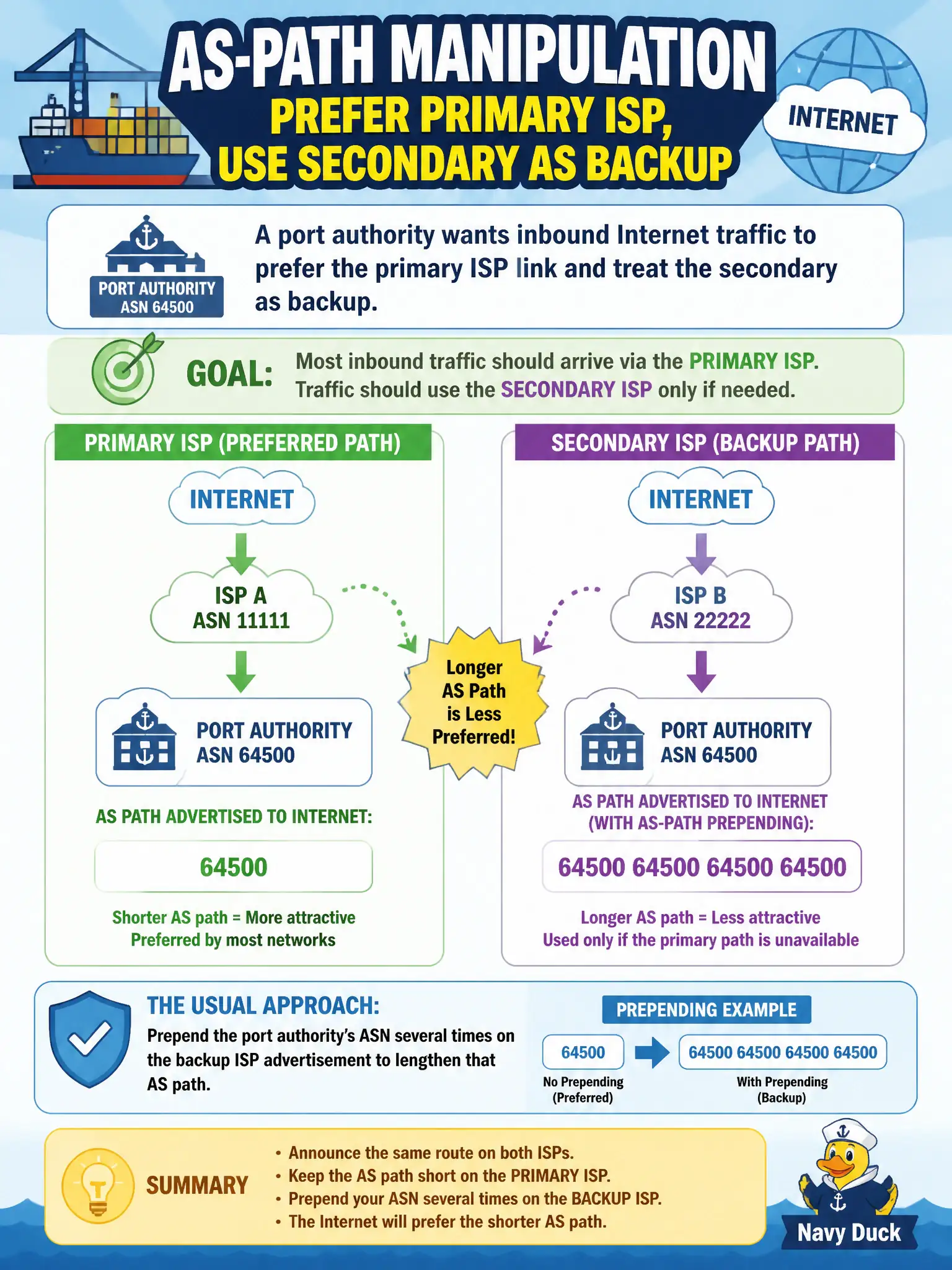
A port authority wants inbound Internet traffic to prefer the primary ISP link and treat the secondary as backup. Which AS-path manipulation is the usual approach on the backup advertisement?
Select an answer to reveal the explanation.
Short Explanation
Prepending is taping extra copies of your ASN onto the backup flyer so the Internet sees a longer path and picks the primary. You’re making the backup look worse on purpose—without lying about someone else’s ASN.
Full Explanation
AS-path prepending lengthens the path advertised toward an upstream so remote best-path selection prefers the shorter primary advertisement. A port authority wanting inbound Internet traffic to prefer the primary ISP link and treat the secondary as backup should prepend the port authority’s ASN several times on the backup ISP advertisement to lengthen that AS path. It is a common inbound traffic-engineering tool on backup eBGP links.
Stripping the local ASN from the backup path so remote ASes see a shorter forged path breaks loop detection and is not a valid TE technique. Setting MED higher only on the primary and leaving the backup untouched works against preferring the primary for inbound traffic. Enabling allowas-in on both ISP sessions does not implement backup prepending and weakens loop detection on public edges.
Exam caveat: prepending influences ASes that use AS-path length; it may not override LOCAL_PREF inside a distant AS, and excessive prepending can make a path unused even for backup. Operational check: prepend on backup only, view the path from looking glasses, confirm primary wins inbound, fail primary and confirm backup still attracts traffic, then tune prepend count.