
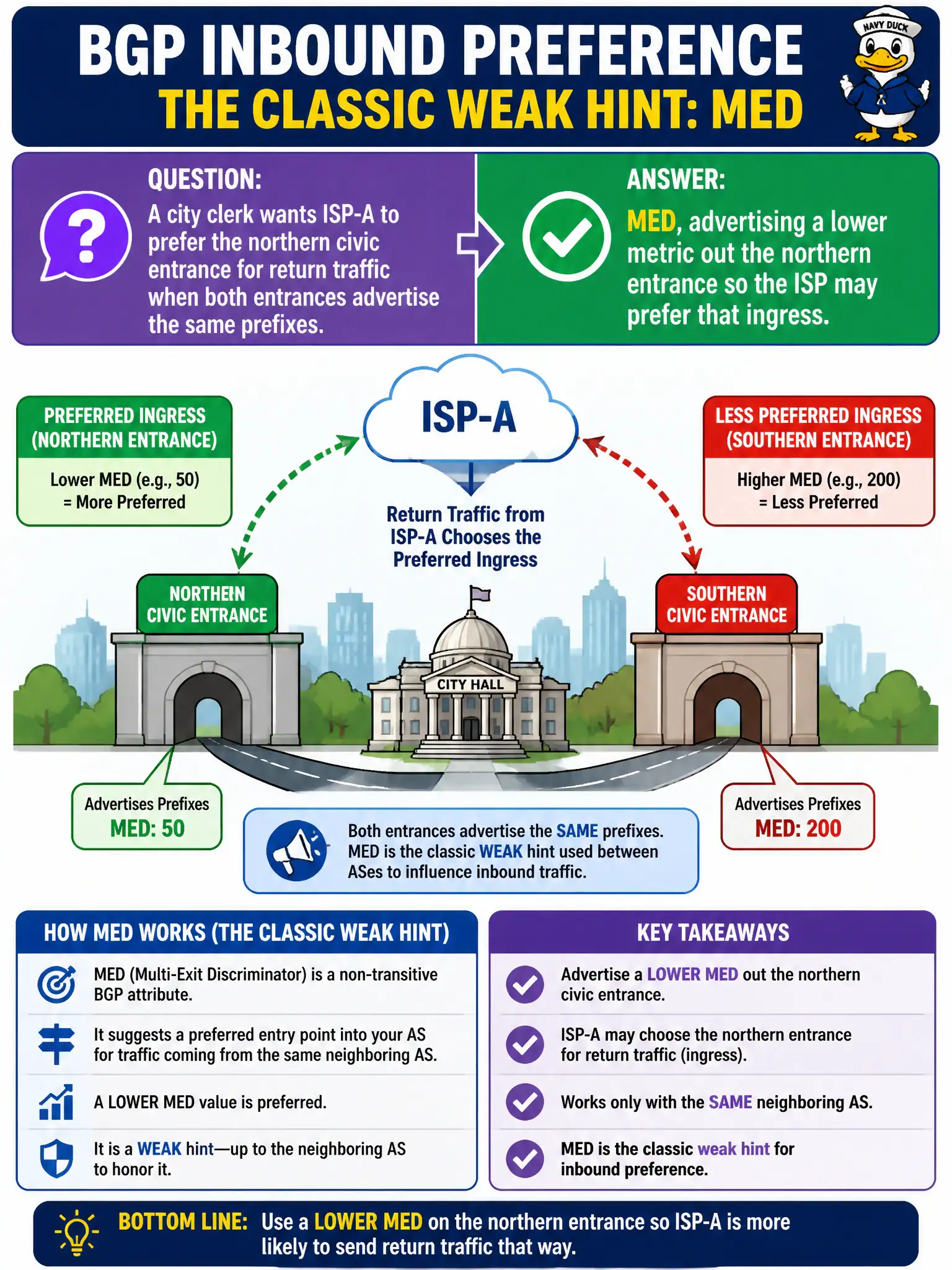
A city clerk wants ISP-A to prefer the northern civic entrance for return traffic when both entrances advertise the same prefixes. Which attribute is the classic weak hint for that inbound preference?
Select an answer to reveal the explanation.
Short Explanation
MED is a polite suggestion to the ISP: ‘if you’re comparing our two doors, the north door has the lower number.’ It’s not a command—the ISP can ignore it—but it’s the classic inbound hint between those entrances.
Full Explanation
MED is the classic weak hint for inbound traffic engineering: advertising a lower MED out one entrance may cause a neighboring AS that honors MED to prefer that ingress for return traffic. A city clerk wanting ISP-A to prefer the northern civic entrance for return traffic when both entrances advertise the same prefixes should advertise a lower MED out the northern entrance. MED is advisory between ASes and depends on the ISP honoring it, often only when AS paths are otherwise comparable.
LOCAL_PREF cannot be set on the ISP’s route reflectors from the city’s CLI—LOCAL_PREF is local to an AS. AS-path prepending only on the northern entrance would make that path look longer and typically worsen northern preference, opposite of the goal. Cisco Weight is not advertised in eBGP OPEN messages to the ISP.
Exam caveat: many ISPs ignore MED or compare it only within the same neighboring AS; prepending or communities may be required when MED is insufficient. Operational check: advertise lower MED north / higher MED south, ask the ISP whether MED is honored, observe traceroute from the Internet toward civic prefixes, and fall back to communities or selective prepending if inbound preference does not shift.