
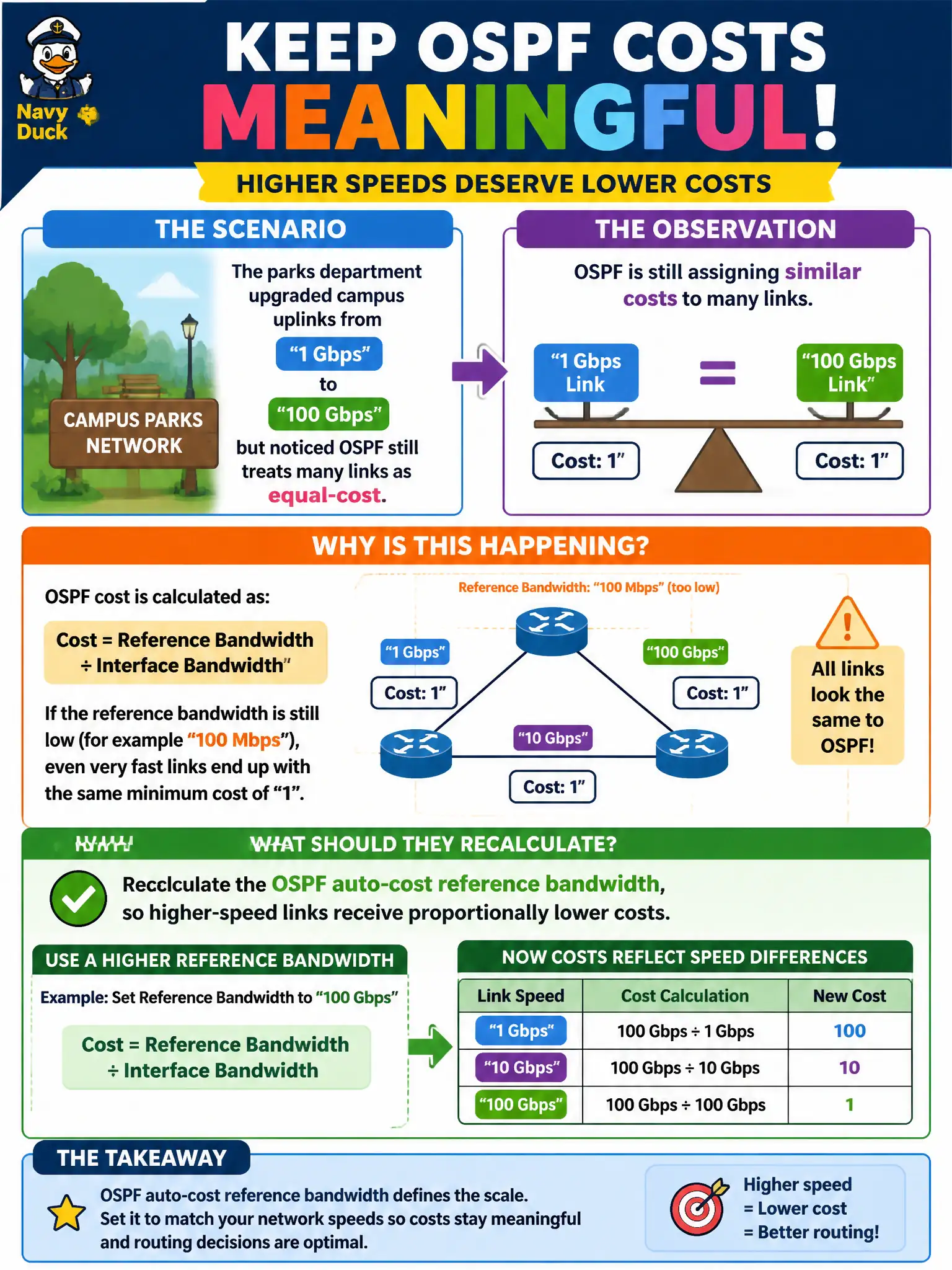
A parks department upgraded campus uplinks from 1 Gbps to 100 Gbps and noticed OSPF still treats many links as equal-cost. What should they recalculate so interface costs stay meaningful?
Select an answer to reveal the explanation.
Short Explanation
OSPF cost is ‘reference bandwidth divided by link speed.’ If the reference stayed stuck in the 1G era, a 10G and a 100G can look the same. Raise the reference so the fat pipes actually look cheaper—and keep that value consistent domain-wide.
Full Explanation
OSPF interface cost defaults from reference-bandwidth divided by interface bandwidth. After multi-gigabit upgrades, an outdated reference collapses many speeds into identical costs and weakens path selection. A parks department that upgraded campus uplinks from 1 Gbps to 100 Gbps and still sees OSPF treat many links as equal-cost should recalculate the OSPF auto-cost reference bandwidth so higher-speed links receive proportionally lower costs. Raise that reference consistently on all OSPF routers in the domain.
Adjusting BGP MED on every uplink is not a substitute, because OSPF does not ignore interface bandwidth after 1 Gbps in favor of MED. Tuning STP diameter or bridge priority does not derive OSPF cost. Recalculating the EIGRP delay formula is irrelevant when the campus IGP is OSPF.
Exam caveat: changing reference bandwidth changes costs network-wide—coordinate the change to avoid transient loops or unexpected ECMP shifts, and consider manual interface costs on special policy links. Operational check: set a modern reference bandwidth on all OSPF routers, verify 100G links show lower cost than 1G or 10G, confirm forwarding paths match design, and document the standard reference value for the parks campus.